School of Medicine and Psychology, College of Health and Medicine, Australian National University, 54 Mills Road, Acton 2601, Australia.
Department of Public Health and Preventive Medicine, Faculty of Medicine, Udayana University, Indonesia.
Bull World Health Organ. 2024 Jul 1;102(7):521-532F. doi: 10.2471/BLT.23.291246. Epub 2024 Apr 30.
To conduct a systematic review on the effects of multisectoral interventions for health on health system performance.
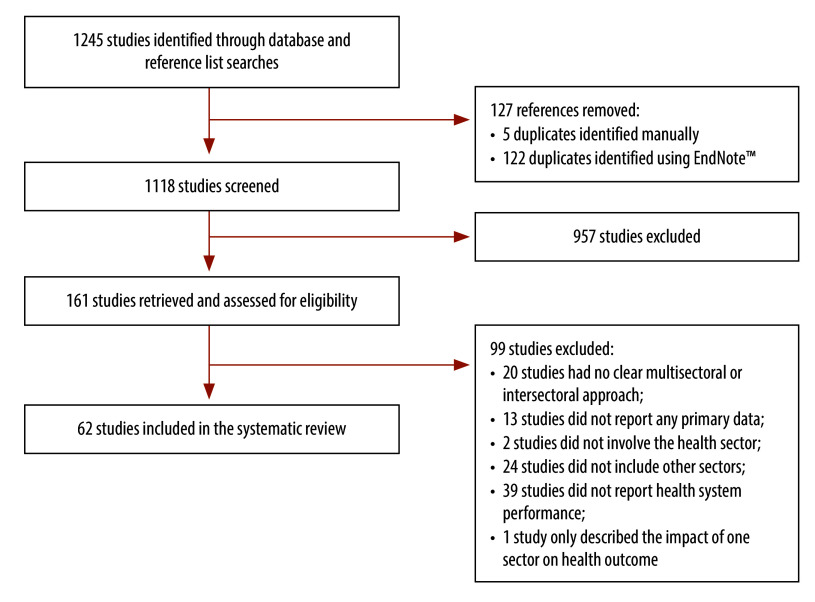
We conducted a systematic review according to the preferred reporting items for systematic review and meta-analysis protocols. We searched for peer-reviewed journal articles in PubMed®, Scopus, Web of Science, Cumulated Index to Nursing and Allied Health Literature, and the Cochrane Database of Systematic Reviews on 31 August 2023 (updating on 28 February 2024). We removed duplicates, screened titles and abstracts, and then conducted a full-text eligibility and quality assessment.
We identified an initial 1118 non-duplicate publications, 62 of which met our inclusion and exclusion criteria. The largest proportions of reviewed studies focused on multisectoral interventions directly related to specific health outcomes (66.1%; 41 studies) and/or social determinants of health (48.4%; 30 studies), but without explicit reference to overall health system performance. Most reviewed publications did not address process indicators (83.9%; 52/62) or discuss sustainability for multisectoral interventions in health (72.6%; 45/62). However, we observed that the greatest proportion (66.1%; 41/62) considered health system goals: health equity (68.3%; 28/41) and health outcomes (63.4%; 26/41). Although the greatest proportion (64.5%; 40/62) proposed mechanisms explaining how multisectoral interventions for health could lead to the intended outcomes, none used realistic evaluations to assess these.
Our review has established that multisectoral interventions influence health system performance through immediate improvements in service delivery efficiency, readiness, acceptability and affordability. The interconnectedness of these effects demonstrates their role in addressing the complexities of modern health care.
系统评价多部门卫生干预对卫生系统绩效的影响。
我们根据系统评价和荟萃分析报告的首选项目进行了系统评价。我们于 2023 年 8 月 31 日在 PubMed®、Scopus、Web of Science、Cumulated Index to Nursing and Allied Health Literature 和 Cochrane 系统评价数据库中搜索同行评议的期刊文章,并于 2024 年 2 月 28 日进行更新。我们剔除了重复项,筛选了标题和摘要,然后进行了全文资格和质量评估。
我们最初确定了 1118 篇非重复出版物,其中 62 篇符合我们的纳入和排除标准。综述研究中最大的比例集中在与特定健康结果(66.1%;41 项研究)和/或健康社会决定因素(48.4%;30 项研究)直接相关的多部门干预措施,但没有明确提及整体卫生系统绩效。大多数综述出版物没有解决过程指标(83.9%;52/62)或讨论卫生领域多部门干预的可持续性(72.6%;45/62)。然而,我们观察到,最大的比例(66.1%;41/62)考虑了卫生系统目标:卫生公平(68.3%;28/41)和健康结果(63.4%;26/41)。尽管最大的比例(64.5%;40/62)提出了解释多部门卫生干预如何导致预期结果的机制,但没有一个使用现实评估来评估这些机制。
我们的综述表明,多部门卫生干预通过提高服务提供的效率、准备情况、可接受性和可负担性,对卫生系统绩效产生影响。这些影响的相互联系表明它们在应对现代医疗保健复杂性方面的作用。