Foley Stephen F, Chen Chunfei, Jacob Dorrit E
School of Natural Sciences, Macquarie University, North Ryde 2109, New South Wales, Australia.
Research School of Earth Sciences, Australian National University, Canberra, AT 2601, Australia.
Natl Sci Rev. 2024 Mar 18;11(6):nwae098. doi: 10.1093/nsr/nwae098. eCollection 2024 Jun.
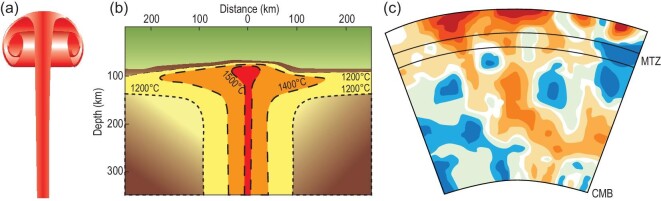
Recent advances indicate that the amount of carbon released by gradual degassing from the mantle needs to be revised upwards, whereas the carbon supplied by plumes may have been overestimated in the past. Variations in rock types and oxidation state may be very local and exert strong influences on carbon storage and release mechanisms. Deep subduction may be prevented by diapirism in thick sedimentary packages, whereas carbonates in thinner sequences may be subducted. Carbonates stored in the mantle transition zone will melt when they heat up, recognized by coupled stable isotope systems (e.g. Mg, Zn, Ca). There is no single 'mantle oxygen fugacity', particularly in the thermal boundary layer (TBL) and lowermost lithosphere, where very local mixtures of rock types coexist. Carbonate-rich melts from either subduction or melting of the uppermost asthenosphere trap carbon by redox freezing or as carbonate-rich dykes in this zone. Deeply derived, reduced melts may form further diamond reservoirs, recognized as polycrystalline diamonds associated with websteritic silicate minerals. Carbon is released by either edge-driven convection, which tears sections of the TBL and lower lithosphere down so that they melt by a mixture of heating and oxidation, or by lateral advection of solids beneath rifts. Both mechanisms operate at steps in lithosphere thickness and result in carbonate-rich melts, explaining the spatial association of craton edges and carbonate-rich magmatism. High-pressure experiments on individual rock types, and increasingly on reactions between rocks and melts, are fine-tuning our understanding of processes and turning up unexpected results that are not seen in studies of single rocks. Future research should concentrate on elucidating local variations and integrating these with the interpretation of geophysical signals. Global concepts such as average sediment compositions and a uniform mantle oxidation state are not appropriate for small-scale processes; an increased focus on local variations will help to refine carbon budget models.
近期进展表明,地幔逐渐脱气释放的碳量需要向上修正,而过去羽状物所供应的碳量可能被高估了。岩石类型和氧化态的变化可能非常局部化,并对碳的储存和释放机制产生强烈影响。厚沉积层中的底辟作用可能会阻止深部俯冲,而较薄层序中的碳酸盐岩可能会被俯冲。地幔过渡带中储存的碳酸盐岩受热时会熔化,这可通过耦合稳定同位素系统(如Mg、Zn、Ca)识别出来。不存在单一的“地幔氧逸度”,尤其是在热边界层(TBL)和岩石圈最底部,那里共存着非常局部的岩石类型混合物。俯冲或软流圈最上部熔化产生的富含碳酸盐的熔体,通过氧化还原冻结或在此区域形成富含碳酸盐的岩脉来捕获碳。深度来源的还原熔体可能会形成更多的金刚石储层,表现为与韦氏硅酸盐矿物相关的多晶金刚石。碳通过边缘驱动对流释放,这种对流会撕裂TBL和岩石圈下部的部分区域,使其因加热和氧化的混合作用而熔化,或者通过裂谷下方固体的横向平流释放。这两种机制在岩石圈厚度的不同阶段起作用,并导致富含碳酸盐的熔体形成,这解释了克拉通边缘与富含碳酸盐岩浆作用的空间联系。对单一岩石类型进行的高压实验,以及越来越多关于岩石与熔体之间反应的实验,正在微调我们对相关过程的理解,并揭示出在单一岩石研究中未见的意外结果。未来的研究应集中于阐明局部变化,并将这些变化与地球物理信号的解释相结合。诸如平均沉积物组成和统一的地幔氧化态等全球概念不适用于小规模过程;更多地关注局部变化将有助于完善碳收支模型。