Department of Biochemistry, Molecular Biology and Biophysics, University of Minnesota, Minneapolis, Minneapolis, Minnesota, USA.
Center for Metabolomics and Proteomics, University of Minnesota, Minneapolis, Minnesota, USA.
mSystems. 2024 Jul 23;9(7):e0092923. doi: 10.1128/msystems.00929-23. Epub 2024 Jun 27.
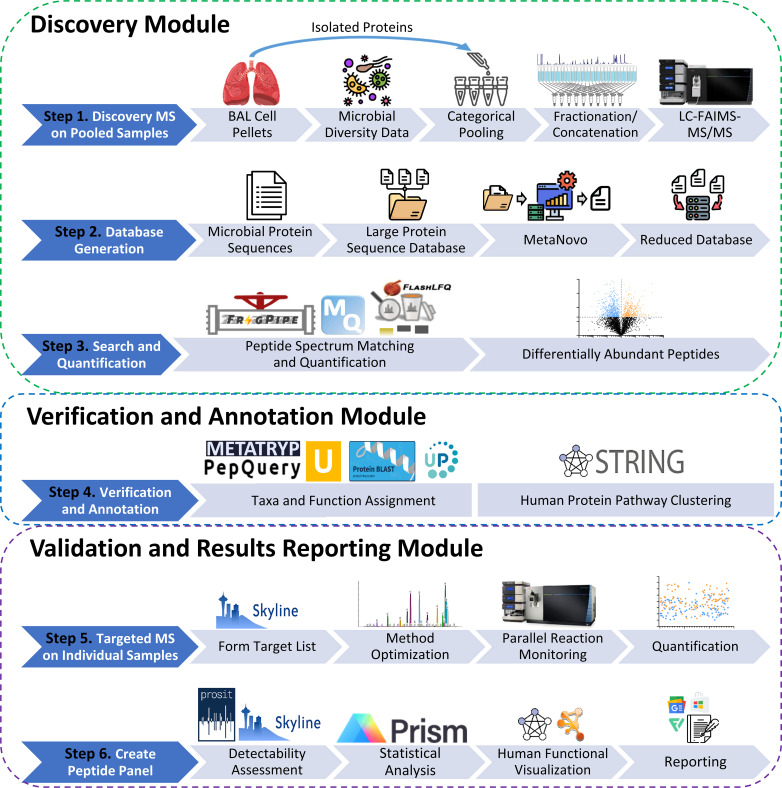
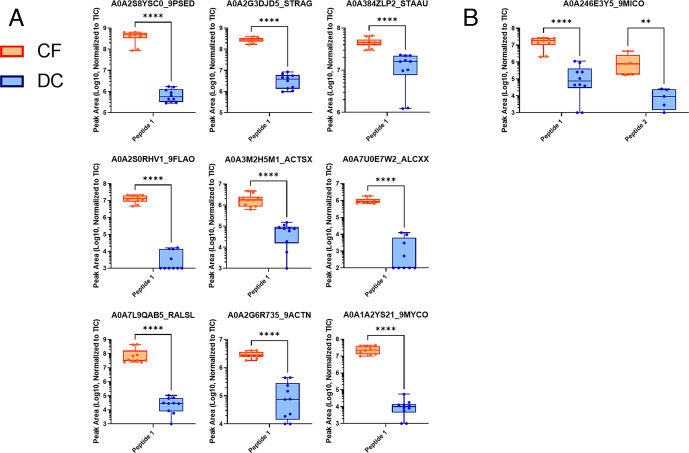
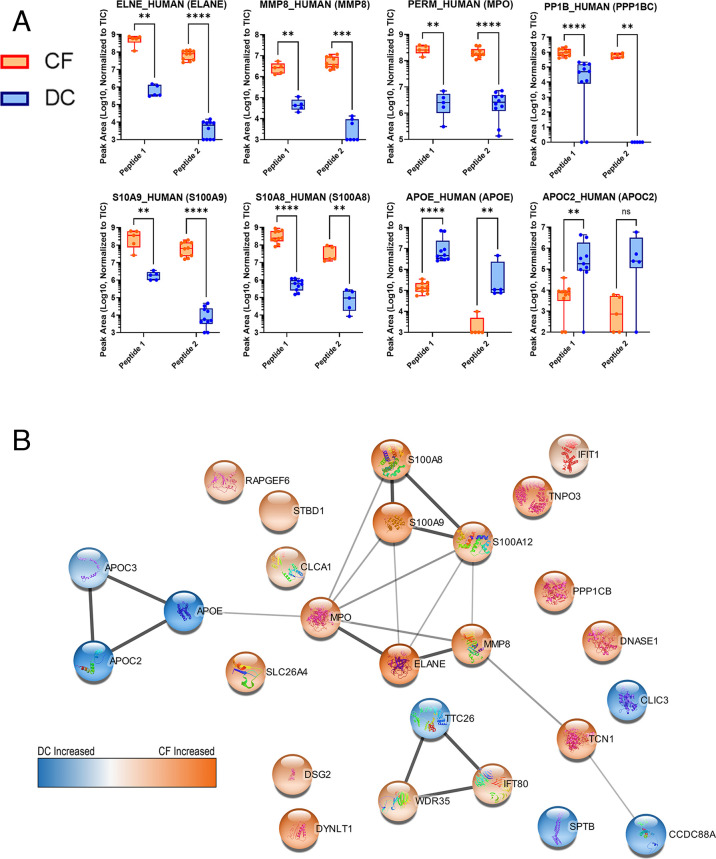
Airway microbiota are known to contribute to lung diseases, such as cystic fibrosis (CF), but their contributions to pathogenesis are still unclear. To improve our understanding of host-microbe interactions, we have developed an integrated analytical and bioinformatic mass spectrometry (MS)-based metaproteomics workflow to analyze clinical bronchoalveolar lavage (BAL) samples from people with airway disease. Proteins from BAL cellular pellets were processed and pooled together in groups categorized by disease status (CF vs. non-CF) and bacterial diversity, based on previously performed small subunit rRNA sequencing data. Proteins from each pooled sample group were digested and subjected to liquid chromatography tandem mass spectrometry (MS/MS). MS/MS spectra were matched to human and bacterial peptide sequences leveraging a bioinformatic workflow using a metagenomics-guided protein sequence database and rigorous evaluation. Label-free quantification revealed differentially abundant human peptides from proteins with known roles in CF, like neutrophil elastase and collagenase, and proteins with lesser-known roles in CF, including apolipoproteins. Differentially abundant bacterial peptides were identified from known CF pathogens (e.g., ), as well as other taxa with potentially novel roles in CF. We used this host-microbe peptide panel for targeted parallel-reaction monitoring validation, demonstrating for the first time an MS-based assay effective for quantifying host-microbe protein dynamics within BAL cells from individual CF patients. Our integrated bioinformatic and analytical workflow combining discovery, verification, and validation should prove useful for diverse studies to characterize microbial contributors in airway diseases. Furthermore, we describe a promising preliminary panel of differentially abundant microbe and host peptide sequences for further study as potential markers of host-microbe relationships in CF disease pathogenesis.IMPORTANCEIdentifying microbial pathogenic contributors and dysregulated human responses in airway disease, such as CF, is critical to understanding disease progression and developing more effective treatments. To this end, characterizing the proteins expressed from bacterial microbes and human host cells during disease progression can provide valuable new insights. We describe here a new method to confidently detect and monitor abundance changes of both microbe and host proteins from challenging BAL samples commonly collected from CF patients. Our method uses both state-of-the art mass spectrometry-based instrumentation to detect proteins present in these samples and customized bioinformatic software tools to analyze the data and characterize detected proteins and their association with CF. We demonstrate the use of this method to characterize microbe and host proteins from individual BAL samples, paving the way for a new approach to understand molecular contributors to CF and other diseases of the airway.
气道微生物群被认为有助于肺部疾病,如囊性纤维化(CF),但其在发病机制中的作用仍不清楚。为了提高我们对宿主-微生物相互作用的理解,我们开发了一种综合的分析和基于生物信息学的质谱(MS)代谢组学工作流程,以分析患有气道疾病的人的临床支气管肺泡灌洗(BAL)样本。根据先前进行的小亚基 rRNA 测序数据,将 BAL 细胞沉淀中的蛋白质进行处理并按疾病状态(CF 与非 CF)和细菌多样性分类进行分组。将每个分组样本的蛋白质进行消化,并进行液相色谱串联质谱(MS/MS)分析。使用基于宏基因组学指导的蛋白质序列数据库和严格评估的生物信息学工作流程,将 MS/MS 光谱与人类和细菌肽序列进行匹配。无标记定量法揭示了来自具有 CF 已知作用的蛋白质(如中性粒细胞弹性蛋白酶和胶原酶)和具有较少 CF 作用的蛋白质(如载脂蛋白)的已知 CF 中差异丰富的人类肽。从已知的 CF 病原体(例如 )以及其他在 CF 中具有潜在新作用的分类群中鉴定出差异丰富的细菌肽。我们使用该宿主-微生物肽面板进行靶向平行反应监测验证,首次证明了基于 MS 的测定法可有效定量 CF 个体患者的 BAL 细胞中宿主-微生物蛋白动力学。我们结合发现、验证和验证的综合生物信息学和分析工作流程,应该有助于进行各种研究,以表征气道疾病中的微生物贡献者。此外,我们描述了一个有前途的差异丰富的微生物和宿主肽序列初步面板,作为 CF 疾病发病机制中宿主-微生物关系的潜在标志物进行进一步研究。
在气道疾病(如 CF)中识别微生物致病性贡献者和失调的人类反应对于了解疾病进展和开发更有效的治疗方法至关重要。为此,描述在疾病进展过程中从细菌微生物和人类宿主细胞表达的蛋白质可以提供有价值的新见解。我们在这里描述了一种从 CF 患者通常收集的具有挑战性的 BAL 样本中可靠地检测和监测微生物和宿主蛋白丰度变化的新方法。我们的方法使用最先进的基于质谱的仪器来检测这些样本中存在的蛋白质,并使用定制的生物信息学软件工具来分析数据并描述检测到的蛋白质及其与 CF 的关联。我们展示了该方法在单个 BAL 样本中用于表征微生物和宿主蛋白的用途,为了解 CF 和其他气道疾病的分子贡献者开辟了新途径。