Loughney Lisa, Bolger Jarlath, Tully Roisin, Sorensen Jan, Bambrick Marie, Carroll Paul A, Arumugasamy Mayilone, Murphy Thomas J, McCaffrey Noel, Robb William B
ExWell Medical, Dublin, Ireland.
Department of Surgery, Royal College of Surgeons in Ireland.
Int J Surg. 2024 Oct 1;110(10):6632-6646. doi: 10.1097/JS9.0000000000001663.
Although the benefits of post-operative rehabilitation in cancer surgery are well established, the role of prehabilitation is less defined. Oesophagogastric cancers present a unique opportunity to study the impact of prehabilitation during the neoadjuvant window, whether with chemotherapy or chemoradiotherapy (NCT) in patients who are frequently nutritionally depleted. This trial examines the impact of a community-based exercise programme on patient fitness during and after the neoadjuvant window.
A pragmatic, randomized controlled multicentre trial was undertaken in three centres. Inclusion criteria were patients aged at least 18 years planned for NCT and esophagectomy or gastrectomy. Participants were randomized 1:1 to an exercise prehabilitation group (EX) or to usual care (UC). The primary endpoint was cardiorespiratory fitness between baseline and pre-surgery time point using the 6-minute walk test (MVT). Secondary endpoints included a hand dynamometer, 10-s sit-to-stand, activity behaviour, body mass index, semi-structured interviews, questionnaires assessing the quality of life, surgical fear, general self-efficacy and mastery.
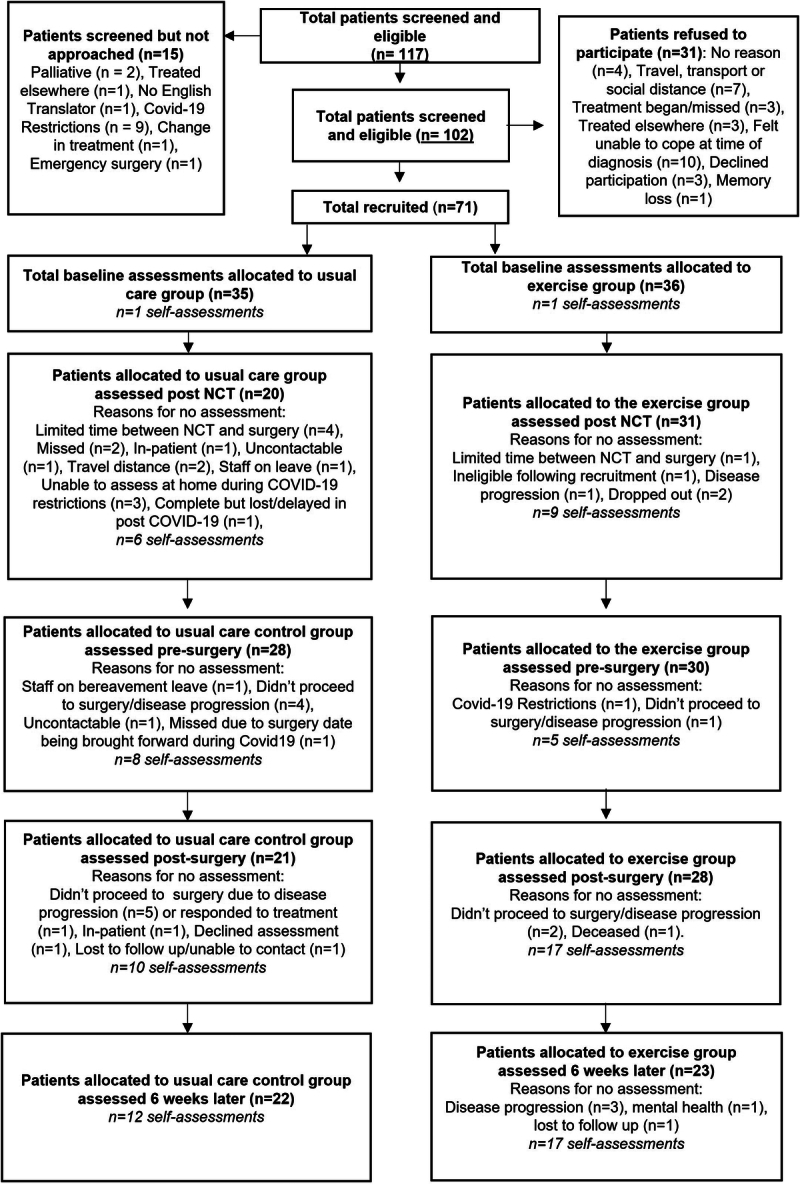
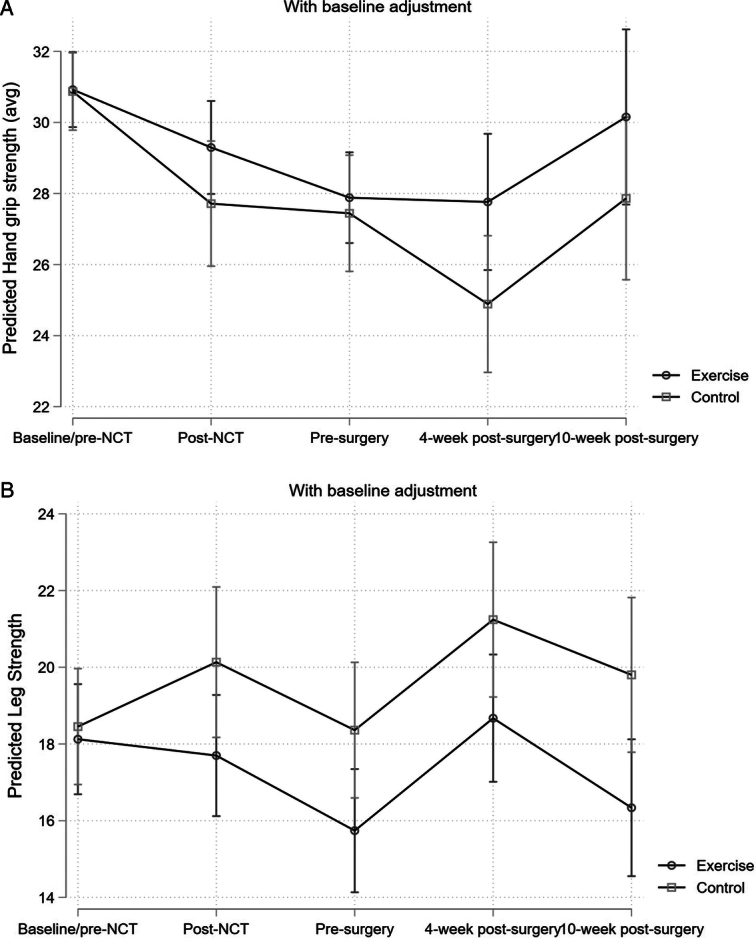
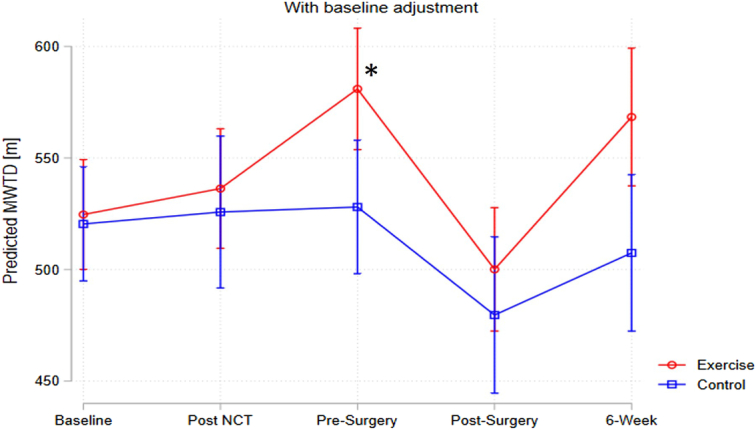
Between March 2019 and December 2020, 71 participants were recruited: EX ( n =36) or UC ( n =35). From baseline to pre-surgery, the difference-in-difference (DID) for EX showed a significant improvement in 6MWT of 50.7 m ( P =0.05) compared to UC [mean (SD): 522.1 m (+/-104.3) to 582.1 m (+/-108) vs. 497.5 m (+/-106.3) to 506.0 m (+/-140.4). There was no statistically significant DID for secondary outcome measures.
This community exercise prehabilitation programme significantly improves physical fitness for surgery, is feasible and provides a standardized framework for the prescription of exercise in oesophagogastric cancer patients undergoing NCT.
尽管癌症手术后康复的益处已得到充分证实,但术前康复的作用尚不明确。食管癌和胃癌为研究术前康复在新辅助治疗期(无论是化疗还是放化疗)的影响提供了独特机会,这类患者往往存在营养消耗。本试验旨在研究一项基于社区的运动计划对新辅助治疗期及之后患者体能的影响。
在三个中心进行了一项实用的随机对照多中心试验。纳入标准为计划接受新辅助治疗及食管切除术或胃切除术的至少18岁患者。参与者按1:1随机分为运动术前康复组(EX)或常规护理组(UC)。主要终点是使用6分钟步行试验(MVT)评估基线至手术前时间点的心肺功能。次要终点包括握力计测试、10秒坐立试验、活动行为、体重指数、半结构化访谈、评估生活质量、手术恐惧、一般自我效能感和掌控感的问卷。
2019年3月至2020年12月期间,共招募了71名参与者:EX组(n = 36)和UC组(n = 35)。从基线到手术前,EX组的差异差值(DID)显示6MWT有显著改善,较UC组提高了50.7米(P = 0.05)[均值(标准差):522.1米(±104.3)至582.1米(±108),而UC组为497.5米(±106.3)至506.0米(±140.4)]。次要结局指标的DID无统计学意义。
这项社区运动术前康复计划显著提高了手术患者的体能,具有可行性,并为接受新辅助治疗的食管癌和胃癌患者的运动处方提供了标准化框架。