Center for Environmental and Respiratory Health Research, Population Health, University of Oulu, Oulu, Finland.
Biocenter Oulu, University of Oulu, Oulu, Finland.
Environ Health Perspect. 2024 Jun;132(6):66001. doi: 10.1289/EHP13948. Epub 2024 Jun 27.
Changes in land use and climate change have been reported to reduce biodiversity of both the environment and human microbiota. These reductions in biodiversity may lead to inadequate and unbalanced stimulation of immunoregulatory circuits and, ultimately, to clinical diseases, such as asthma and allergies.
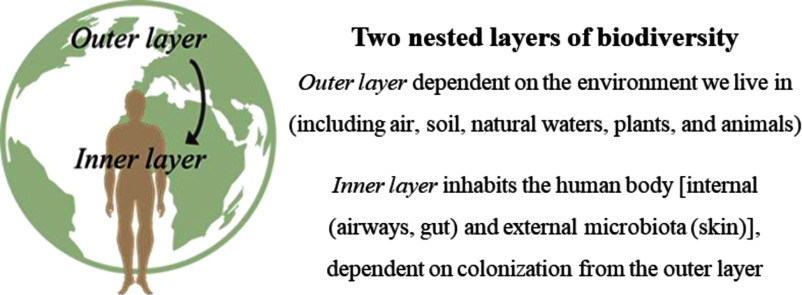
We summarized available empirical evidence on the role of inner (gut, skin, and airways) and outer (air, soil, natural waters, plants, and animals) layers of biodiversity in the development of asthma, wheezing, and allergic sensitization.
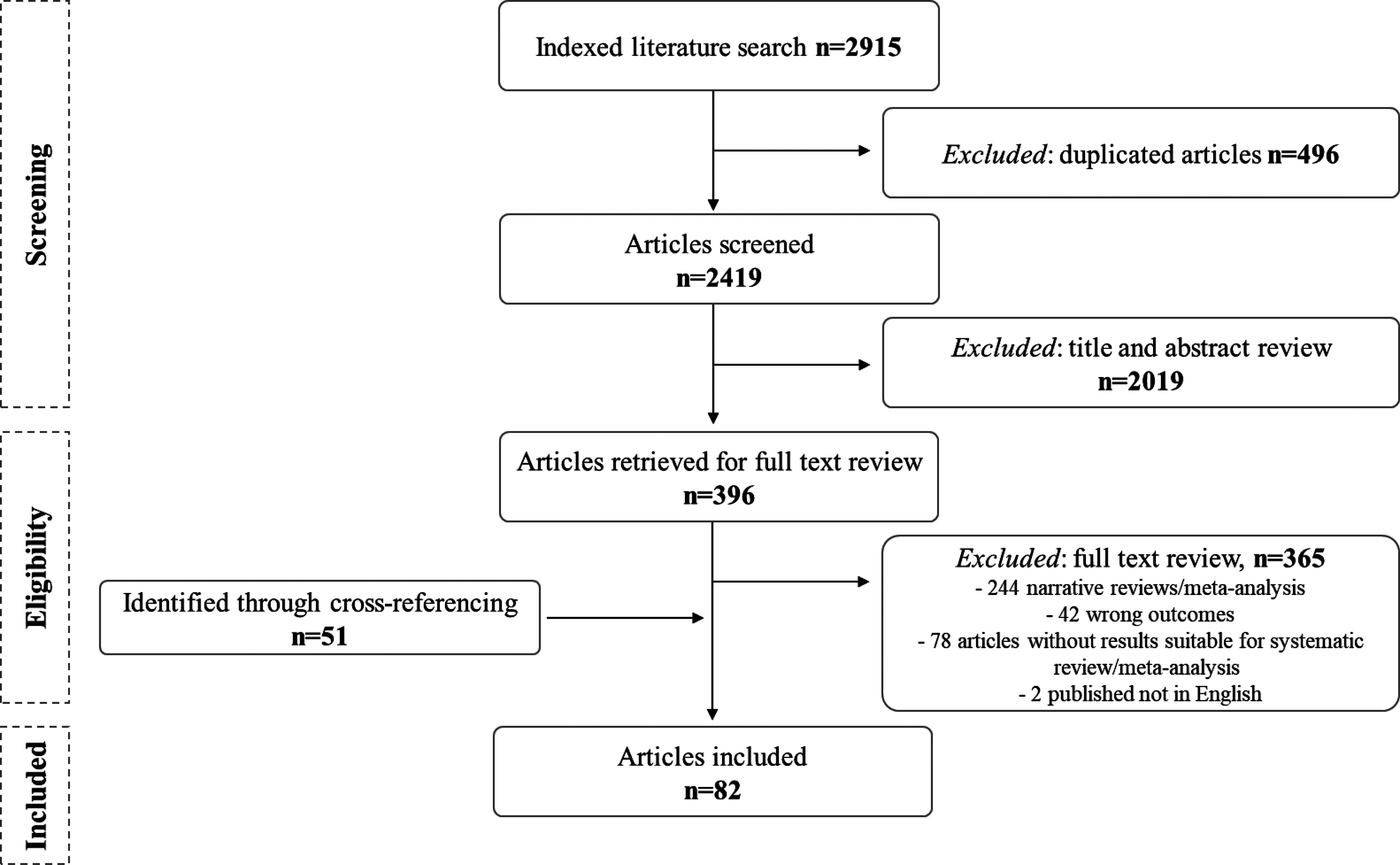
We conducted a systematic search in SciVerse Scopus, PubMed MEDLINE, and Web of Science up to 5 March 2024 to identify relevant human studies assessing the relationships between inner and outer layers of biodiversity and the risk of asthma, wheezing, or allergic sensitization. The protocol was registered in PROSPERO (CRD42022381725).
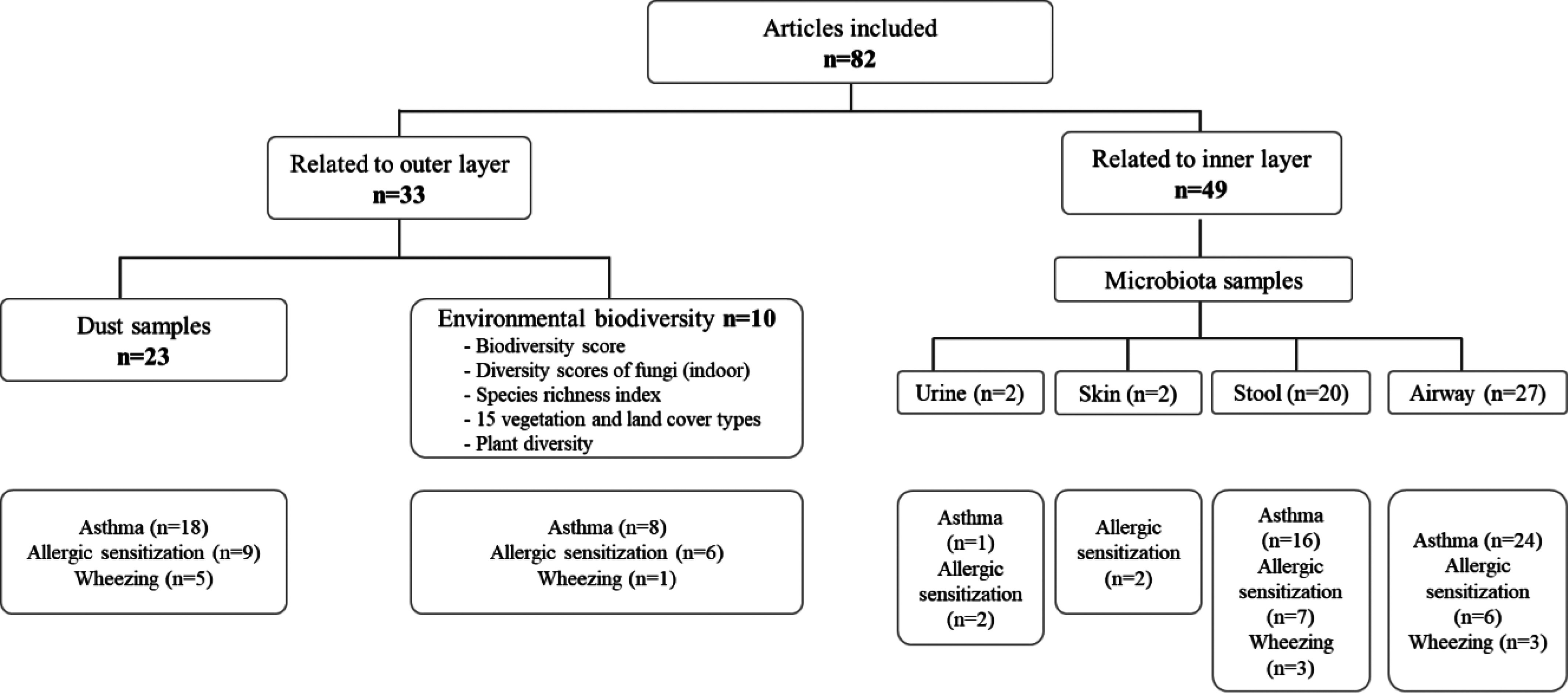
A total of 2,419 studies were screened and, after exclusions and a full-text review of 447 studies, 82 studies were included in the comprehensive, final review. Twenty-nine studies reported a protective effect of outer layer biodiversity in the development of asthma, wheezing, or allergic sensitization. There were also 16 studies suggesting an effect of outer layer biodiversity on increasing asthma, wheezing, or allergic sensitization. However, there was no clear evidence on the role of inner layer biodiversity in the development of asthma, wheezing, and allergic sensitization (13 studies reported a protective effect and 15 reported evidence of an increased risk).
Based on the reviewed literature, a future systematic review could focus more specifically on outer layer biodiversity and asthma. It is unlikely that association with inner layer biodiversity would have enough evidence for systematic review. Based on this comprehensive review, there is a need for population-based longitudinal studies to identify critical periods of exposure in the life course into adulthood and to better understand mechanisms linking environmental exposures and changes in microbiome composition, diversity, and/or function to development of asthma and allergic sensitization. https://doi.org/10.1289/EHP13948.
土地利用变化和气候变化据报道会降低环境和人类微生物组的生物多样性。这种生物多样性的减少可能导致免疫调节回路的刺激不足和不平衡,并最终导致临床疾病,如哮喘和过敏。
我们总结了现有关于内(肠道、皮肤和气道)和外(空气、土壤、天然水、植物和动物)生物多样性层在哮喘、喘息和过敏敏化发展中的作用的实证证据。
我们在 SciVerse Scopus、PubMed MEDLINE 和 Web of Science 上进行了系统搜索,截至 2024 年 3 月 5 日,以确定评估内、外生物多样性层与哮喘、喘息或过敏敏化风险之间关系的相关人类研究。该方案已在 PROSPERO(CRD42022381725)中注册。
共筛选出 2419 项研究,在排除和对 447 项研究进行全文审查后,有 82 项研究纳入全面的最终综述。29 项研究报告了外层生物多样性对哮喘、喘息或过敏敏化发展的保护作用。还有 16 项研究表明外层生物多样性对增加哮喘、喘息或过敏敏化的作用。然而,关于内层生物多样性在哮喘、喘息和过敏敏化发展中的作用尚无明确证据(13 项研究报告了保护作用,15 项研究报告了风险增加的证据)。
基于已审查的文献,未来的系统评价可以更具体地关注外层生物多样性与哮喘。内层生物多样性不太可能有足够的系统评价证据。基于本次全面审查,需要进行基于人群的纵向研究,以确定生命历程中进入成年后的暴露关键期,并更好地了解环境暴露与微生物组组成、多样性和/或功能变化之间的联系,以了解其与哮喘和过敏敏化发展的关系。