Zhang Guoli, Zhang Jian, Tao Yu, Gan Fuwei, Lin Geyu, Liang Juncong, Shen Chengshuo, Zhang Yuebiao, Qiu Huibin
School of Chemistry and Chemical Engineering, Zhangjiang Institute for Advanced Study, Frontiers Science Center for Transformative Molecules, State Key Laboratory of Metal Matrix Composites, Shanghai Jiao Tong University, Shanghai, 200240, China.
Shanghai Key Laboratory of High Resolution Electron Microscopy, School of Physical Science and Technology, ShanghaiTech University, Shanghai, 201210, China.
Nat Commun. 2024 Jun 27;15(1):5469. doi: 10.1038/s41467-024-49865-y.
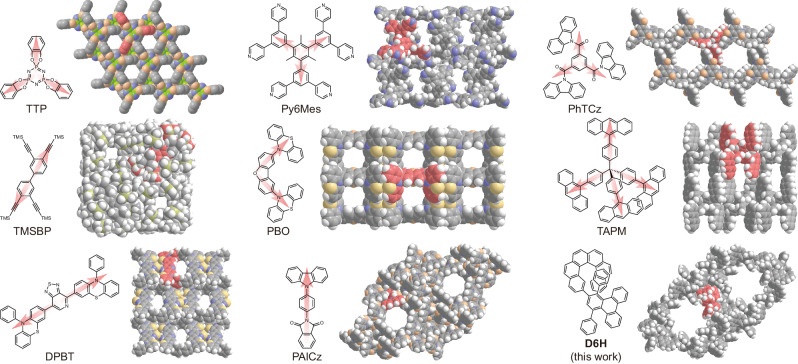
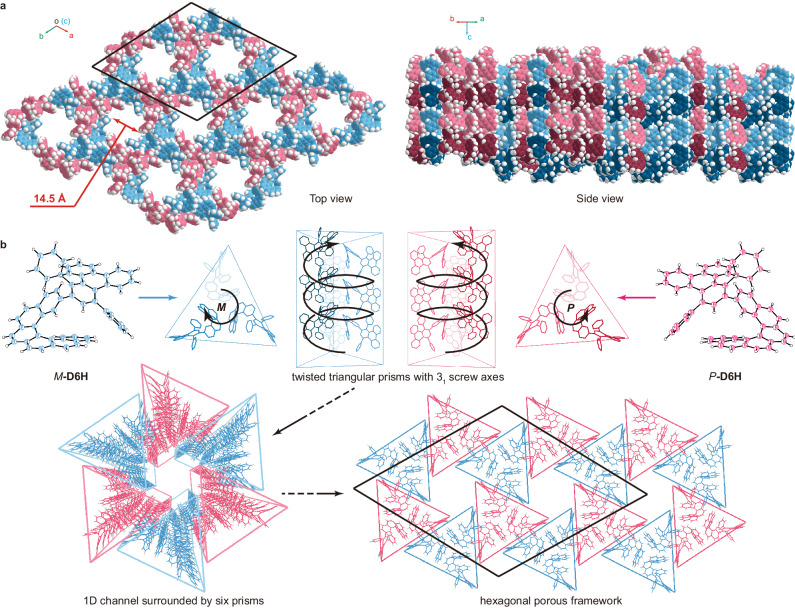
Porous frameworks constructed via noncovalent interactions show wide potential in molecular separation and gas adsorption. However, it remains a major challenge to prepare these materials from low-symmetry molecular building blocks. Herein, we report a facile strategy to fabricate noncovalent porous crystals through modular self-assembly of a low-symmetry helicene racemate. The P and M enantiomers in the racemate first stack into right- and left-handed triangular prisms, respectively, and subsequently the two types of prisms alternatively stack together into a hexagonal network with one-dimensional channels with a diameter of 14.5 Å. Remarkably, the framework reveals high stability upon heating to 275 °C, majorly due to the abundant π-interactions between the complementarily engaged helicene building blocks. Such porous framework can be readily prepared by fast rotary evaporation, and is easy to recycle and repeatedly reform. The refined porous structure and enriched π-conjugation also favor the selective adsorption of a series of small molecules.
通过非共价相互作用构建的多孔框架在分子分离和气体吸附方面显示出广阔的潜力。然而,用低对称分子构建块制备这些材料仍然是一个重大挑战。在此,我们报道了一种通过低对称螺旋烯外消旋体的模块化自组装制备非共价多孔晶体的简便策略。外消旋体中的P和M对映体首先分别堆叠成右手和左手三角棱柱,随后这两种类型的棱柱交替堆叠在一起形成具有直径为14.5 Å的一维通道的六边形网络。值得注意的是,该框架在加热到275°C时仍显示出高稳定性,这主要归因于互补结合的螺旋烯构建块之间丰富的π相互作用。这种多孔框架可以通过快速旋转蒸发轻松制备,并且易于回收和反复重构。精细的多孔结构和丰富的π共轭也有利于一系列小分子的选择性吸附。