Aksnes Mari, Schibstad Mari Haavig, Chaudhry Farrukh Abbas, Neerland Bjørn Erik, Caplan Gideon, Saltvedt Ingvild, Eldholm Rannveig S, Myrstad Marius, Edwin Trine Holt, Persson Karin, Idland Ane-Victoria, Pollmann Christian Thomas, Olsen Roy Bjørkholt, Wyller Torgeir Bruun, Zetterberg Henrik, Cunningham Emma, Watne Leiv Otto
Institute of Clinical Medicine, University of Oslo, Oslo, Norway.
Department of Geriatric Medicine, Sørlandet Hospital, Arendal, Norway.
Commun Med (Lond). 2024 Jun 27;4(1):124. doi: 10.1038/s43856-024-00558-z.
The aetiology of delirium is not known, but pre-existing cognitive impairment is a predisposing factor. Here we explore the associations between delirium and cerebrospinal fluid (CSF) levels of matrix metalloproteinases (MMPs) and their tissue inhibitors (TIMPs), proteins with important roles in both acute injury and chronic neurodegeneration.
Using a 13-plex Discovery Assay®, we quantified CSF levels of 9 MMPs and 4 TIMPs in 280 hip fracture patients (140 with delirium), 107 cognitively unimpaired individuals, and 111 patients with Alzheimer's disease dementia. The two delirium-free control groups without acute trauma were included to unravel the effects of acute trauma (hip fracture), dementia, and delirium.
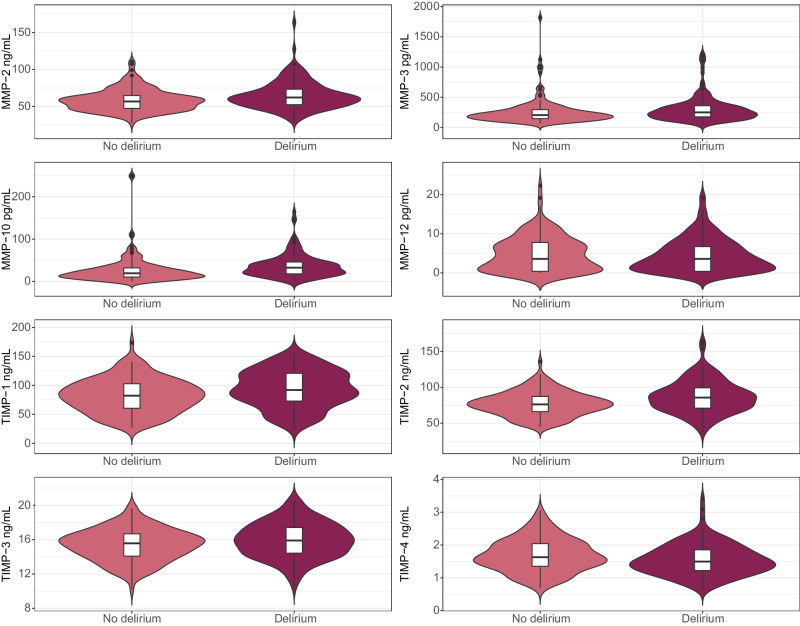
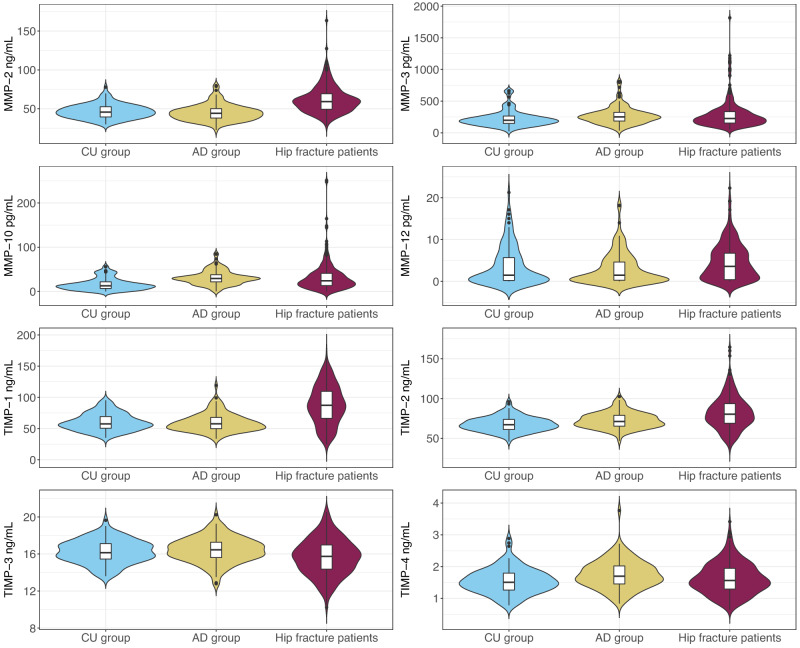
Here we show that delirium is associated with higher levels of MMP-2, MMP-3, MMP-10, TIMP-1, and TIMP-2; a trend suggests lower levels of TIMP-4 are also associated with delirium. Most delirium patients had pre-existing dementia and low TIMP-4 is the only marker associated with delirium in adjusted analyses. MMP-2, MMP-12, and TIMP-1 levels are clearly higher in the hip fracture patients than in both control groups and several other MMP/TIMPs are impacted by acute trauma or dementia status.
Several CSF MMP/TIMPs are significantly associated with delirium in hip fracture patients, but alterations in most of these MMP/TIMPs could likely be explained by acute trauma and/or pre-fracture dementia. Low levels of TIMP-4 appear to be directly associated with delirium, and the role of this marker in delirium pathophysiology should be further explored.
谵妄的病因尚不清楚,但既往存在的认知障碍是一个诱发因素。在此,我们探讨谵妄与基质金属蛋白酶(MMPs)及其组织抑制剂(TIMPs)的脑脊液(CSF)水平之间的关联,这些蛋白质在急性损伤和慢性神经退行性变中均起重要作用。
我们使用13重发现分析试剂盒,对280例髋部骨折患者(140例伴有谵妄)、107例认知未受损个体以及111例阿尔茨海默病痴呆患者的脑脊液中9种MMPs和4种TIMPs水平进行了定量分析。纳入两个无急性创伤的无谵妄对照组,以阐明急性创伤(髋部骨折)、痴呆和谵妄的影响。
我们发现谵妄与MMP-2、MMP-3、MMP-10、TIMP-1和TIMP-2水平升高有关;一种趋势表明,TIMP-4水平降低也与谵妄有关。大多数谵妄患者既往患有痴呆,在调整分析中,低TIMP-4是与谵妄相关的唯一标志物。髋部骨折患者的MMP-2、MMP-12和TIMP-1水平明显高于两个对照组,其他几种MMP/TIMPs受急性创伤或痴呆状态影响。
几种脑脊液MMP/TIMPs与髋部骨折患者的谵妄显著相关,但这些MMP/TIMPs中的大多数变化可能由急性创伤和/或骨折前痴呆所解释。低水平的TIMP-4似乎与谵妄直接相关,该标志物在谵妄病理生理学中的作用应进一步探讨。