Oslo Delirium Research Group, Oslo University Hospital, Oslo, Norway.
Institute of Clinical Medicine, Campus Ahus, University of Oslo, Oslo, Norway.
J Clin Invest. 2023 Jan 17;133(2):e163472. doi: 10.1172/JCI163472.
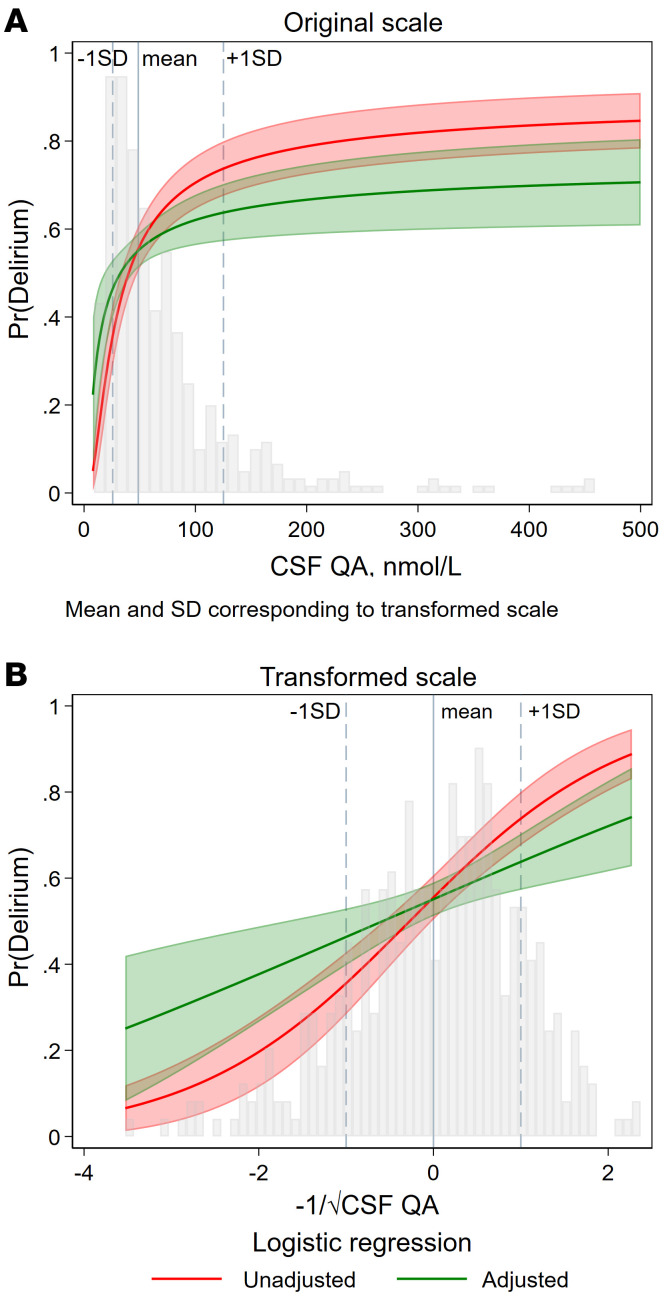
BACKGROUNDThe kynurenine pathway (KP) has been identified as a potential mediator linking acute illness to cognitive dysfunction by generating neuroactive metabolites in response to inflammation. Delirium (acute confusion) is a common complication of acute illness and is associated with increased risk of dementia and mortality. However, the molecular mechanisms underlying delirium, particularly in relation to the KP, remain elusive.METHODSWe undertook a multicenter observational study with 586 hospitalized patients (248 with delirium) and investigated associations between delirium and KP metabolites measured in cerebrospinal fluid (CSF) and serum by targeted metabolomics. We also explored associations between KP metabolites and markers of neuronal damage and 1-year mortality.RESULTSIn delirium, we found concentrations of the neurotoxic metabolite quinolinic acid in CSF (CSF-QA) (OR 2.26 [1.78, 2.87], P < 0.001) to be increased and also found increases in several other KP metabolites in serum and CSF. In addition, CSF-QA was associated with the neuronal damage marker neurofilament light chain (NfL) (β 0.43, P < 0.001) and was a strong predictor of 1-year mortality (HR 4.35 [2.93, 6.45] for CSF-QA ≥ 100 nmol/L, P < 0.001). The associations between CSF-QA and delirium, neuronal damage, and mortality remained highly significant following adjustment for confounders and multiple comparisons.CONCLUSIONOur data identified how systemic inflammation, neurotoxicity, and delirium are strongly linked via the KP and should inform future delirium prevention and treatment clinical trials that target enzymes of the KP.FUNDINGNorwegian Health Association and South-Eastern Norway Regional Health Authorities.
色氨酸代谢途径(KP)已被确定为一种潜在的介导物,通过在炎症反应中生成神经活性代谢物来连接急性疾病和认知功能障碍。谵妄(急性意识混乱)是急性疾病的常见并发症,与痴呆和死亡率增加相关。然而,谵妄的分子机制,特别是与 KP 的关系,仍然难以捉摸。
我们进行了一项多中心观察性研究,共纳入 586 名住院患者(248 名患有谵妄),通过靶向代谢组学检测脑脊液(CSF)和血清中的 KP 代谢物与谵妄之间的关联。我们还探索了 KP 代谢物与神经元损伤标志物和 1 年死亡率之间的关系。
在谵妄中,我们发现 CSF 中神经毒性代谢物喹啉酸(CSF-QA)的浓度(CSF-QA)(OR 2.26 [1.78, 2.87],P < 0.001)升高,并且还发现血清和 CSF 中其他几种 KP 代谢物的升高。此外,CSF-QA 与神经元损伤标志物神经丝轻链(NfL)相关(β 0.43,P < 0.001),并且是 1 年死亡率的强预测因子(CSF-QA ≥ 100 nmol/L 的 HR 4.35 [2.93, 6.45],P < 0.001)。在调整混杂因素和多次比较后,CSF-QA 与谵妄、神经元损伤和死亡率之间的关联仍然高度显著。
我们的数据确定了全身炎症、神经毒性和谵妄如何通过 KP 紧密联系在一起,这应该为未来以 KP 酶为靶点的谵妄预防和治疗临床试验提供信息。
挪威健康协会和东南挪威地区卫生当局。