Hematology Department, Hospital Universitario 12 de Octubre, Instituto de Investigación Sanitaria Imas12, Madrid, Spain.
Hematological Malignancies Clinical Research Unit, Centro Nacional de Investigaciones Oncológicas (CNIO), Madrid, Spain.
Front Immunol. 2024 Jun 13;15:1252258. doi: 10.3389/fimmu.2024.1252258. eCollection 2024.
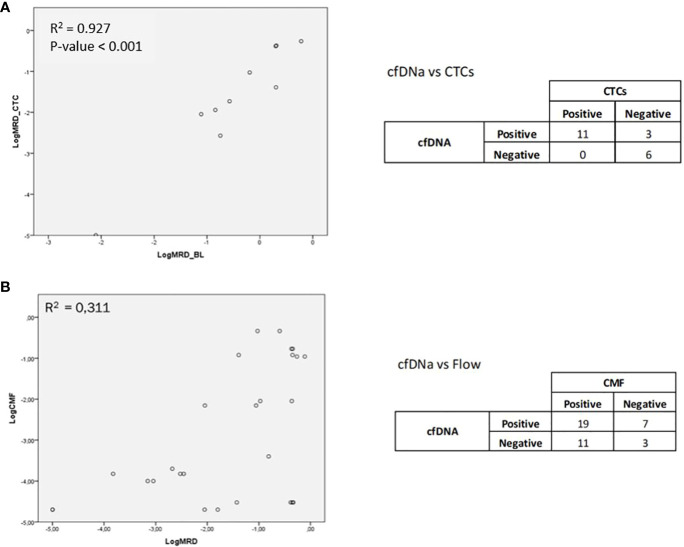
This study discusses the importance of minimal residual disease (MRD) detection in acute myeloid leukemia (AML) patients using liquid biopsy and next-generation sequencing (NGS). AML prognosis is based on various factors, including genetic alterations. NGS has revealed the molecular complexity of AML and helped refine risk stratification and personalized therapies. The long-term survival rates for AML patients are low, and MRD assessment is crucial in predicting prognosis. Currently, the most common methods for MRD detection are flow cytometry and quantitative PCR, but NGS is being incorporated into clinical practice due to its ability to detect genomic aberrations in the majority of AML patients. Typically, bone marrow samples are used for MRD assessment, but using peripheral blood samples or liquid biopsies would be less invasive. Leukemia originates in the bone marrow, along with the cfDNA obtained from peripheral blood. This study aimed to assess the utility of cell-free DNA (cfDNA) from peripheral blood samples for MRD detection in AML patients. A cohort of 20 AML patients was analyzed using NGS, and a correlation between MRD assessment by cfDNA and circulating tumor cells (CTCs) in paired samples was observed. Furthermore, a higher tumor signal was detected in cfDNA compared to CTCs, indicating greater sensitivity. Challenges for the application of liquid biopsy in MRD assessment were discussed, including the selection of appropriate markers and the sensitivity of certain markers. This study emphasizes the potential of liquid biopsy using cfDNA for MRD detection in AML patients and highlights the need for further research in this area.
本研究探讨了液体活检和下一代测序(NGS)在急性髓细胞白血病(AML)患者中检测微小残留病(MRD)的重要性。AML 的预后取决于多种因素,包括遗传改变。NGS 揭示了 AML 的分子复杂性,并有助于细化风险分层和个性化治疗。AML 患者的长期生存率较低,MRD 评估对于预测预后至关重要。目前,MRD 检测最常用的方法是流式细胞术和定量 PCR,但由于 NGS 能够检测大多数 AML 患者的基因组异常,因此已将其纳入临床实践。通常,骨髓样本用于 MRD 评估,但使用外周血样本或液体活检会更具侵入性。白血病起源于骨髓,外周血中也存在 cfDNA。本研究旨在评估外周血 cfDNA 用于 AML 患者 MRD 检测的效用。对 20 例 AML 患者进行了 NGS 分析,并观察了 cfDNA 与配对样本中循环肿瘤细胞(CTC)的 MRD 评估之间的相关性。此外,cfDNA 中的肿瘤信号高于 CTCs,表明敏感性更高。还讨论了液体活检在 MRD 评估中的应用挑战,包括合适标志物的选择和某些标志物的敏感性。本研究强调了使用 cfDNA 进行 AML 患者 MRD 检测的液体活检的潜力,并强调了该领域进一步研究的必要性。