• 文献检索
  • 文档翻译
  • 深度研究
  • 学术资讯
  • Suppr Zotero 插件Zotero 插件
  • 邀请有礼
  • 套餐&价格
  • 历史记录
应用&插件
Suppr Zotero 插件Zotero 插件浏览器插件Mac 客户端Windows 客户端微信小程序
定价
高级版会员购买积分包购买API积分包
服务
文献检索文档翻译深度研究API 文档MCP 服务
关于我们
关于 Suppr公司介绍联系我们用户协议隐私条款
关注我们

Suppr 超能文献

核心技术专利:CN118964589B侵权必究
粤ICP备2023148730 号-1Suppr @ 2026

文献检索

告别复杂PubMed语法,用中文像聊天一样搜索,搜遍4000万医学文献。AI智能推荐,让科研检索更轻松。

立即免费搜索

文件翻译

保留排版,准确专业,支持PDF/Word/PPT等文件格式,支持 12+语言互译。

免费翻译文档

深度研究

AI帮你快速写综述,25分钟生成高质量综述,智能提取关键信息,辅助科研写作。

立即免费体验

循环miRNA谱与急性缺血性脑卒中溶栓治疗后出血转化风险:一项初步研究。

Circulating miRNA profiles and the risk of hemorrhagic transformation after thrombolytic treatment of acute ischemic stroke: a pilot study.

作者信息

Stańczak Marcin, Wyszomirski Adam, Słonimska Paulina, Kołodziej Barbara, Jabłoński Bartosz, Stanisławska-Sachadyn Anna, Karaszewski Bartosz

机构信息

Department of Adult Neurology, Faculty of Medicine, Medical University of Gdańsk, Gdańsk, Poland.

Department of Adult Neurology, University Clinical Center, Gdańsk, Poland.

出版信息

Front Neurol. 2024 Jun 12;15:1399345. doi: 10.3389/fneur.2024.1399345. eCollection 2024.

DOI:10.3389/fneur.2024.1399345
PMID:38938784
原文链接:https://pmc.ncbi.nlm.nih.gov/articles/PMC11210454/
Abstract

BACKGROUND

Hemorrhagic transformation (HT) in acute ischemic stroke is likely to occur in patients treated with intravenous thrombolysis (IVT) and may lead to neurological deterioration and symptomatic intracranial hemorrhage (sICH). Despite the complex inclusion and exclusion criteria for IVT and some useful tools to stratify HT risk, sICH still occurs in approximately 6% of patients because some of the risk factors for this complication remain unknown.

OBJECTIVE

This study aimed to explore whether there are any differences in circulating microRNA (miRNA) profiles between patients who develop HT after thrombolysis and those who do not.

METHODS

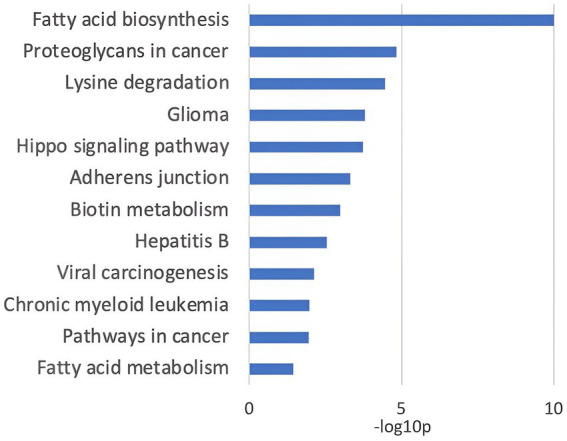
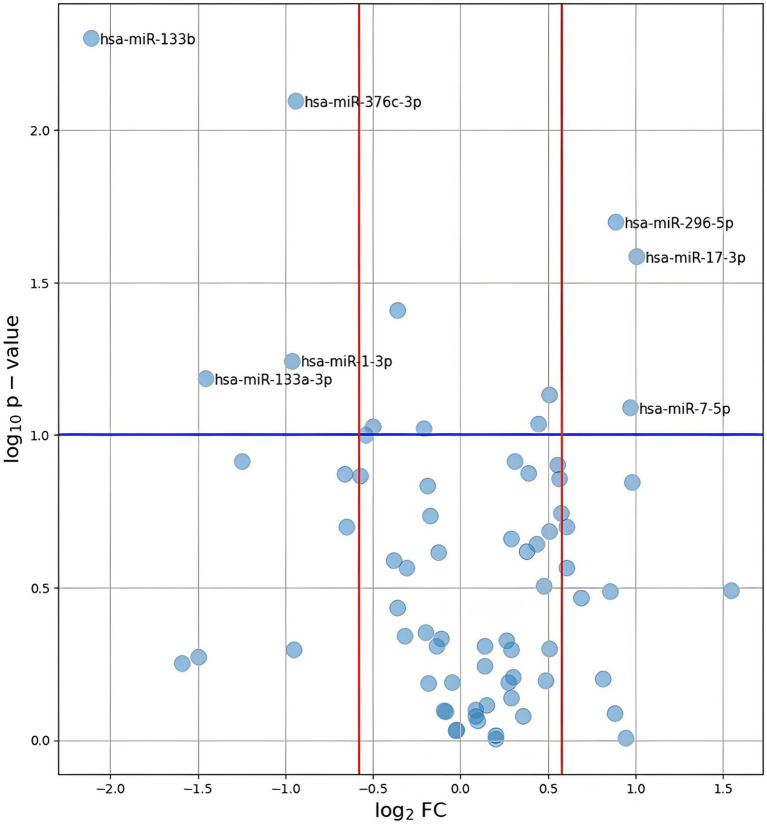
Using qPCR, we quantified the expression of 84 miRNAs in plasma samples collected prior to thrombolytic treatment from 10 individuals who eventually developed HT and 10 patients who did not. For miRNAs that were downregulated (fold change (FC) <0.67) or upregulated (FC >1.5) with < 0.10, we investigated the tissue specificity and performed KEGG pathway annotation using bioinformatics tools. Owing to the small patient sample size, instead of multivariate analysis with all major known HT risk factors, we matched the results with the admission NIHSS scores only.

RESULTS

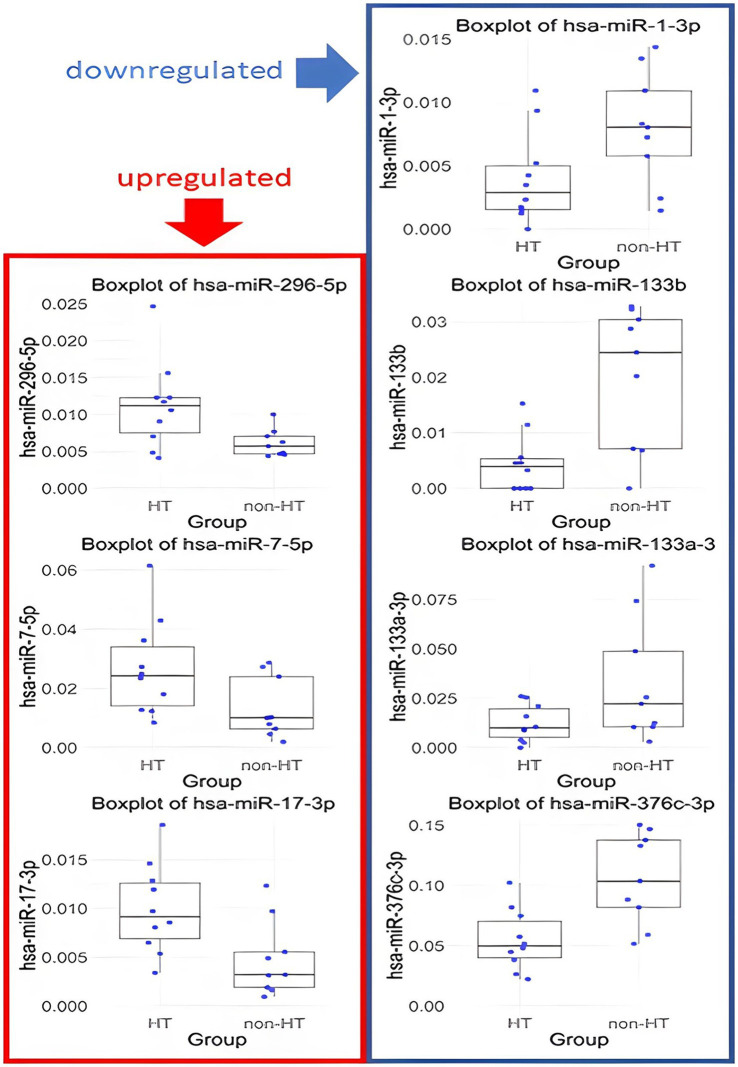
We observed trends towards downregulation of miR-1-3p, miR-133a-3p, miR-133b and miR-376c-3p, and upregulation of miR-7-5p, miR-17-3p, and miR-296-5p. Previously, the upregulated miR-7-5p was found to be highly expressed in the brain, whereas miR-1, miR-133a-3p and miR-133b appeared to be specific to the muscles and myocardium.

CONCLUSION

miRNA profiles tend to differ between patients who develop HT and those who do not, suggesting that miRNA profiling, likely in association with other omics approaches, may increase the current power of tools predicting thrombolysis-associated sICH in acute ischemic stroke patients. This study represents a free hypothesis-approach pilot study as a continuation from our previous work. Herein, we showed that applying mathematical analyses to extract information from raw big data may result in the identification of new pathophysiological pathways and may complete standard design works.

摘要

背景

急性缺血性卒中患者接受静脉溶栓治疗后可能会发生出血性转化(HT),这可能导致神经功能恶化和症状性颅内出血(sICH)。尽管静脉溶栓有复杂的纳入和排除标准以及一些用于分层HT风险的有用工具,但sICH仍发生在约6%的患者中,因为该并发症的一些危险因素仍然未知。

目的

本研究旨在探讨溶栓后发生HT的患者与未发生HT的患者之间循环微小RNA(miRNA)谱是否存在差异。

方法

我们使用定量聚合酶链反应(qPCR)对10例最终发生HT的个体和10例未发生HT的患者在溶栓治疗前采集的血浆样本中84种miRNA的表达进行了定量。对于下调(倍数变化(FC)<0.67)或上调(FC>1.5)且P<0.10的miRNA,我们研究了其组织特异性,并使用生物信息学工具进行KEGG通路注释。由于患者样本量小,我们没有对所有已知的主要HT危险因素进行多变量分析,而是仅将结果与入院时的美国国立卫生研究院卒中量表(NIHSS)评分进行匹配。

结果

我们观察到miR-1-3p、miR-133a-3p、miR-133b和miR-376c-3p有下调趋势,miR-7-5p、miR-17-3p和miR-296-5p有上调趋势。此前发现上调的miR-7-5p在脑中高表达,而miR-1、miR-133a-3p和miR-133b似乎对肌肉和心肌具有特异性。

结论

发生HT的患者与未发生HT的患者之间miRNA谱往往存在差异,这表明miRNA谱分析可能与其他组学方法相结合,可能会增强当前预测急性缺血性卒中患者溶栓相关sICH的工具的效能。本研究是一项自由假设方法的探索性研究,是我们之前工作的延续。在此,我们表明应用数学分析从原始大数据中提取信息可能会识别新的病理生理途径,并可能完成标准设计工作。
https://cdn.ncbi.nlm.nih.gov/pmc/blobs/42d3/11210454/3e83042e58ee/fneur-15-1399345-g004.jpg
https://cdn.ncbi.nlm.nih.gov/pmc/blobs/42d3/11210454/c36961c06161/fneur-15-1399345-g001.jpg
https://cdn.ncbi.nlm.nih.gov/pmc/blobs/42d3/11210454/5c559fff2516/fneur-15-1399345-g002.jpg
https://cdn.ncbi.nlm.nih.gov/pmc/blobs/42d3/11210454/6ebe0611fdfa/fneur-15-1399345-g003.jpg
https://cdn.ncbi.nlm.nih.gov/pmc/blobs/42d3/11210454/3e83042e58ee/fneur-15-1399345-g004.jpg
https://cdn.ncbi.nlm.nih.gov/pmc/blobs/42d3/11210454/c36961c06161/fneur-15-1399345-g001.jpg
https://cdn.ncbi.nlm.nih.gov/pmc/blobs/42d3/11210454/5c559fff2516/fneur-15-1399345-g002.jpg
https://cdn.ncbi.nlm.nih.gov/pmc/blobs/42d3/11210454/6ebe0611fdfa/fneur-15-1399345-g003.jpg
https://cdn.ncbi.nlm.nih.gov/pmc/blobs/42d3/11210454/3e83042e58ee/fneur-15-1399345-g004.jpg

相似文献

1
Circulating miRNA profiles and the risk of hemorrhagic transformation after thrombolytic treatment of acute ischemic stroke: a pilot study.循环miRNA谱与急性缺血性脑卒中溶栓治疗后出血转化风险:一项初步研究。
Front Neurol. 2024 Jun 12;15:1399345. doi: 10.3389/fneur.2024.1399345. eCollection 2024.
2
Increased plasma levels of miR-124-3p, miR-125b-5p and miR-192-5p are associated with outcomes in acute ischaemic stroke patients receiving thrombolysis.血浆中 miR-124-3p、miR-125b-5p 和 miR-192-5p 水平升高与接受溶栓治疗的急性缺血性脑卒中患者的预后相关。
Atherosclerosis. 2019 Oct;289:36-43. doi: 10.1016/j.atherosclerosis.2019.08.002. Epub 2019 Aug 17.
3
Predictive Role of Pre-Thrombolytic Neutrophil-Platelet Ratio on Hemorrhagic Transformation After Intravenous Thrombolysis in Acute Ischemic Stroke.溶栓前中性粒细胞/血小板比值对急性缺血性脑卒中静脉溶栓后出血性转化的预测作用。
Clin Appl Thromb Hemost. 2024 Jan-Dec;30:10760296231223192. doi: 10.1177/10760296231223192.
4
Circulating MicroRNAs as Potential Molecular Biomarkers for Intracranial Aneurysmal Rupture.循环 microRNAs 作为颅内动脉瘤破裂的潜在分子生物标志物。
Mol Diagn Ther. 2020 Jun;24(3):351-364. doi: 10.1007/s40291-020-00465-8.
5
Associations between computed tomography markers of cerebral small vessel disease and hemorrhagic transformation after intravenous thrombolysis in acute ischemic stroke patients.急性缺血性卒中患者静脉溶栓后脑小血管病的计算机断层扫描标志物与出血性转化之间的关联
Front Neurol. 2023 Apr 3;14:1144564. doi: 10.3389/fneur.2023.1144564. eCollection 2023.
6
Effect of intravenous thrombolysis in acute ischemic stroke patients with cerebral microbleeds and analysis of risk factors for hemorrhagic transformation.脑微出血急性缺血性脑卒中患者静脉溶栓的效果及出血转化的危险因素分析。
Eur Rev Med Pharmacol Sci. 2022 Feb;26(3):779-786. doi: 10.26355/eurrev_202202_27986.
7
MicroRNA Expression Profile in Acute Ischemic Stroke.急性缺血性卒中中的微小RNA表达谱
Res Sq. 2024 Jan 3:rs.3.rs-3754883. doi: 10.21203/rs.3.rs-3754883/v1.
8
SIV Infection Regulates Compartmentalization of Circulating Blood Plasma miRNAs within Extracellular Vesicles (EVs) and Extracellular Condensates (ECs) and Decreases EV-Associated miRNA-128.SIV 感染调节循环血浆 miRNA 在细胞外囊泡(EVs)和细胞外凝聚物(ECs)中的区室化,并降低 EV 相关 miRNA-128。
Viruses. 2023 Feb 24;15(3):622. doi: 10.3390/v15030622.
9
U-Shaped Association Between Serum Uric Acid and Hemorrhagic Transformation After Intravenous Thrombolysis.静脉溶栓后血清尿酸与出血性转化之间的U型关联
Curr Neurovasc Res. 2022;19(2):150-159. doi: 10.2174/1567202619666220707093427.
10
Circadian Rhythm and Risk of Hemorrhagic Transformation after Acute Ischemic Stroke Treated with Intravenous Thrombolysis - A Systematic Review.昼夜节律与急性缺血性脑卒中静脉溶栓后出血性转化风险的关系:系统评价。
CNS Neurol Disord Drug Targets. 2023;22(10):1493-1506. doi: 10.2174/1871527322666221004113752.

引用本文的文献

1
CircMYH9/miR-133a-3p/CXCR4 axis: a novel regulatory network in sperm fertilization and embryo development.环状肌球蛋白重链9/微小RNA-133a-3p/趋化因子受体4轴:精子受精和胚胎发育中的新型调控网络
Mol Biomed. 2024 Dec 13;5(1):69. doi: 10.1186/s43556-024-00236-5.

本文引用的文献

1
Prediction factors and clinical significance of different types of hemorrhagic transformation after intravenous thrombolysis.不同类型的静脉溶栓后出血性转化的预测因素及其临床意义。
Eur J Med Res. 2023 Nov 11;28(1):509. doi: 10.1186/s40001-023-01503-x.
2
Circulating microRNAs as diagnostic biomarkers for ischemic stroke: evidence from comprehensive analysis and real-world validation.循环 microRNAs 作为缺血性中风的诊断生物标志物:综合分析和真实世界验证的证据。
Int J Med Sci. 2023 Jun 4;20(8):1009-1023. doi: 10.7150/ijms.83963. eCollection 2023.
3
Neutrophilic noncoding RNAs predict outcomes of acute ischemic stroke patients treated with recombinant tissue plasminogen activator.
中性粒细胞非编码RNA可预测接受重组组织型纤溶酶原激活剂治疗的急性缺血性中风患者的预后。
Front Pharmacol. 2022 Oct 6;13:1003806. doi: 10.3389/fphar.2022.1003806. eCollection 2022.
4
Overview of MicroRNAs as Diagnostic and Prognostic Biomarkers for High-Incidence Cancers in 2021.2021 年高发性癌症的 microRNAs 作为诊断和预后生物标志物概述。
Int J Mol Sci. 2022 Sep 27;23(19):11389. doi: 10.3390/ijms231911389.
5
Machine Learning-Based Model for Prediction of Hemorrhage Transformation in Acute Ischemic Stroke After Alteplase.基于机器学习的阿替普酶治疗后急性缺血性卒中出血转化预测模型
Front Neurol. 2022 Jun 10;13:897903. doi: 10.3389/fneur.2022.897903. eCollection 2022.
6
Hemorrhagic Transformation After Ischemic Stroke: Mechanisms and Management.缺血性卒中后的出血性转化:机制与管理
Front Neurol. 2021 Nov 30;12:703258. doi: 10.3389/fneur.2021.703258. eCollection 2021.
7
miRNATissueAtlas2: an update to the human miRNA tissue atlas.miRNATissueAtlas2:人类 miRNA 组织图谱的更新。
Nucleic Acids Res. 2022 Jan 7;50(D1):D211-D221. doi: 10.1093/nar/gkab808.
8
Biomarkers in the Prediction of Hemorrhagic Transformation in Acute Stroke: A Systematic Review and Meta-Analysis.生物标志物在急性卒中出血性转化预测中的应用:一项系统评价与Meta分析
Cerebrovasc Dis. 2022;51(2):235-247. doi: 10.1159/000518570. Epub 2021 Sep 22.
9
SWATH-MS for prospective identification of protein blood biomarkers of rtPA-associated intracranial hemorrhage in acute ischemic stroke: a pilot study.SWATH-MS 用于前瞻性鉴定急性缺血性脑卒中患者 rtPA 相关颅内出血的蛋白血液生物标志物:一项初步研究。
Sci Rep. 2021 Sep 21;11(1):18765. doi: 10.1038/s41598-021-97710-9.
10
Global, regional, and national burden of stroke and its risk factors, 1990-2019: a systematic analysis for the Global Burden of Disease Study 2019.1990—2019年全球、区域和国家的卒中负担及其风险因素:全球疾病负担研究2019的系统分析
Lancet Neurol. 2021 Oct;20(10):795-820. doi: 10.1016/S1474-4422(21)00252-0. Epub 2021 Sep 3.