Rosenbaum Janet E
Epidemiology and Biostatistics, State University of New York Downstate Health Sciences University, Brooklyn, USA.
Cureus. 2024 May 29;16(5):e61297. doi: 10.7759/cureus.61297. eCollection 2024 May.
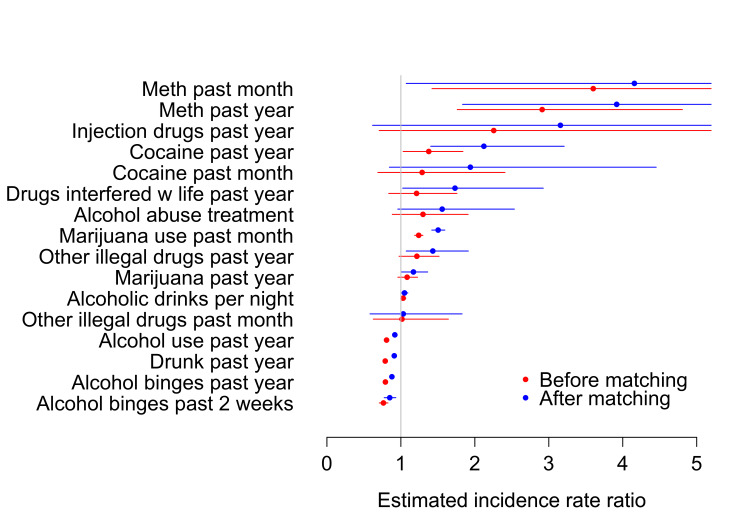
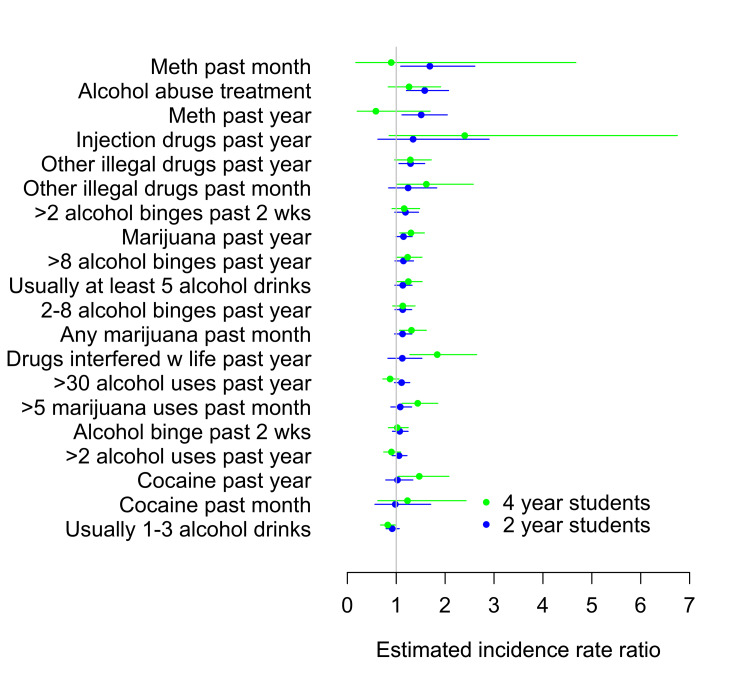
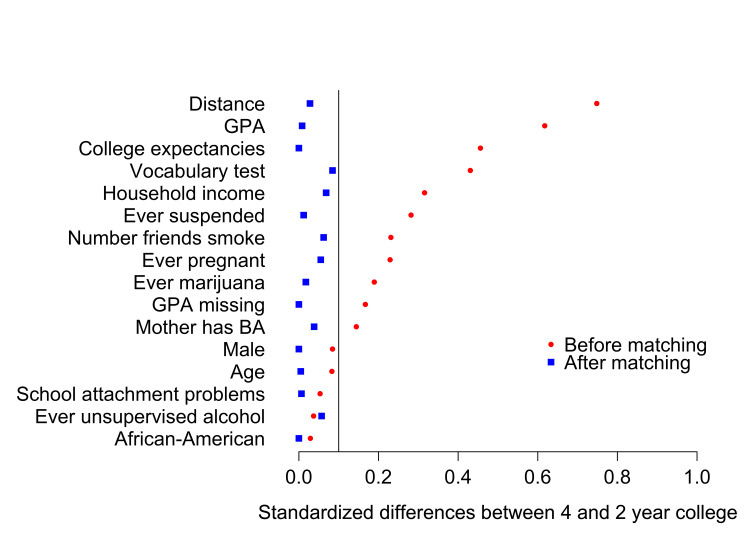
Young adults from disadvantaged populations access higher education through two-year colleges, but substance use research among young adults focuses on four-year colleges. Filling this research gap is important given recent policy changes that have increased marijuana availability for young adults. This study uses a subsample of college-enrolled participants from the National Longitudinal Study of Adolescent to Adult Health (Add Health) to evaluate whether substance use predicts educational attainment seven years later, comparing 888 students attending a two-year college with 1,398 matched students attending a four-year college. Matched students were identified using a propensity score method so that students were comparable on 15 measures, including precollege grades, precollege test scores, and precollege substance use. Compared with similar four-year college students, two-year college students were more likely to use methamphetamines, cocaine, or marijuana; more likely to report problematic substance use; and less likely to use alcohol. Two-year college students who used methamphetamines in the past year (incidence rate ratio (IRR) = 1.51, 95% CI (1.12, 2.04), p = 0.007) or past month (IRR = 1.69, 95% CI (1.09, 2.61), p = 0.02) or completed alcohol abuse treatment (IRR = 1.58, 95% CI (1.21, 2.07), p < 0.001) were less likely to complete college than two-year college students without those risk factors. Among the matched four-year college students, students who reported that drugs interfered with school or work in the past year (IRR = 1.84 (1.28, 2.64), p = 0.001), used cocaine in the past year (IRR = 1.47 (1.04, 2.08), p = 0.03), and used marijuana in the past year (IRR = 1.30 (1.07, 1.57), p = 0.007), past month (IRR = 1.31 (1.07, 1.61), p = 0.01), or ≥5 times in the past month (IRR = 1.44 (1.12, 1.85) p = 0.005) were less likely to complete college than the matched four-year college students without those risk factors. Substance use interventions should target both two-year and four-year college students. Two-year colleges that better accommodate students who complete substance use treatment may improve these students' completion. Students who use marijuana or cocaine or whose drug use impairs functioning may benefit from an incremental approach of completing a two-year degree prior to transferring to a four-year degree rather than enrolling directly in a four-year program.
来自弱势群体的年轻人通过两年制学院接受高等教育,但针对年轻人的物质使用研究主要集中在四年制学院。鉴于最近的政策变化增加了年轻人获取大麻的机会,填补这一研究空白很重要。本研究使用了来自全国青少年健康纵向研究(Add Health)中注册入学的参与者子样本,以评估物质使用是否能预测七年后的教育程度,将888名就读两年制学院的学生与1398名匹配的就读四年制学院的学生进行比较。使用倾向得分法确定匹配学生,以便学生在15项指标上具有可比性,包括大学前成绩、大学前考试成绩和大学前物质使用情况。与类似的四年制学院学生相比,两年制学院学生更有可能使用甲基苯丙胺、可卡因或大麻;更有可能报告有问题的物质使用;而使用酒精的可能性较小。过去一年使用过甲基苯丙胺(发病率比(IRR)=1.51,95%置信区间(1.12,2.04),p = 0.007)或过去一个月使用过(IRR = 1.69,95%置信区间(1.09,2.61),p = 0.02)或完成过酒精滥用治疗(IRR = 1.58,95%置信区间(1.21,2.07),p < 0.001)的两年制学院学生比没有这些风险因素的两年制学院学生完成大学学业的可能性更小。在匹配的四年制学院学生中,那些报告过去一年毒品干扰了学业或工作(IRR = 1.84(1.28,2.64),p = 0.001)、过去一年使用过可卡因(IRR = 1.47(1.04,2.08),p = 0.03)以及过去一年使用过大麻(IRR = 1.30(1.07,1.57),p = 0.007)、过去一个月使用过大麻(IRR = 1.31(1.07,1.61),p = 0.01)或过去一个月使用大麻≥5次(IRR = 1.44(1.12,1.85),p = 0.005)的学生比没有这些风险因素的匹配四年制学院学生完成大学学业的可能性更小。物质使用干预应针对两年制和四年制学院的学生。能更好地接纳完成物质使用治疗学生的两年制学院可能会提高这些学生的毕业率。使用大麻或可卡因或其毒品使用影响正常功能的学生可能会受益于一种渐进式方法,即在转入四年制学位之前先完成两年制学位,而不是直接进入四年制课程。