Blankenship Donald D, Moussessian Alina, Chapin Elaine, Young Duncan A, Wesley Patterson G, Plaut Jeffrey J, Freedman Adam P, Schroeder Dustin M, Grima Cyril, Steinbrügge Gregor, Soderlund Krista M, Ray Trina, Richter Thomas G, Jones-Wilson Laura, Wolfenbarger Natalie S, Scanlan Kirk M, Gerekos Christopher, Chan Kristian, Seker Ilgin, Haynes Mark S, Barr Mlinar Amy C, Bruzzone Lorenzo, Campbell Bruce A, Carter Lynn M, Elachi Charles, Gim Yonggyu, Hérique Alain, Hussmann Hauke, Kofman Wlodek, Kurth William S, Mastrogiuseppe Marco, McKinnon William B, Moore Jeffrey M, Nimmo Francis, Paty Carol, Plettemeier Dirk, Schmidt Britney E, Zolotov Mikhail Y, Schenk Paul M, Collins Simon, Figueroa Harry, Fischman Mark, Tardiff Eric, Berkun Andy, Paller Mimi, Hoffman James P, Kurum Andy, Sadowy Gregory A, Wheeler Kevin B, Decrossas Emmanuel, Hussein Yasser, Jin Curtis, Boldissar Frank, Chamberlain Neil, Hernandez Brenda, Maghsoudi Elham, Mihaly Jonathan, Worel Shana, Singh Vik, Pak Kyung, Tanabe Jordan, Johnson Robert, Ashtijou Mohammad, Alemu Tafesse, Burke Michael, Custodero Brian, Tope Michael C, Hawkins David, Aaron Kim, Delory Gregory T, Turin Paul S, Kirchner Donald L, Srinivasan Karthik, Xie Julie, Ortloff Brad, Tan Ian, Noh Tim, Clark Duane, Duong Vu, Joshi Shivani, Lee Jeng, Merida Elvis, Akbar Ruzbeh, Duan Xueyang, Fenni Ines, Sanchez-Barbetty Mauricio, Parashare Chaitali, Howard Duane C, Newman Julie, Cruz Marvin G, Barabas Neil J, Amirahmadi Ahmadreza, Palmer Brendon, Gawande Rohit S, Milroy Grace, Roberti Rick, Leader Frank E, West Richard D, Martin Jan, Venkatesh Vijay, Adumitroaie Virgil, Rains Christine, Quach Cuong, Turner Jordi E, O'Shea Colleen M, Kempf Scott D, Ng Gregory, Buhl Dillon P, Urban Timothy J
Institute for Geophysics, University of Texas at Austin, Austin, TX 78758 USA.
Jet Propulsion Laboratory, California Institute of Technology, Pasadena, CA 91109 USA.
Space Sci Rev. 2024;220(5):51. doi: 10.1007/s11214-024-01072-3. Epub 2024 Jun 27.
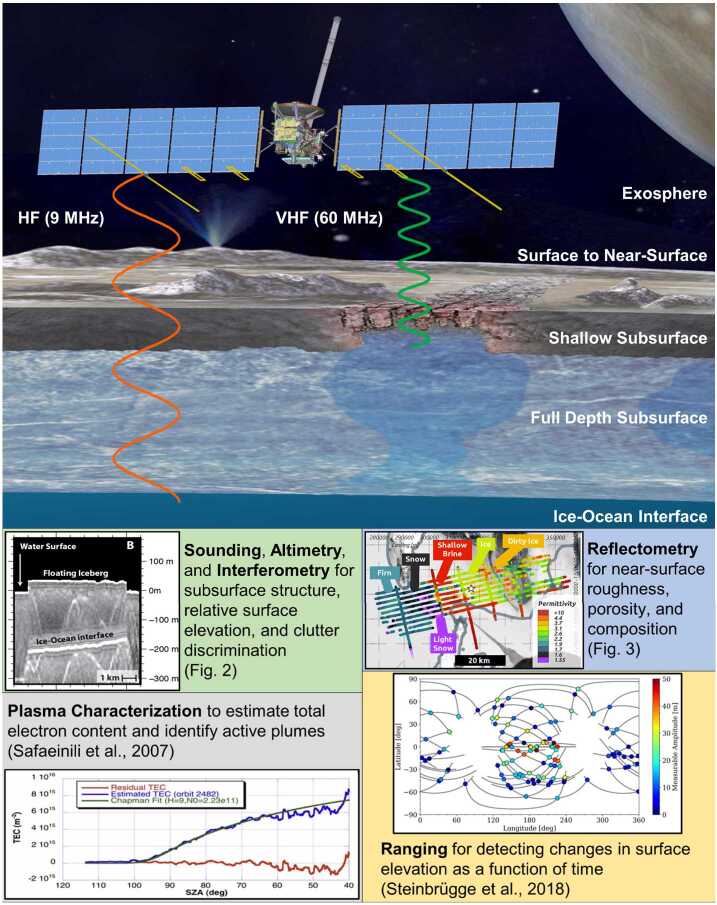
The Radar for Europa Assessment and Sounding: Ocean to Near-surface (REASON) is a dual-frequency ice-penetrating radar (9 and 60 MHz) onboard the Europa Clipper mission. REASON is designed to probe Europa from exosphere to subsurface ocean, contributing the third dimension to observations of this enigmatic world. The hypotheses REASON will test are that (1) the ice shell of Europa hosts liquid water, (2) the ice shell overlies an ocean and is subject to tidal flexing, and (3) the exosphere, near-surface, ice shell, and ocean participate in material exchange essential to the habitability of this moon. REASON will investigate processes governing this material exchange by characterizing the distribution of putative non-ice material (e.g., brines, salts) in the subsurface, searching for an ice-ocean interface, characterizing the ice shell's global structure, and constraining the amplitude of Europa's radial tidal deformations. REASON will accomplish these science objectives using a combination of radar measurement techniques including , , , , , and . Building on a rich heritage from Earth, the moon, and Mars, REASON will be the first ice-penetrating radar to explore the outer solar system. Because these radars are untested for the icy worlds in the outer solar system, a novel approach to measurement quality assessment was developed to represent uncertainties in key properties of Europa that affect REASON performance and ensure robustness across a range of plausible parameters suggested for the icy moon. REASON will shed light on a never-before-seen dimension of Europa and - in concert with other instruments on Europa Clipper - help to investigate whether Europa is a habitable world.
从海洋到近地表(REASON)是木卫二快船任务搭载的双频穿冰雷达(9兆赫和60兆赫)。REASON旨在从外层大气到地下海洋对木卫二进行探测,为这个神秘世界的观测增添第三个维度。REASON将检验的假说是:(1)木卫二的冰壳含有液态水;(2)冰壳覆盖着海洋并受到潮汐挠曲作用;(3)外层大气、近地表、冰壳和海洋参与了对这颗卫星宜居性至关重要的物质交换。REASON将通过描绘地下假定的非冰物质(如盐水、盐)的分布、寻找冰 - 海洋界面、描绘冰壳的全球结构以及限制木卫二径向潮汐变形的幅度,来研究控制这种物质交换的过程。REASON将使用包括 、 、 、 、 和 在内的多种雷达测量技术组合来实现这些科学目标。基于来自地球、月球和火星的丰富遗产,REASON将成为首个探测外太阳系的穿冰雷达。由于这些雷达尚未在外太阳系的冰质世界中进行过测试,因此开发了一种新的测量质量评估方法,以表示影响REASON性能的木卫二关键特性的不确定性,并确保在为这颗冰卫星建议的一系列合理参数范围内的稳健性。REASON将揭示木卫二一个前所未见的维度,并与木卫二快船号上的其他仪器协同工作,帮助研究木卫二是否是一个宜居世界。