
空气质量改善与青少年时期哮喘发病率:基于人群的前瞻性队列研究。
Improved Air Quality and Asthma Incidence from School Age to Young Adulthood: A Population-based Prospective Cohort Study.
机构信息
Institute of Environmental Medicine and.
Department of Clinical Science and Education, Södersjukhuset, Karolinska Institutet, Stockholm, Sweden.
出版信息
Ann Am Thorac Soc. 2024 Oct;21(10):1432-1440. doi: 10.1513/AnnalsATS.202402-200OC.
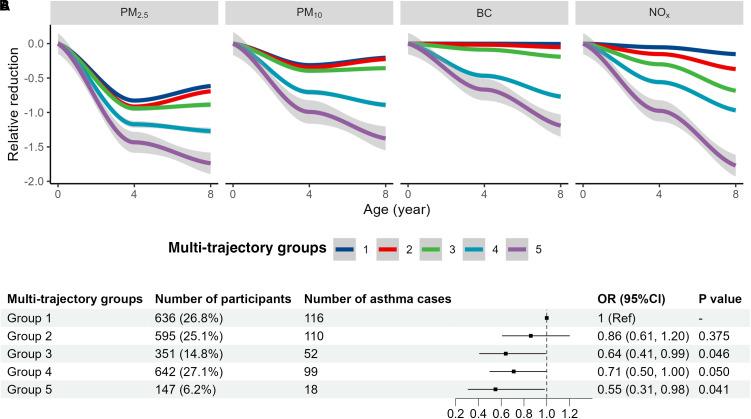
The benefits of improved air quality on asthma remain understudied. Our aim was to investigate associations of changes in ambient air pollution with incident asthma from school age until young adulthood in an area with mostly low air pollution levels. Participants in the BAMSE (Swedish abbreviation for Children, Allergy, Environment, Stockholm, Epidemiology) birth cohort from Stockholm without asthma before the 8-year follow-up were included ( = 2,371). We estimated the association of change in individual-level air pollutant exposure (particulate matter with an aerodynamic diameter ≤ 2.5 μm [PM] and ≤ 10 μm [PM], black carbon [BC], and nitrogen oxides [NO]) from the first year of life to the 8-year follow-up with asthma incidence from the 8-year until the 24-year follow-up. Multipollutant trajectories were identified using the group-based multivariate trajectory model. We also used parametric G-computation to quantify the asthma incidence under different hypothetical interventions regarding air pollution levels. Air pollution levels at residency decreased during the period, with median reductions of 5.6% for PM, 3.1% for PM, 5.9% for BC, and 26.8% for NO. A total of 395 incident asthma cases were identified from the 8-year until the 24-year follow-up. The odds ratio for asthma was 0.89 (95% confidence interval [CI], 0.80-0.99) for each interquartile range reduction in PM (equal to 8.1% reduction). Associations appeared less clear for PM, BC, and NO. Five multipollutant trajectories were identified; the largest reduction trajectory displayed the lowest odds of asthma (odds ratio, 0.55; 95% CI, 0.31-0.98) compared with the lowest reduction trajectory. If the PM exposure had not declined up to the 8-year follow-up, the hypothetical asthma incidence was estimated to have been 10.9% higher (95% CI, 0.8-20.8%). A decrease in PM levels during childhood was associated with a lower risk of incident asthma from school age to young adulthood in an area with relatively low air pollution levels, suggesting broad respiratory health benefits from improved air quality.
改善空气质量对哮喘的益处仍研究不足。我们的目的是在一个空气污染水平主要较低的地区,研究从学龄期到成年早期的环境空气污染变化与哮喘发病的关系。我们纳入了来自斯德哥尔摩的 BAMSE(瑞典语为儿童、过敏、环境、斯德哥尔摩、流行病学)出生队列的、在 8 年随访前无哮喘的参与者( = 2371)。我们估计从生命第一年到 8 年随访期间的个体水平空气污染物暴露(空气动力学直径≤2.5 μm [PM] 和≤10 μm [PM] 的颗粒物、黑碳 [BC] 和氮氧化物 [NO])变化与 8 年随访到 24 年随访期间哮喘发病的关系。使用基于群组的多变量轨迹模型确定多污染物轨迹。我们还使用参数 G 计算来量化不同空气污染水平假设干预下的哮喘发病率。在此期间,居住地的空气污染水平下降,PM 中位数降低 5.6%,PM 中位数降低 3.1%,BC 中位数降低 5.9%,NO 中位数降低 26.8%。从 8 年随访到 24 年随访期间共确定了 395 例哮喘发病病例。PM 每降低一个四分位距,哮喘的比值比为 0.89(95%置信区间 [CI],0.80-0.99)(相当于 8.1%的降低)。对于 PM、BC 和 NO,关联似乎不太明显。确定了 5 种多污染物轨迹;与最低降低轨迹相比,最大降低轨迹显示哮喘的可能性最低(比值比,0.55;95%CI,0.31-0.98)。如果 PM 暴露在 8 年随访前没有下降,估计假设的哮喘发病率将高出 10.9%(95%CI,0.8-20.8%)。在空气污染水平相对较低的地区,儿童时期 PM 水平的下降与学龄期到成年早期哮喘发病风险的降低有关,这表明空气质量的改善带来了广泛的呼吸健康益处。

 Zotero 插件