Yu Zhebin, Kress Sara, Blay Natalia, Gregor Petr, Kukk Hanna-Maria, Leskien Miriam, Majewska Renata, Oosterwegel Max J, Szabó Daniel, Ten Have Margreet, Klánová Jana, Mikeš Ondřej, Bergström Anna, Bussalleu Alonso, de Cid Rafael, Dalecka Andrea, Dadvand Payam, van Dorsselaer Saskia, Fischer Krista, de Hoogh Kees, Koppelman Gerard H, Kronberg Jaanika, Lakerveld Jeroen, Ljungman Petter, Merid Simon Kebede, Macek Pawel, Manczuk Marta, Merritt Anne-Sophie, Pac Agnieszka, Palta Priit, Pershagen Göran, Peters Annette, Pikhart Hynek, Saucy Apolline, Schikowski Tamara, Shen Youchen, Standl Marie, Tonne Cathryn, Vermeulen Roel, Vlaanderen Jelle, Vonk Judith M, Wolf Kathrin, Ek Carl Henrik, Gruzieva Olena, Gehring Ulrike, Melén Erik
Institute of Environmental Medicine, Karolinska Institutet, Stockholm, Sweden.
IUF - Leibniz Research Institute for Environmental Medicine, Düsseldorf, Germany.
Lancet Reg Health Eur. 2025 May 15;54:101314. doi: 10.1016/j.lanepe.2025.101314. eCollection 2025 Jul.
The joint impact of exposure to multiple urban environmental factors on asthma remains unclear.
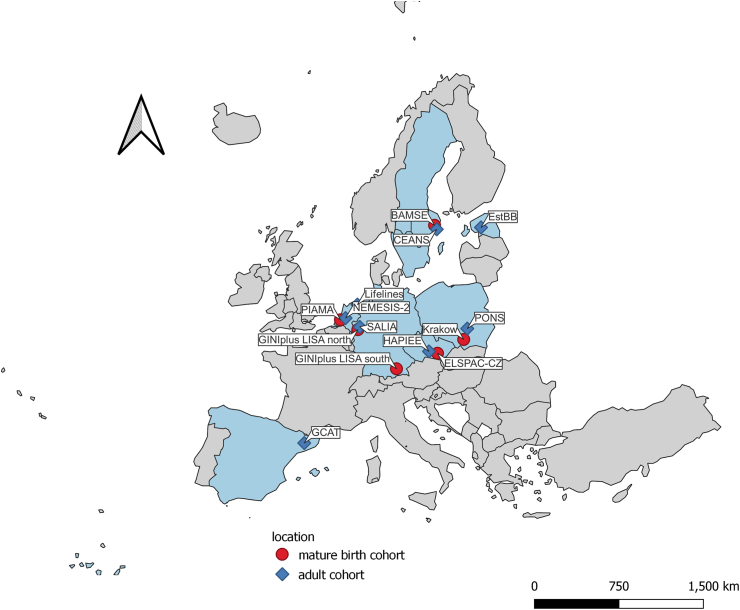
We analysed data from 14 European cohorts to assess the impact of the urban exposome on asthma incidence across the life course. We linked three external exposome domains (air pollution, built environment, ambient temperature) to the participants' home addresses at baseline. We performed k-means clustering within each domain and assessed associations of clusters with asthma adjusting for potentially relevant covariates in cohort-specific analyses, with subsequent separate meta-analyses for birth and adult cohorts. An environmental risk score using a coefficient-weighted sum approach was used to assess the impact of combining the three domains.
A total of 7428 incident asthma cases were identified among 349,037 participants (from birth up to age 70+). Overall, we observed higher risks of asthma for clusters characterized by high particulate matter and nitrogen dioxide exposure in adults (OR = 1.13, 95%CI:1.01-1.25), and clusters characterized by high built-up area and low levels of greenness in both children and adults (OR = 1.36, 95%CI: 1.14-1.64 for birth cohorts and OR = 1.15, 95%CI: 1.03-1.28 for adult cohorts, respectively). The joint exposure using the environment risk score combining the three domains was consistently associated with higher risks of incident asthma (OR = 1.13, 95%CI: 1.07-1.20 for birth cohorts, OR = 1.15, 95%CI: 1.10-1.20 for adult cohorts per 20% increase). On average 11.6% of the incident asthma cases could be attributed to environmental risk score above cohort-specific median levels.
Multiple environmental exposures jointly contribute to incident asthma risk across the life course. Urban planning accounting for these factors may help mitigate asthma development.
This study was funded by the European Union's Horizon 2020 research and innovation program under agreement No 874627 (EXPANSE).
暴露于多种城市环境因素对哮喘的联合影响仍不明确。
我们分析了来自14个欧洲队列的数据,以评估城市暴露组在整个生命过程中对哮喘发病率的影响。我们在基线时将三个外部暴露组领域(空气污染、建筑环境、环境温度)与参与者的家庭住址相关联。我们在每个领域内进行k均值聚类,并在特定队列分析中调整潜在相关协变量后评估聚类与哮喘的关联,随后对出生队列和成人队列进行单独的荟萃分析。使用系数加权和方法的环境风险评分用于评估三个领域组合的影响。
在349,037名参与者(从出生到70岁以上)中,共确定了7428例哮喘发病病例。总体而言,我们观察到,在成人中,以高颗粒物和二氧化氮暴露为特征的聚类哮喘风险较高(OR = 1.13,95%CI:1.01 - 1.25),在儿童和成人中,以高建筑面积和低绿化水平为特征的聚类哮喘风险较高(出生队列中OR = 1.36,95%CI:1.14 - 1.64;成人队列中OR = 1.15,95%CI:1.03 - 1.28)。使用结合三个领域的环境风险评分的联合暴露与哮喘发病风险较高始终相关(出生队列中每增加20%,OR = 1.13,95%CI:1.07 - 1.20;成人队列中OR = 1.15,95%CI:1.10 - 1.20)。平均而言,11.6% 的哮喘发病病例可归因于高于特定队列中位数水平的环境风险评分。
多种环境暴露在整个生命过程中共同导致哮喘发病风险。考虑这些因素的城市规划可能有助于减轻哮喘的发展。
本研究由欧盟“地平线2020”研究与创新计划资助,协议编号874627(EXPANSE)。