University of Southampton, Southampton, UK.
University Hospital Southampton NHS Foundation Trust, Southampton, UK.
Ann Biomed Eng. 2024 Nov;52(11):2975-2986. doi: 10.1007/s10439-024-03560-7. Epub 2024 Jul 3.
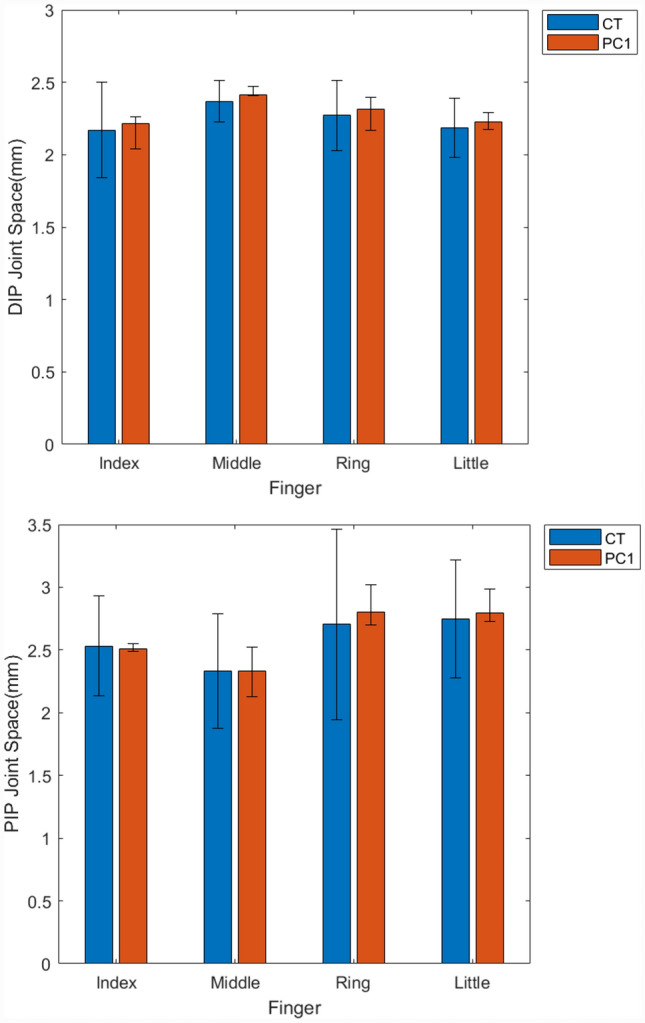
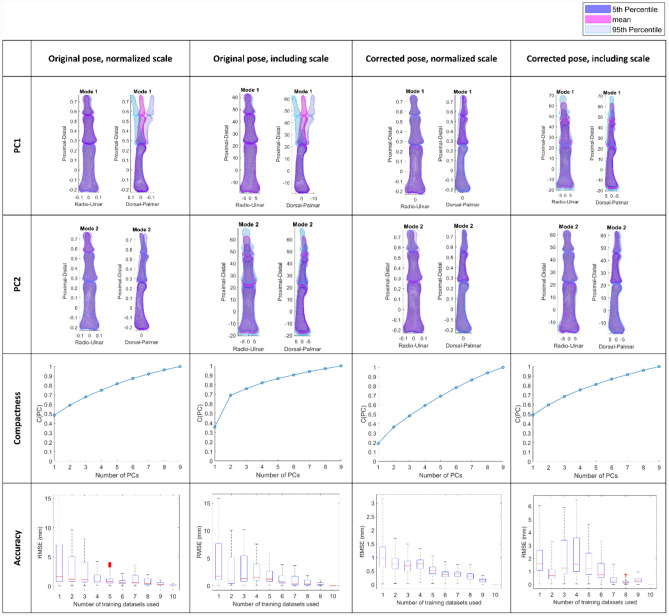
This paper presents statistical shape models of the four fingers of the hand, with an emphasis on anatomic analysis of the proximal and distal interphalangeal joints. A multi-body statistical shape modelling pipeline was implemented on an exemplar training dataset of computed tomography (CT) scans of 10 right hands (5F:5M, 27-37 years, free from disease or injury) imaged at 0.3 mm resolution, segmented, meshed and aligned. Model generated included pose neutralisation to remove joint angle variation during imaging. Repositioning was successful; no joint flexion variation was observed in the resulting model. The first principal component (PC) of morphological variation represented phalanx size in all fingers. Subsequent PCs showed variation in position along the palmar-dorsal axis, and bone breadth: length ratio. Finally, the models were interrogated to provide gross measures of bone lengths and joint spaces. These models have been published for open use to support wider community efforts in hand biomechanical analysis, providing bony anatomy descriptions whilst preserving the security of the underlying imaging data and privacy of the participants. The model describes a small, homogeneous population, and assumptions cannot be made about how it represents individuals outside the training dataset. However, it supplements anthropometric datasets with additional shape information, and may be useful for investigating factors such as joint morphology and design of hand-interfacing devices and products. The model has been shared as an open-source repository ( https://github.com/abel-research/OpenHands ), and we encourage the community to use and contribute to it.
本文提出了手部四个手指的统计形状模型,重点是对近侧和远侧指间关节进行解剖分析。在一个由 10 个右手(5 男 5 女,27-37 岁,无疾病或损伤)的 CT 扫描示例训练数据集上实现了多体统计形状建模管道,这些扫描以 0.3mm 的分辨率进行成像、分割、网格化和对齐。生成的模型包括姿势归一化,以消除成像过程中关节角度的变化。重新定位是成功的;在生成的模型中没有观察到任何关节弯曲变化。形态变化的第一主成分(PC)代表所有手指的指骨大小。随后的 PC 显示沿掌背轴和骨宽:长比的位置变化。最后,对模型进行了查询,以提供骨骼长度和关节间隙的大体测量值。这些模型已公开发布供开放使用,以支持手部生物力学分析的更广泛的社区努力,提供骨骼解剖描述,同时保护基础成像数据的安全性和参与者的隐私。该模型描述了一个小而同质的人群,不能假设它如何代表训练数据集之外的个体。然而,它用额外的形状信息补充了人体测量数据集,并且可能有助于研究关节形态和手界面设备和产品的设计等因素。该模型已作为开源存储库(https://github.com/abel-research/OpenHands)共享,并鼓励社区使用和贡献。