Basso Marcos Fernando, Girardin Giacomo, Vergata Chiara, Buti Matteo, Martinelli Federico
Department of Biology, University of Florence, Florence, Italy.
Department of Agriculture, Food, Environment and Forestry (DAGRI), University of Florence, Florence, Italy.
Front Plant Sci. 2024 Jun 19;15:1384237. doi: 10.3389/fpls.2024.1384237. eCollection 2024.
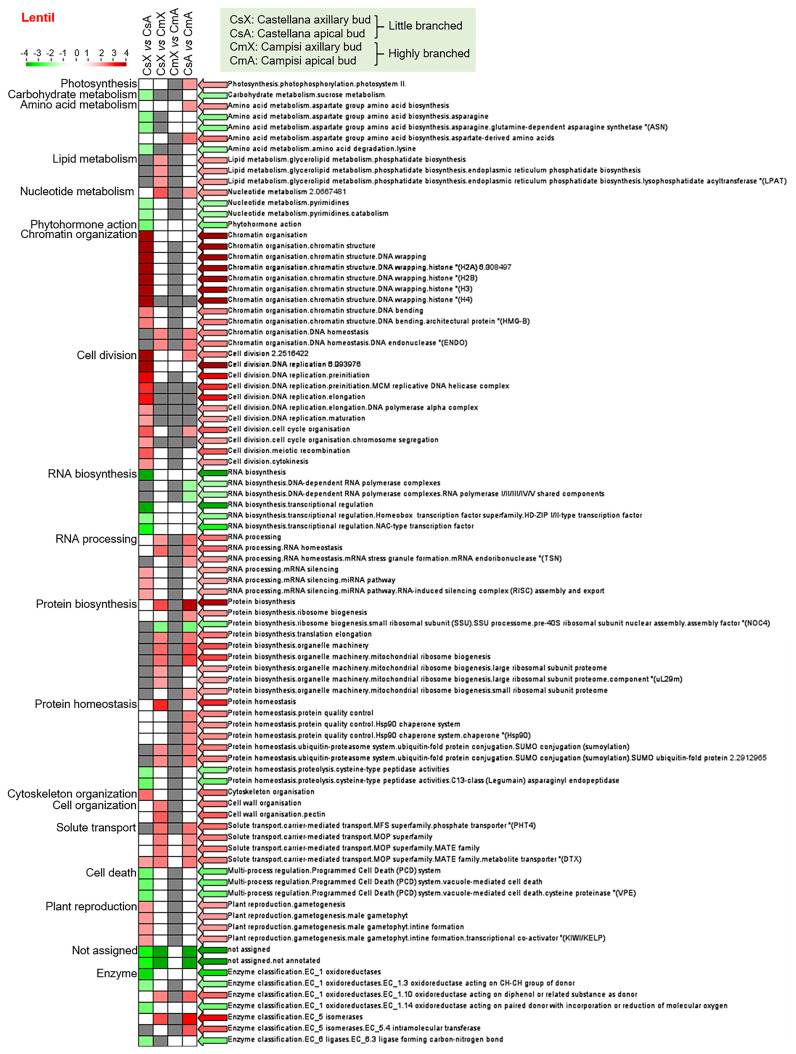
The search for elite cultivars with better architecture has been a demand by farmers of the chickpea and lentil crops, which aims to systematize their mechanized planting and harvesting on a large scale. Therefore, the identification of genes associated with the regulation of the branching and architecture of these plants has currently gained great importance. Herein, this work aimed to gain insight into transcriptomic changes of two contrasting chickpea and lentil cultivars in terms of branching pattern (little highly branched cultivars). In addition, we aimed to identify candidate genes involved in the regulation of shoot branching that could be used as future targets for molecular breeding. The axillary and apical buds of chickpea cultivars Blanco lechoso and FLIP07-318C, and lentil cultivars Castellana and Campisi, considered as little and highly branched, respectively, were harvested. A total of 1,624 and 2,512 transcripts were identified as differentially expressed among different tissues and contrasting cultivars of chickpea and lentil, respectively. Several gene categories were significantly modulated such as cell cycle, DNA transcription, energy metabolism, hormonal biosynthesis and signaling, proteolysis, and vegetative development between apical and axillary tissues and contrasting cultivars of chickpea and lentil. Based on differential expression and branching-associated biological function, ten chickpea genes and seven lentil genes were considered the main players involved in differentially regulating the plant branching between contrasting cultivars. These collective data putatively revealed the general mechanism and high-effect genes associated with the regulation of branching in chickpea and lentil, which are potential targets for manipulation through genome editing and transgenesis aiming to improve plant architecture.
寻找具有更优株型的优良品种一直是鹰嘴豆和小扁豆作物种植者的需求,其目的是实现大规模机械化种植和收获的系统化。因此,目前鉴定与这些植物分枝和株型调控相关的基因变得极为重要。在此,本研究旨在深入了解两种在分枝模式上形成对比的鹰嘴豆和小扁豆品种(分枝少的品种与分枝多的品种)的转录组变化。此外,我们旨在鉴定参与调控茎分枝的候选基因,这些基因可作为未来分子育种的目标。分别收获了被认为分枝少和分枝多的鹰嘴豆品种 Blanco lechoso 和 FLIP07 - 318C,以及小扁豆品种 Castellana 和 Campisi 的腋芽和顶芽。在鹰嘴豆和小扁豆的不同组织及对比品种中,分别鉴定出 1624 个和 2512 个转录本差异表达。鹰嘴豆和小扁豆的顶芽与腋芽组织及对比品种之间,细胞周期、DNA 转录、能量代谢、激素生物合成与信号传导、蛋白水解以及营养生长发育等几个基因类别受到显著调控。基于差异表达和与分枝相关的生物学功能,十个鹰嘴豆基因和七个小扁豆基因被认为是在对比品种间差异调控植物分枝的主要参与者。这些汇总数据推测揭示了与鹰嘴豆和小扁豆分枝调控相关的一般机制和高效基因,它们是通过基因组编辑和转基因进行操作以改善植株株型的潜在靶点。