Departments of1Neurological Surgery.
2University of Missouri School of Medicine, Columbia, Missouri.
J Neurosurg Pediatr. 2024 Jul 5;34(4):347-356. doi: 10.3171/2024.3.PEDS22376. Print 2024 Oct 1.
The objective of this study was to evaluate whether volumetric measurements on early cranial ultrasound (CUS) in high-grade germinal matrix hemorrhage-intraventricular hemorrhage (GMH-IVH) are associated with hydrocephalus and neurodevelopmental metrics.
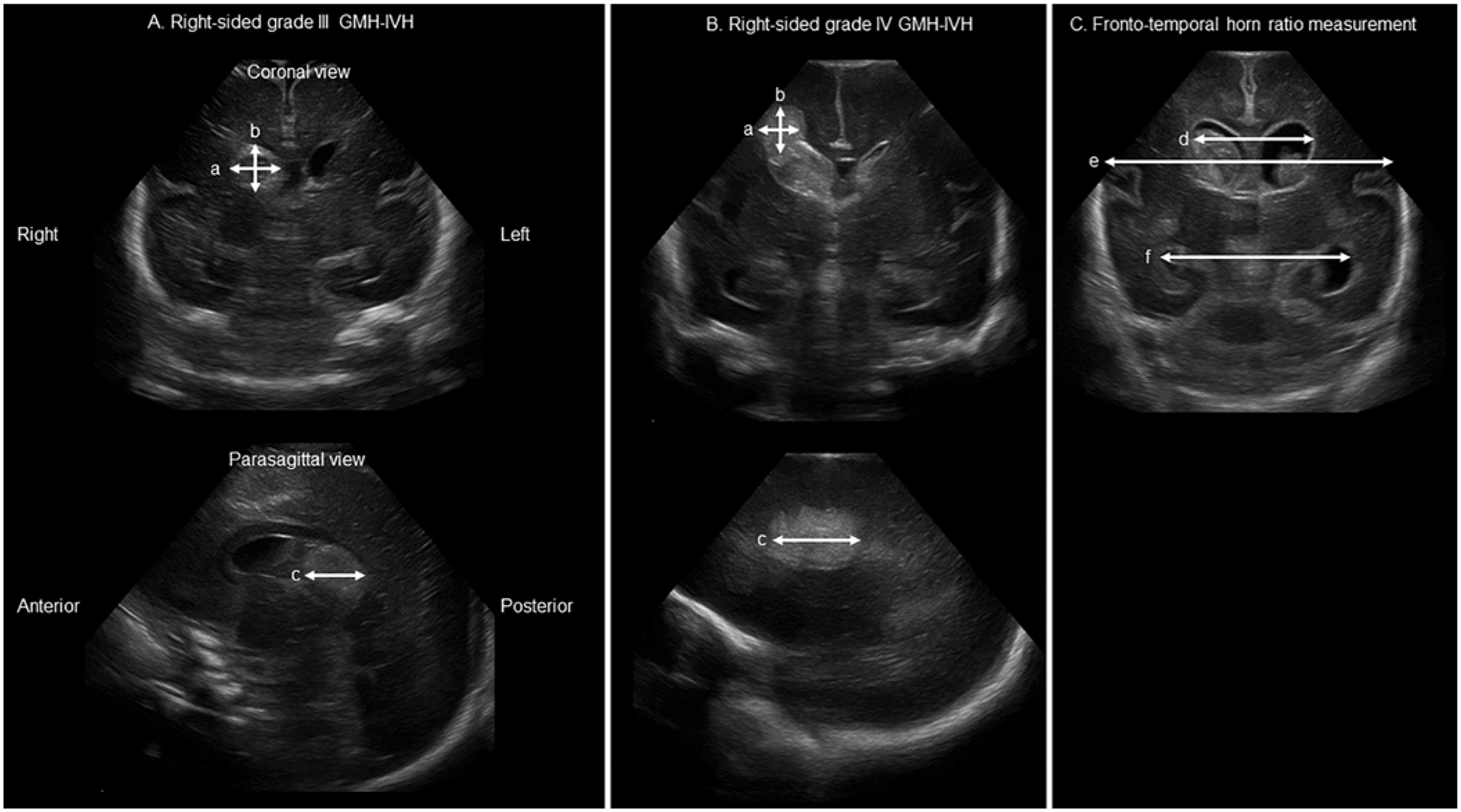
A retrospective case series analysis of infants with high-grade GMH-IVH admitted to the St. Louis Children's Hospital neonatal intensive care unit between 2007 and 2015 who underwent neurodevelopmental testing using the Bayley Scales of Infant and Toddler Development, 3rd Edition (Bayley-III) at 2 years of corrected age was performed. GMH volume, periventricular hemorrhagic infarction volume, and frontotemporal horn ratio were obtained from direct review of neonatal CUS studies. Univariate and multivariable regression models were used to evaluate the association between hemorrhage volumes and hydrocephalus requiring permanent CSF diversion with ventricular shunt or endoscopic third ventriculostomy with or without choroid plexus cauterization and composite Bayley-III cognitive, language, and motor scores.
Forty-three infants (29 males, mean gestational age 25 weeks) met the inclusion criteria. The mean age at time of the CUS with the largest hemorrhage volume or first diagnosis of highest grade was 6.2 days. Nineteen patients underwent treatment for hydrocephalus with permanent CSF diversion. In multivariable analyses, larger GMH volume was associated with worse estimated Bayley-III cognitive (left-sided GMH volume: p = 0.048, total GMH volume: p = 0.023) and motor (left-sided GMH volume: p = 0.010; total GMH volume: p = 0.014) scores. Larger periventricular hemorrhagic infarction volume was associated with worse estimated Bayley-III motor scores (each side p < 0.04). Larger left-sided (OR 2.55, 95% CI 1.10-5.88; p = 0.028) and total (OR 1.35, 95% CI 1.01-1.79; p = 0.041) GMH volumes correlated with hydrocephalus. There was no relationship between early ventricular volume and hydrocephalus or neurodevelopmental outcomes.
Location-specific hemorrhage volume on early CUS may be prognostic for neurodevelopmental and hydrocephalus outcomes in high-grade GMH-IVH.
本研究旨在评估在高级脑室内出血(GMH-IVH)中,早期头颅超声(CUS)的容积测量是否与脑积水和神经发育指标相关。
对 2007 年至 2015 年间在圣路易斯儿童医院新生儿重症监护病房住院的患有高级 GMH-IVH 的婴儿进行了回顾性病例系列分析,这些婴儿在 2 年校正年龄时使用贝利婴幼儿发展量表第三版(Bayley-III)进行了神经发育测试。通过直接查阅新生儿 CUS 研究获得 GMH 体积、脑室内出血性梗死体积和额颞角比值。使用单变量和多变量回归模型评估出血体积与需要永久性脑脊液分流的脑积水之间的关系,永久性脑脊液分流采用脑室分流或内镜第三脑室造口术,伴或不伴脉络丛烧灼术,并与复合 Bayley-III 认知、语言和运动评分相关。
43 名婴儿(29 名男性,平均胎龄 25 周)符合纳入标准。最大出血量或首次诊断为最高级别时的 CUS 平均年龄为 6.2 天。19 名患者接受了永久性脑脊液分流治疗脑积水。多变量分析中,GMH 体积越大,Bayley-III 认知(左侧 GMH 体积:p=0.048,总 GMH 体积:p=0.023)和运动评分(左侧 GMH 体积:p=0.010;总 GMH 体积:p=0.014)越差。较大的脑室内出血性梗死体积与较差的 Bayley-III 运动评分相关(每侧 p<0.04)。较大的左侧(OR 2.55,95%CI 1.10-5.88;p=0.028)和总(OR 1.35,95%CI 1.01-1.79;p=0.041)GMH 体积与脑积水相关。早期脑室容积与脑积水或神经发育结局之间无相关性。
早期 CUS 上的特定部位出血量可能与高级 GMH-IVH 的神经发育和脑积水结局相关。