Department of Psychology, Rikkyo University, 1-2-26 Kitano, Niiza City, Saitama, 352-8558, Japan.
International Research Center for Neurointelligence, University of Tokyo, Tokyo, Japan.
Sci Rep. 2024 Jul 5;14(1):15473. doi: 10.1038/s41598-024-66316-2.
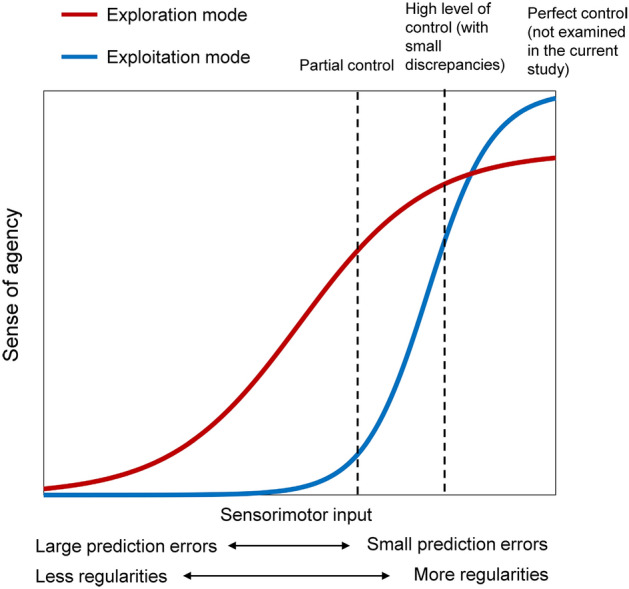
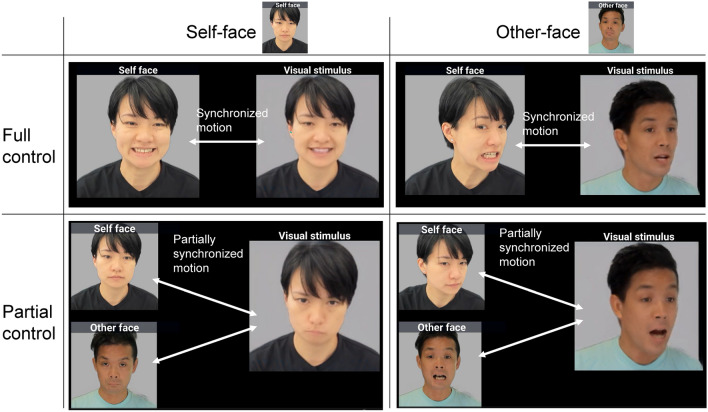
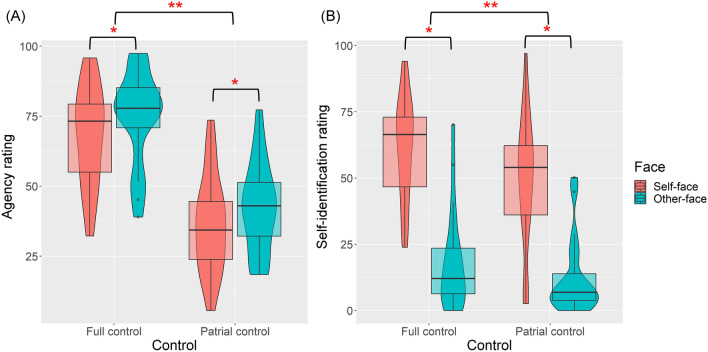
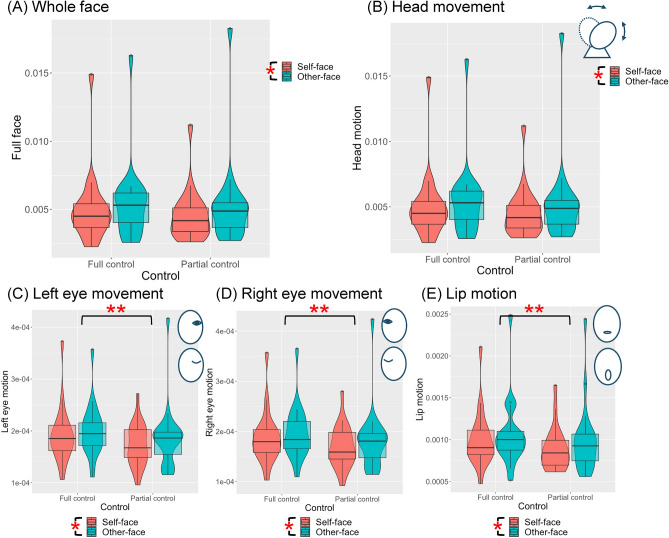
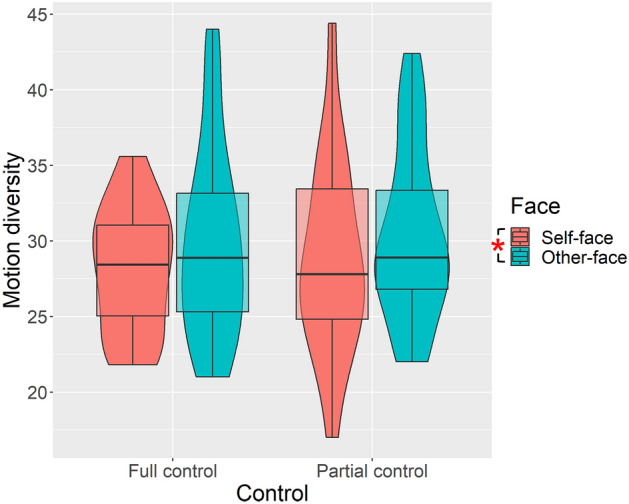
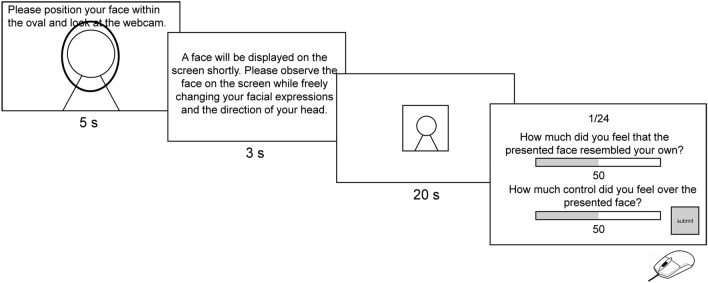
The face serves as a crucial cue for self-identification, while the sense of agency plays a significant role in determining our influence through actions in the environment. The current study investigates how self-identification through facial recognition may influence the perception of control via motion. We propose that self-identification might engender a belief in having control over one's own face, leading to a more acute detection and greater emphasis on discrepancies between their actions and the sensory feedback in control judgments. We refer to the condition governed by the belief in having control as the exploitation mode. Conversely, when manipulating another individual's face, the belief in personal control is absent. In such cases, individuals are likely to rely on the regularity between actions and sensory input for control judgments, exhibiting behaviors that are exploratory in nature to glean such information. This condition is termed the explorative mode. The study utilized a face-motion mixing paradigm, employing a deep generative model to enable participants to interact with either their own or another person's face through facial and head movements. During the experiment, participants observed either their own face or someone else's face (self-face vs. other-face) on the screen. The motion of the face was driven either purely by their own facial and head motion or by an average of the participant's and the experimenter's motion (full control vs. partial control). The results showed that participants reported a higher sense of agency over the other-face than the self-face, while their self-identification rating was significantly higher for the self-face. More importantly, controlling someone else's face resulted in more movement diversity than controlling one's own face. These findings support our exploration-exploitation theory: When participants had a strong belief in control triggered by the self-face, they became highly sensitive to any sensorimotor prediction errors, leading to a lower sense of agency. In contrast, when the belief of control was absent, the exploration mode triggered more explorative behaviors, allowing participants to efficiently gather information to establish a sense of agency.
面部是自我识别的关键线索,而主体感在确定我们通过环境中的行动所产生的影响方面起着重要作用。本研究探讨了通过面部识别进行自我识别如何影响对运动的控制感知。我们提出,自我识别可能会产生对自己面部的控制感,从而更敏锐地察觉并更加强调自己的动作与控制判断中的感官反馈之间的差异。我们将受控制感信念支配的情况称为利用模式。相反,当操纵另一个人的面部时,个人控制的信念就不存在了。在这种情况下,个体可能会依赖于动作和感官输入之间的规律性来进行控制判断,表现出探索性的行为来获取这种信息。这种情况称为探索模式。该研究使用了面部-运动混合范式,利用深度生成模型使参与者能够通过面部和头部运动与自己或他人的面部进行互动。在实验过程中,参与者在屏幕上观察到自己的脸或别人的脸(自我脸与他人脸)。面部运动要么完全由参与者自己的面部和头部运动驱动,要么由参与者和实验者的运动平均驱动(完全控制与部分控制)。结果表明,与自我脸相比,参与者报告对他人脸的主体感更高,而自我脸的自我识别评分明显更高。更重要的是,控制他人的脸比控制自己的脸导致更多的运动多样性。这些发现支持了我们的探索-利用理论:当参与者对面部自我识别产生强烈的控制信念时,他们对任何感觉运动预测误差变得高度敏感,从而导致主体感降低。相比之下,当控制感信念不存在时,探索模式会触发更多的探索性行为,使参与者能够有效地收集信息以建立主体感。