Department of Cardiovascular Surgery, First Affiliated Hospital of Gannan Medical University, No. 23, Qingnian Road, Zhanggong District, Ganzhou City, 341000, Jiangxi Province, China.
Heart Medical Centre, First Affiliated Hospital of Gannan Medical University, Ganzhou City, 341000, Jiangxi Province, China.
Sci Rep. 2024 Jul 6;14(1):15564. doi: 10.1038/s41598-024-66482-3.
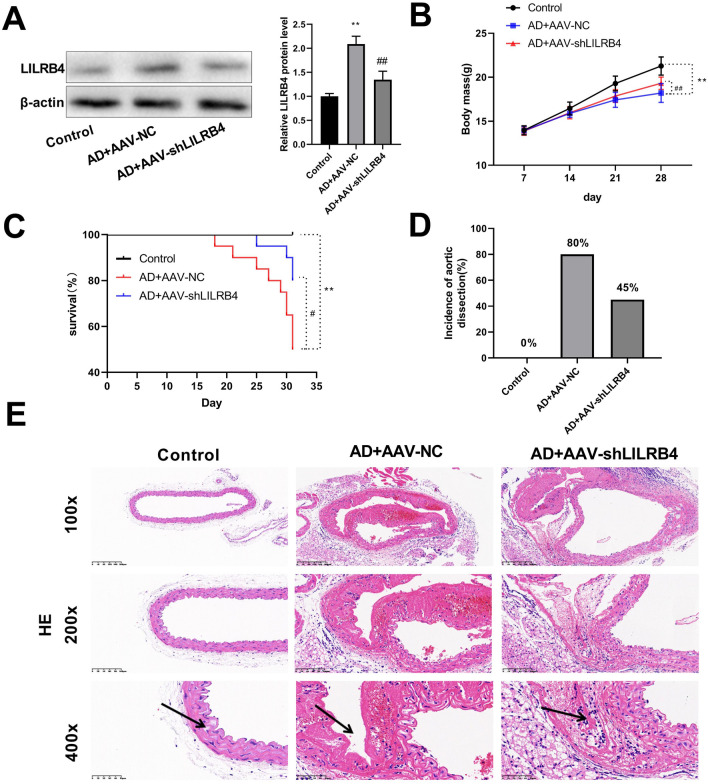
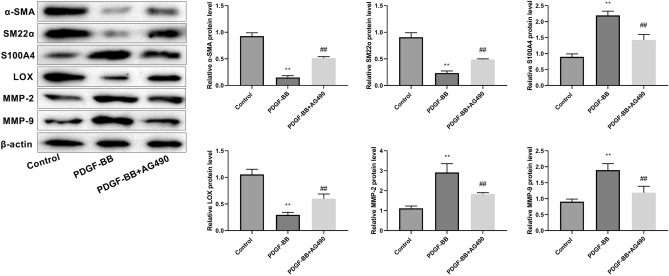
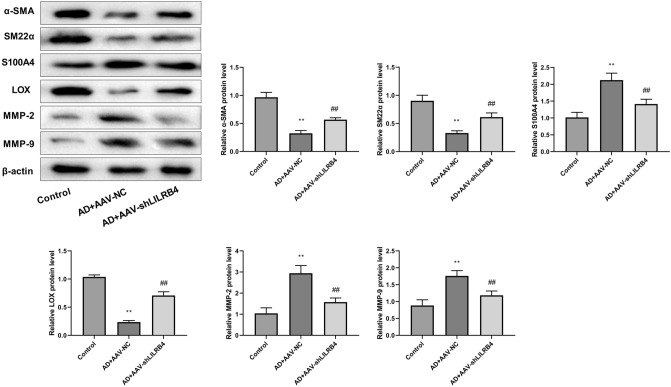
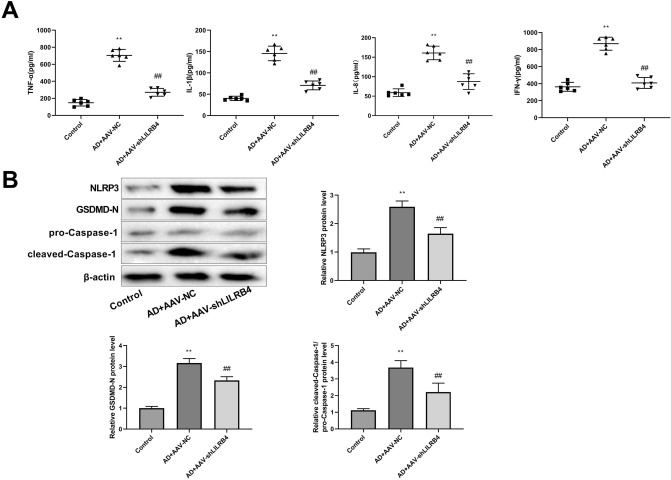
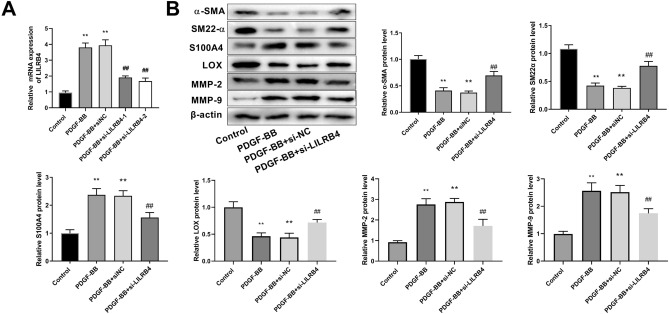
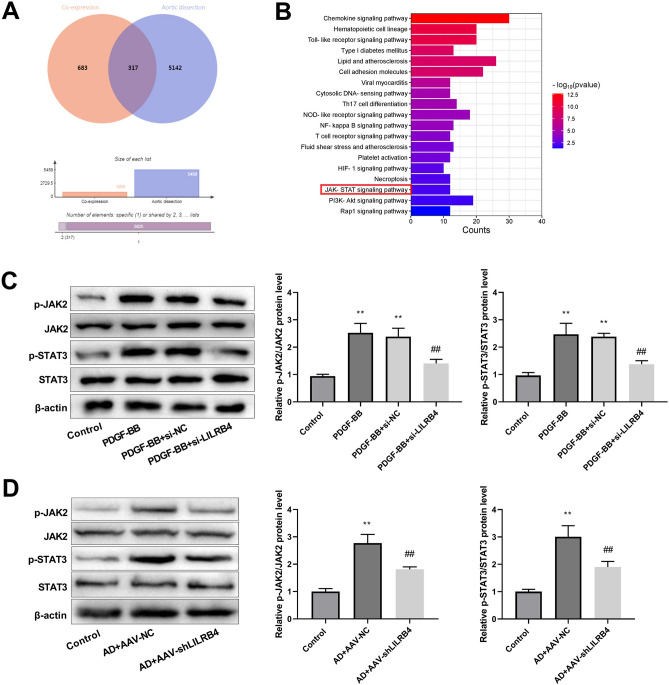
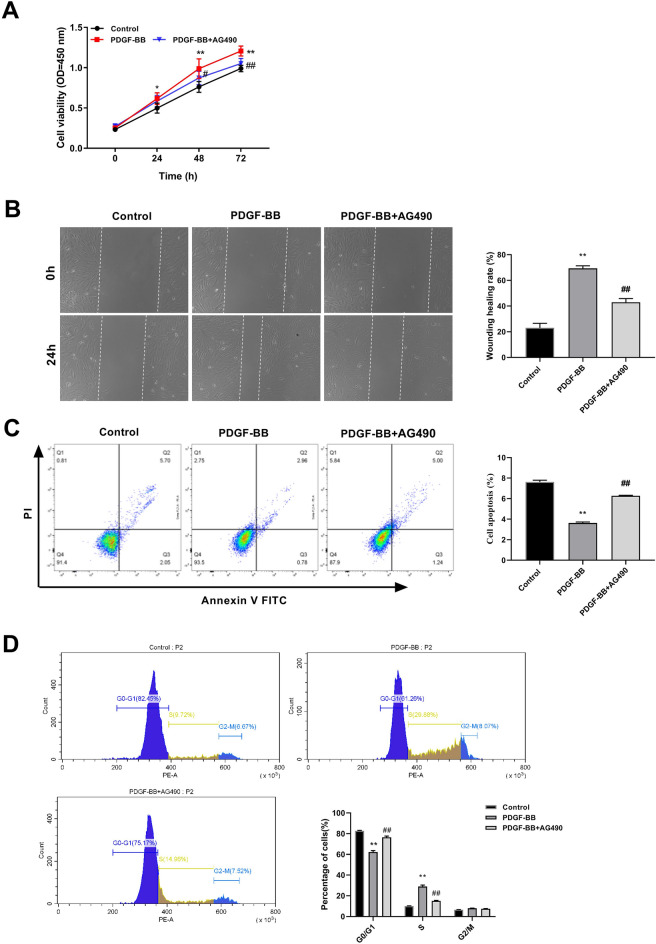
Aortic dissection (AD) is a life-threatening condition with a high mortality rate and without effective pharmacological therapies. Our previous study illustrated that leukocyte immunoglobulin-like receptor B4 (LILRB4) knockdown promoted the contractile phenotypic switch and apoptosis of AD cells. This study aimed to further investigate the role of LILRB4 in animal models of AD and elucidate its underlying molecular mechanisms. Animal models of AD were established using 0.1% beta-aminopropionitrile and angiotensin II and an in vitro model was developed using platelet-derived growth factor BB (PDGF-BB). The effects of LILRB4 knockdown on histopathological changes, pyroptosis, phenotype transition, extracellular matrix (ECM), and Janus kinase 2 (JAK2)/signal transducers and activators of transcription 3 (STAT3) pathways were assessed using a series of in vivo and in vitro assays. The effects of the JAK2 inhibitor AG490 on AD cell function, phenotypic transition, and ECM were explored. LILRB4 was highly expressed in AD and its knockdown increased survival rate, reduced AD incidence, and alleviated histopathological changes in the AD mouse model. Furthermore, LILRB4 knockdown promoted contractile phenotype switch, stabilized the ECM, and inhibited pyroptosis. Mechanistically, LILRB4 knockdown inhibited the JAK2/STAT3 signaling pathway. JAK2 inhibitor AG490 inhibited cell viability and migration, enhanced apoptosis, induced G0/G1 cell cycle arrest, and suppressed S-phase progression in PDGF-BB-stimulated human aortic smooth muscle cells. LILRB4 knockdown suppresses AD development by inhibiting pyroptosis and the JAK2/STAT3 signaling pathway.
主动脉夹层(AD)是一种危及生命的疾病,死亡率高,目前尚无有效的药物治疗方法。我们之前的研究表明,白细胞免疫球蛋白样受体 B4(LILRB4)敲低可促进 AD 细胞的收缩表型转换和凋亡。本研究旨在进一步探讨 LILRB4 在 AD 动物模型中的作用及其潜在的分子机制。使用 0.1%β-氨基丙腈和血管紧张素 II 建立 AD 动物模型,使用血小板衍生生长因子 BB(PDGF-BB)建立体外模型。通过一系列体内和体外实验评估 LILRB4 敲低对组织病理学变化、细胞焦亡、表型转换、细胞外基质(ECM)和 Janus 激酶 2(JAK2)/信号转导和转录激活因子 3(STAT3)通路的影响。探讨 JAK2 抑制剂 AG490 对 AD 细胞功能、表型转换和 ECM 的影响。LILRB4 在 AD 中高表达,敲低 LILRB4 可提高生存率,降低 AD 发生率,并减轻 AD 小鼠模型的组织病理学变化。此外,LILRB4 敲低可促进收缩表型转换,稳定 ECM,并抑制细胞焦亡。机制上,LILRB4 敲低抑制了 JAK2/STAT3 信号通路。JAK2 抑制剂 AG490 抑制细胞活力和迁移,增强凋亡,诱导 G0/G1 细胞周期停滞,并抑制 PDGF-BB 刺激的人主动脉平滑肌细胞中 S 期进程。LILRB4 敲低通过抑制细胞焦亡和 JAK2/STAT3 信号通路抑制 AD 的发展。