Zhao Xinchen, Zhang Shengwei, Sun Xiaoyue, Lin Yao, Capone Luca, Ko Eric C, Kann Benjamin H, Li Yi, Wang Xiaoshan
School of Medicine, University of Electronic Science and Technology of China, Chengdu, China.
Cancer Center, Sichuan Provincial People's Hospital, University of Electronic Science and Technology of China, Chengdu, China.
Transl Lung Cancer Res. 2024 Jun 30;13(6):1383-1395. doi: 10.21037/tlcr-24-414. Epub 2024 Jun 27.
A significant number of individuals diagnosed with non-small cell lung cancer (NSCLC) have distant metastases, and the concept of oligometastatic NSCLC has shown promise in achieving a cure. Stereotactic body radiation therapy (SBRT) is currently considered a viable treatment option for a limited number of tumor metastases. It has also been demonstrated that third-generation tyrosine kinase inhibitors (TKIs) are effective in extending the survival of patients with epidermal growth factor receptor ()-mutated NSCLC. Hence, the combination of SBRT with third-generation TKIs holds the potential to enhance treatment efficacy in patients with oligometastatic -mutated NSCLC. This review aimed to assess the possibility of combining SBRT with TKIs as an optimum treatment option for patients with oligometastatic -mutated NSCLC.
We performed a narrative review by searching the PubMed, Web of Science, Elsevier and ClinicalTrials.gov databases for articles published in the English language from January 2009 to February 2024 and by reviewing the bibliographies of key references to identify important literature related to combining SBRT with third-generation TKIs in oligometastatic -mutated NSCLC.
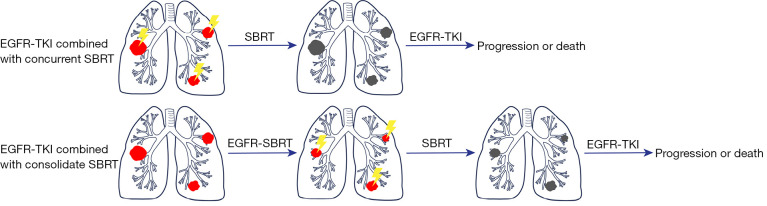
This review aimed to assess the viability of combining SBRT and EGFR-TKIs in oligometastatic -mutated NSCLC. Current clinical trials suggest that the combined therapies have better progression free survival (PFS) when using SBRT as either concurrent with EGFR-TKIs or consolidated with EGFR-TKIs. Furthermore, research with third-generation EGFR-TKIs and SBRT combinations has demonstrated tolerable toxicity levels without significant additional adverse effects as compared to prior therapies. However, further clinical trials are required to establish its effectiveness.
The combined approach of SBRT and TKIs can effectively impede the progression of oligometastatic NSCLC in patients harboring mutations and, most notably, can prolong progression-free survival rates. However, the feasibility of combining SBRT with third-generation TKIs in clinical trials remains unclear.
大量被诊断为非小细胞肺癌(NSCLC)的患者存在远处转移,而寡转移非小细胞肺癌的概念在实现治愈方面已显示出前景。立体定向体部放射治疗(SBRT)目前被认为是治疗有限数量肿瘤转移灶的一种可行选择。此外,已证实第三代酪氨酸激酶抑制剂(TKIs)可有效延长表皮生长因子受体(EGFR)突变的非小细胞肺癌患者的生存期。因此,SBRT与第三代TKIs联合应用有可能提高寡转移EGFR突变非小细胞肺癌患者的治疗效果。本综述旨在评估SBRT与TKIs联合应用作为寡转移EGFR突变非小细胞肺癌患者最佳治疗方案的可能性。
我们通过检索PubMed、Web of Science、爱思唯尔和ClinicalTrials.gov数据库,查找2009年1月至2024年2月发表的英文文章,并查阅关键参考文献的书目,以识别与SBRT和第三代TKIs联合应用于寡转移EGFR突变非小细胞肺癌相关的重要文献,进行了一项叙述性综述。
本综述旨在评估SBRT与EGFR-TKIs联合应用于寡转移EGFR突变非小细胞肺癌的可行性。目前的临床试验表明,在将SBRT与EGFR-TKIs同时应用或与EGFR-TKIs巩固应用时,联合治疗具有更好的无进展生存期(PFS)。此外,第三代EGFR-TKIs与SBRT联合应用的研究表明,与既往治疗相比,其毒性水平可耐受,且无明显额外不良反应。然而,需要进一步的临床试验来确定其有效性。
SBRT与TKIs联合应用可有效阻止携带EGFR突变患者的寡转移非小细胞肺癌进展,最显著的是可延长无进展生存率。然而,SBRT与第三代TKIs在临床试验中的联合应用可行性仍不明确。