Zhang Jingyi, Guo Yuting, Wei Chunyan, Yan Yu, Shan Huifang, Wu Bin, Wu Fengbo
Department of Pharmacy, West China Hospital, Sichuan University, Chengdu, China.
West China School of Pharmacy, Sichuan University, Chengdu, China.
Front Pharmacol. 2024 Jun 21;15:1363501. doi: 10.3389/fphar.2024.1363501. eCollection 2024.
Statins were regarded as a main medication for managing hypercholesterolemia. Administration of statin therapy could reduce the incidence of cardiovascular disease in individuals diagnosed with type 2 diabetes mellitus (DM), which was recognized by multipal clinical guidelines. But previous studies had conflicting results on whether the long-term use of statins could benefit the renal function in diabetic patients.
To evaluate the association between statin treatment and Chronic Kidney Disease in DM patients.
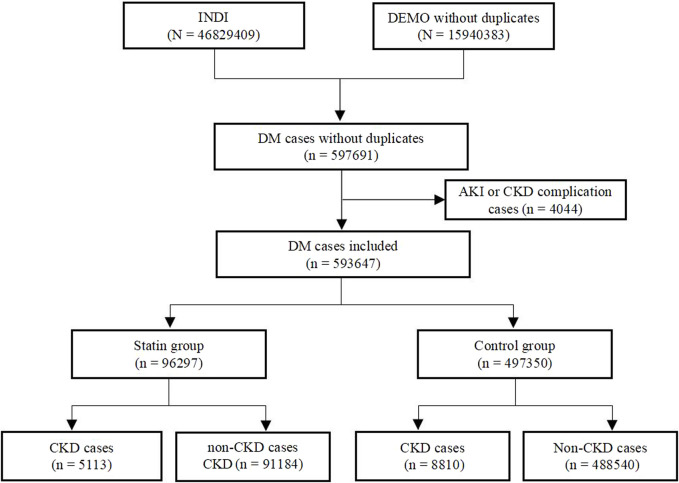
This is a retrospective disproportionality analysis and cohort study based on real-world data. All DM cases reported in US Food and Drug Administration adverse event reporting system (FAERS) between the first quarter of 2004 and the fourth quarter of 2022 were included. Disproportionality analyses were conducted by estimating the reporting odds ratio (ROR) and the information component (IC). We further compared the CKD odds ratio (OR) between the statins group and the other primary suspected drug group among the included diabetes mellitus cases.
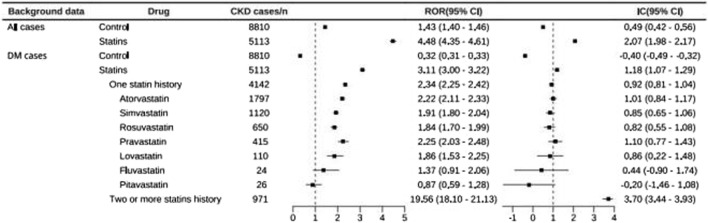
We finally included 593647 DM cases from FAERS, 5113 (5.31%) CKD cases in the statins group and 8810 (1.77%) CKD cases in the control group. Data analysis showed that the statins group showed a significant CKD signal (ROR: 3.11, 95% CI: 3.00-3.22; IC: 1.18, 95% CI: 1.07-1.29). In case group with two or more statins treatment history, the CKD signal was even stronger (ROR: 19.56, 95% CI: 18.10-21.13; IC: 3.70, 95% CI:3.44-3.93) compared with cases with one statin treatment history.
The impact of statin therapy on the progression of renal disease in individuals diagnosed with type 2 diabetes mellitus (DM) remains inconclusive. After data mining on the current FAERS dataset, we discovered significant signals between statin treatment and CKD in diabetic patients. Furthermore, the incidence rate of CKD was higher among DM patients who used statins compared to those who did not.
他汀类药物被视为治疗高胆固醇血症的主要药物。他汀类药物治疗可降低2型糖尿病(DM)患者心血管疾病的发病率,这已得到多个临床指南的认可。但既往研究对于长期使用他汀类药物是否能使糖尿病患者的肾功能获益存在相互矛盾的结果。
评估他汀类药物治疗与糖尿病患者慢性肾脏病之间的关联。
这是一项基于真实世界数据的回顾性不成比例分析和队列研究。纳入2004年第一季度至2022年第四季度在美国食品药品监督管理局不良事件报告系统(FAERS)中报告的所有糖尿病病例。通过估计报告比值比(ROR)和信息成分(IC)进行不成比例分析。我们进一步比较了纳入的糖尿病病例中他汀类药物组与其他主要可疑药物组之间的慢性肾脏病比值比(OR)。
我们最终从FAERS中纳入了593647例糖尿病病例,他汀类药物组中有5113例(5.31%)慢性肾脏病病例,对照组中有8810例(1.77%)慢性肾脏病病例。数据分析显示,他汀类药物组显示出显著的慢性肾脏病信号(ROR:3.11,95%CI:3.00 - 3.22;IC:1.18,95%CI:1.07 - 1.29)。在有两种或更多他汀类药物治疗史的病例组中,与有一次他汀类药物治疗史的病例相比,慢性肾脏病信号更强(ROR:19.56,95%CI:18.10 - 21.13;IC:3.70,95%CI:3.44 - 3.93)。
他汀类药物治疗对2型糖尿病(DM)患者肾脏疾病进展的影响仍不明确。在对当前FAERS数据集进行数据挖掘后,我们发现了他汀类药物治疗与糖尿病患者慢性肾脏病之间的显著信号。此外,使用他汀类药物的糖尿病患者中慢性肾脏病的发病率高于未使用他汀类药物的患者。