Al-Shalchy Ali, Al-Taie Rania H, Algburi Hagar A, Ismail Mustafa
Department of Surgery, Univeristy of Baghdad, College of Medicine, Baghdad, Iraq.
Department of Surgery, Univeristy of Mustansiriyah, College of Medicine, Baghdad, Iraq.
Surg Neurol Int. 2024 Jun 14;15:202. doi: 10.25259/SNI_351_2024. eCollection 2024.
Transorbital approaches represent a paradigm shift in skull base surgery, focusing on minimally invasive techniques that prioritize patient outcomes and surgical precision. The scientific community, recognizing the significance of these advances, necessitates a possible review and meta-analysis to encapsulate the collective efficacy, safety, and developmental trajectory of these approaches.
This was a literature review targeting literature in the past 10 years to present evidence for studies on surgical approaches transorbital. The included articles were analyzed. In addition, the references list of the included papers was searched for further articles.
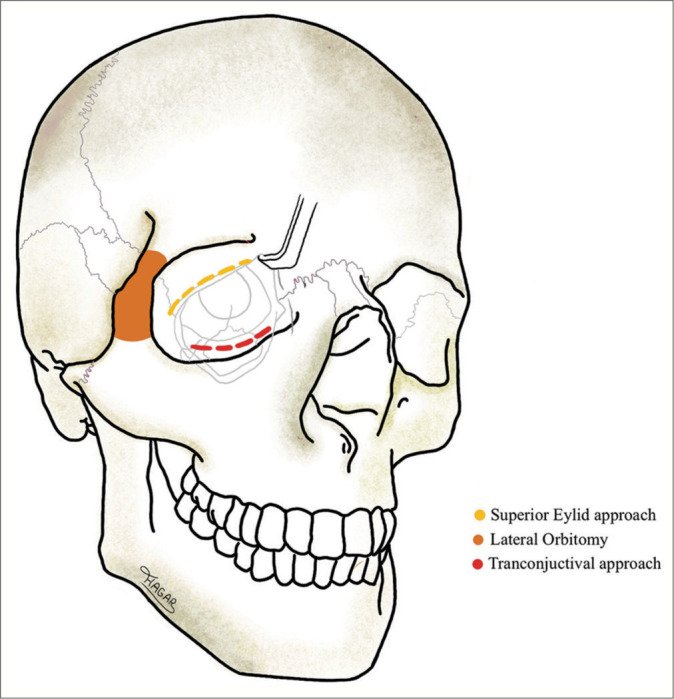
Studies based on the endoscopic endonasal and transorbital approach have emphasized that it is minimally invasive; on the other hand, it offers an advantage to maximal resection success in the case of skull base tumors with advanced endoscopic skills. Transorbital neuroendoscopic surgery was criticized for being highly technical and narrow in its scope, with reduced morbidity. Superior Eyelid Approach involves a direct access with hidden incisions, potential for eyelid complications. Lateral orbitotomy entailed some inherent risks, such as muscle and nerve injury, but it gave excellent exposure to lesions that are lateral in the orbit. The transorbital endoscopic intraconal approach and the transconjunctival approach give direct advantages but are, however, limited to the type of lesion and location.
The main technique focused on in this overview is the approaches through orbits, which greatly contribute to further innovation brought into the surgical panorama of skull base interventions. All such techniques do have their characteristics and applications, keeping them moving toward less invasiveness.
经眶入路代表了颅底手术的范式转变,专注于以患者预后和手术精准度为优先的微创技术。科学界认识到这些进展的重要性,有必要进行一次可能的综述和荟萃分析,以总结这些入路的总体疗效、安全性和发展轨迹。
这是一项针对过去10年文献的综述,旨在为经眶手术入路的研究提供证据。对纳入的文章进行了分析。此外,还搜索了纳入论文的参考文献列表以查找更多文章。
基于鼻内镜下经鼻和经眶入路的研究强调其具有微创性;另一方面,对于具有先进内镜技术的颅底肿瘤病例,它在实现最大程度的切除成功方面具有优势。经眶神经内镜手术因技术要求高、范围狭窄且发病率降低而受到批评。上睑入路涉及隐藏切口的直接入路,存在眼睑并发症的可能性。外侧眶切开术存在一些固有风险,如肌肉和神经损伤,但它能很好地暴露眼眶外侧的病变。经眶内镜锥内入路和经结膜入路具有直接优势,但仅限于病变类型和位置。
本综述重点关注的主要技术是经眶入路,这对颅底手术全景带来的进一步创新有很大贡献。所有这些技术都有其特点和应用,使它们朝着更少的侵袭性发展。