Gümüş Aylin Bayındır, Açık Murat, Durmaz Sevinç Eşer
First and Emergency Aid Program, Vocational School of Health Services, Kırıkkale University, Kırıkkale 71450, Türkiye.
Department of Nutrition and Dietetics, Faculty of Health Sciences, Fırat University, Elazığ 23200, Türkiye.
Prev Nutr Food Sci. 2024 Jun 30;29(2):199-209. doi: 10.3746/pnf.2024.29.2.199.
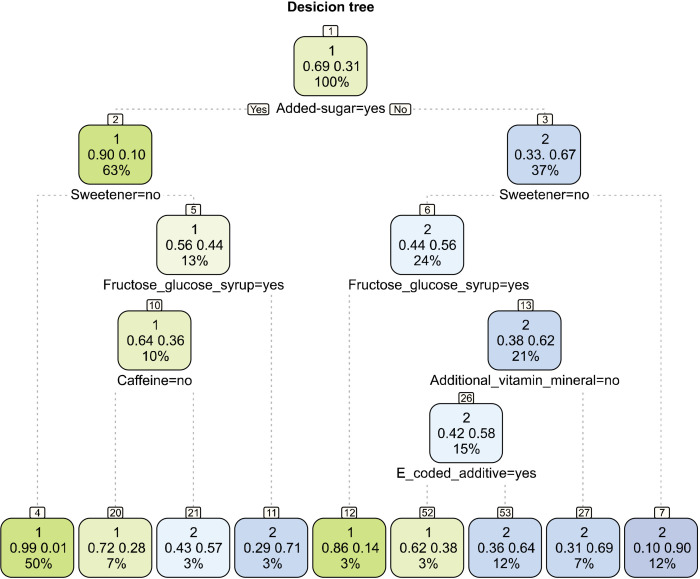
This study aimed to compare the nutritional quality of beverages sold in Türkiye according to their labeling profiles. A total of 304 nonalcoholic beverages sold in supermarkets and online markets with the highest market capacity in Türkiye were included. Milk and dairy products, sports drinks, and beverages for children were excluded. The health star rating (HSR) was used to assess the nutritional quality of beverages. The nutritional quality of beverages was evaluated using a decision tree model according to the HSR score based on the variables presented on the beverage label. Moreover, confusion matrix tests were used to test the model's accuracy. The mean HSR score of beverages was 2.6±1.9, of which 30.2% were in the healthy category (HSR≥3.5). Fermented and 100% fruit juice beverages had the highest mean HSR scores. According to the decision tree model of the training set, the predictors of HSR quality score, in order of importance, were as follows: added sugar (46%), sweetener (28%), additives (19%), fructose-glucose syrup (4%), and caffeine (3%). In the test set, the accuracy rate and F1 score were 0.90 and 0.82, respectively, suggesting that the prediction performance of our model had the perfect fit. According to the HSR classification, most beverages were found to be unhealthy. Thus, they increase the risk of the development of obesity and other diseases because of their easy consumption. The decision tree learning algorithm could guide the population to choose healthy beverages based on their labeling information.
本研究旨在根据饮料的标签信息比较土耳其销售的饮料的营养质量。共纳入了土耳其市场容量最大的超市和在线市场销售的304种非酒精饮料。牛奶及奶制品、运动饮料和儿童饮料被排除在外。采用健康星级评分(HSR)来评估饮料的营养质量。根据饮料标签上呈现的变量,使用决策树模型根据HSR评分对饮料的营养质量进行评估。此外,使用混淆矩阵测试来检验模型的准确性。饮料的平均HSR评分为2.6±1.9,其中30.2%属于健康类别(HSR≥3.5)。发酵饮料和100%果汁饮料的平均HSR评分最高。根据训练集的决策树模型,HSR质量评分的预测因素按重要性排序如下:添加糖(46%)、甜味剂(28%)、添加剂(19%)、果糖-葡萄糖糖浆(4%)和咖啡因(3%)。在测试集中,准确率和F1分数分别为0.90和0.82,表明我们模型的预测性能具有完美的拟合度。根据HSR分类,发现大多数饮料不健康。因此,由于其易于消费,它们增加了肥胖和其他疾病发生的风险。决策树学习算法可以指导人们根据标签信息选择健康饮料。