Laboratory of Experimental Immunology, Istituto Dermopatico dell'Immacolata - Istituto di Ricovero e Cura a Carattere Scientifico (IDI-IRCCS), Rome, Italy.
Front Immunol. 2024 Jun 21;15:1393799. doi: 10.3389/fimmu.2024.1393799. eCollection 2024.
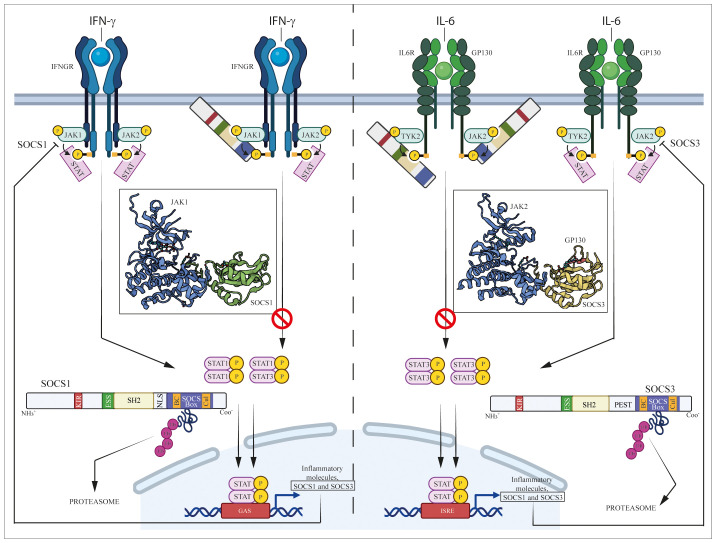
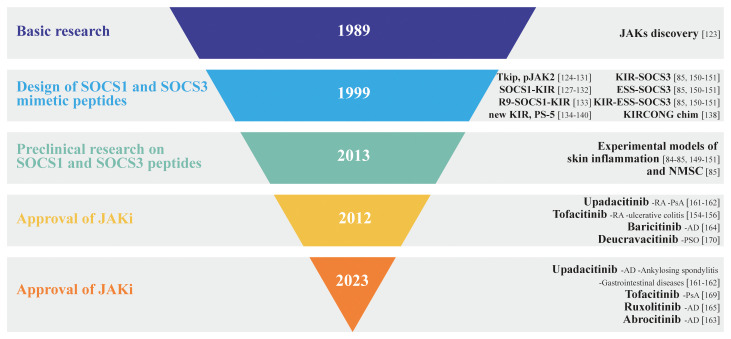
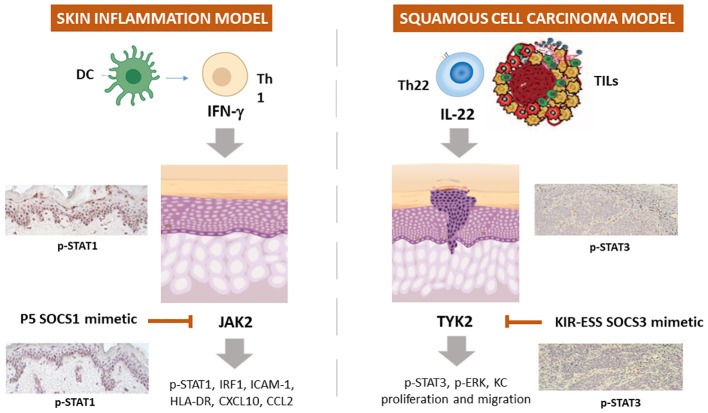
SOCS are a family of negative inhibitors of the molecular cascades induced by cytokines, growth factors and hormones. At molecular level, SOCS proteins inhibit the kinase activity of specific sets of receptor-associated Janus Activated Kinases (JAKs), thereby suppressing the propagation of intracellular signals. Of the eight known members, SOCS1 and SOCS3 inhibit activity of JAKs mainly induced by cytokines and can play key roles in regulation of inflammatory and immune responses. SOCS1 and SOCS3 are the most well-characterized SOCS members in skin inflammatory diseases, where their inhibitory activity on cytokine activated JAKs and consequent anti-inflammatory action has been widely investigated in epidermal keratinocytes. Structurally, SOCS1 and SOCS3 share the presence of a N-terminal domain containing a kinase inhibitory region (KIR) motif able to act as a pseudo-substrate for JAK and to inhibit its activity. During the last decades, the design and employment of SOCS1 and SOCS3-derived peptides mimicking KIR domains in experimental models of dermatoses definitively established a strong anti-inflammatory and ameliorative impact of JAK inhibition on skin inflammatory responses. Herein, we discuss the importance of the findings collected in the past on SOCS1 and SOCS3 function in the inflammatory responses associated to skin immune-mediated diseases and malignancies, for the development of the JAK inhibitor drugs. Among them, different JAK inhibitors have been introduced in the clinical practice for treatment of atopic dermatitis and psoriasis, and others are being investigated for skin diseases like alopecia areata and vitiligo.
SOCS 是一类负向调控细胞因子、生长因子和激素诱导的分子级联反应的抑制因子家族。在分子水平上,SOCS 蛋白抑制特定的受体相关 Janus 激活激酶(JAK)家族的激酶活性,从而抑制细胞内信号的传递。在已知的 8 个成员中,SOCS1 和 SOCS3 主要抑制细胞因子诱导的 JAK 活性,在炎症和免疫反应的调控中发挥关键作用。SOCS1 和 SOCS3 是皮肤炎症性疾病中研究最充分的 SOCS 成员,其对细胞因子激活的 JAK 的抑制活性及其抗炎作用已在表皮角质形成细胞中得到广泛研究。结构上,SOCS1 和 SOCS3 都含有一个 N 端结构域,该结构域包含一个激酶抑制区(KIR)基序,能够作为 JAK 的伪底物并抑制其活性。在过去的几十年中,SOCS1 和 SOCS3 衍生肽模拟 KIR 结构域的设计和应用在皮肤炎症性疾病的实验模型中,明确了 JAK 抑制对皮肤炎症反应的强烈抗炎和改善作用。在此,我们讨论了过去关于 SOCS1 和 SOCS3 在与皮肤免疫介导性疾病和恶性肿瘤相关的炎症反应中的功能的研究结果的重要性,这些结果为 JAK 抑制剂药物的开发提供了依据。其中,已有不同的 JAK 抑制剂被引入临床治疗特应性皮炎和银屑病,其他抑制剂也在研究用于治疗斑秃和白癜风等皮肤疾病。