Department of Obstetrics and Gynaecology, Faculty of Medicine and Health, Örebro University, Örebro, Sweden.
Clinical Epidemiology and Biostatistics, School of Medical Sciences, Faculty of Medicine and Health, Örebro University, Örebro, Sweden.
PLoS Med. 2024 Jul 8;21(7):e1004420. doi: 10.1371/journal.pmed.1004420. eCollection 2024 Jul.
The World Health Organisation (WHO) 2013 diagnostic criteria for gestational diabetes mellitus (GDM) has been criticised due to the limited evidence of benefits on pregnancy outcomes in different populations when switching from previously higher glycemic thresholds to the lower WHO-2013 diagnostic criteria. The aim of this study was to determine whether the switch from previous Swedish (SWE-GDM) to the WHO-2013 GDM criteria in Sweden following risk factor-based screening improves pregnancy outcomes.
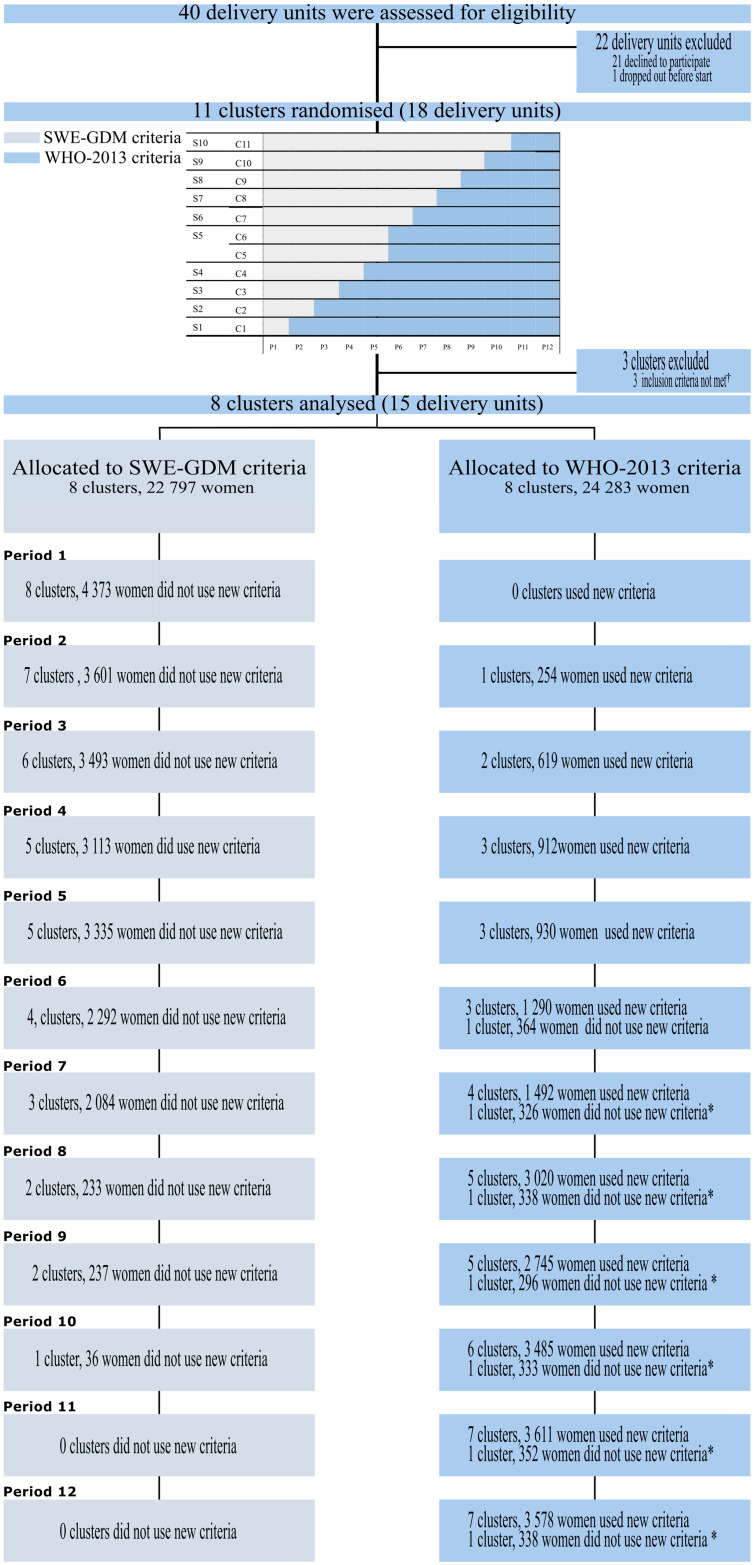
A stepped wedge cluster randomised trial was performed between January 1 and December 31, 2018 in 11 clusters (17 delivery units) across Sweden, including all pregnancies under care and excluding preexisting diabetes, gastric bypass surgery, or multifetal pregnancies from the analysis. After implementation of uniform clinical and laboratory guidelines, a number of clusters were randomised to intervention (switch to WHO-2013 GDM criteria) each month from February to November 2018. The primary outcome was large for gestational age (LGA, defined as birth weight >90th percentile). Other secondary and prespecified outcomes included maternal and neonatal birth complications. Primary analysis was by modified intention to treat (mITT), excluding 3 clusters that were randomised before study start but were unable to implement the intervention. Prespecified subgroup analysis was undertaken among those discordant for the definition of GDM. Multilevel mixed regression models were used to compare outcome LGA between WHO-2013 and SWE-GDM groups adjusted for clusters, time periods, and potential confounders. Multiple imputation was used for missing potential confounding variables. In the mITT analysis, 47 080 pregnancies were included with 6 882 (14.6%) oral glucose tolerance tests (OGTTs) performed. The GDM prevalence increased from 595/22 797 (2.6%) to 1 591/24 283 (6.6%) after the intervention. In the mITT population, the switch was associated with no change in primary outcome LGA (2 790/24 209 (11.5%) versus 2 584/22 707 (11.4%)) producing an adjusted risk ratio (aRR) of 0.97 (95% confidence interval 0.91 to 1.02, p = 0.26). In the subgroup, the prevalence of LGA was 273/956 (28.8%) before and 278/1 239 (22.5%) after the switch, aRR 0.87 (95% CI 0.75 to 1.01, p = 0.076). No serious events were reported. Potential limitations of this trial are mainly due to the trial design, including failure to adhere to guidelines within and between the clusters and influences of unidentified temporal variations.
In this study, implementing the WHO-2013 criteria in Sweden with risk factor-based screening did not significantly reduce LGA prevalence defined as birth weight >90th percentile, in the total population, or in the subgroup discordant for the definition of GDM. Future studies are needed to evaluate the effects of treating different glucose thresholds during pregnancy in different populations, with different screening strategies and clinical management guidelines, to optimise women's and children's health in the short and long term.
The trial is registered with ISRCTN (41918550).
世界卫生组织(WHO)2013 年妊娠糖尿病(GDM)诊断标准因在不同人群中切换到较低的 WHO-2013 诊断标准后对妊娠结局的益处证据有限而受到批评。本研究旨在确定瑞典在基于风险因素的筛查后从之前的瑞典(SWE-GDM)标准切换到 WHO-2013 GDM 标准是否改善了妊娠结局。
2018 年 1 月 1 日至 12 月 31 日,在瑞典的 11 个集群(17 个分娩单位)中进行了一项阶梯式楔形集群随机试验,包括所有接受护理的妊娠,并排除了先前存在的糖尿病、胃旁路手术或多胎妊娠。在实施统一的临床和实验室指南后,从 2018 年 2 月至 11 月,每月有多个集群被随机分配到干预组(转换为 WHO-2013 GDM 标准)。主要结局是巨大儿(LGA,定义为出生体重>第 90 百分位数)。其他次要和预定结局包括母婴出生并发症。主要分析采用改良意向治疗(mITT),排除了 3 个在研究开始前就被随机分配但无法实施干预的集群。在 GDM 定义不一致的人群中进行了预设亚组分析。使用多水平混合回归模型,根据集群、时间段和潜在混杂因素,比较 WHO-2013 组和 SWE-GDM 组的结局 LGA。使用多重插补处理潜在混杂变量缺失。在 mITT 分析中,纳入了 47080 例妊娠,其中 6882 例(14.6%)进行了口服葡萄糖耐量试验(OGTT)。干预后,GDM 患病率从 595/22797(2.6%)增加到 1591/24283(6.6%)。在 mITT 人群中,这种转变与主要结局 LGA 没有变化相关(2790/24209(11.5%)与 2584/22707(11.4%)),调整后的风险比(aRR)为 0.97(95%置信区间 0.91 至 1.02,p=0.26)。在亚组中,转换前 LGA 的患病率为 273/956(28.8%),转换后为 278/1239(22.5%),aRR 为 0.87(95%CI 0.75 至 1.01,p=0.076)。未报告严重事件。该试验的潜在局限性主要归因于试验设计,包括未能在集群内和集群间遵守指南以及无法识别的时间变化的影响。
在这项研究中,瑞典在基于风险因素的筛查中实施 WHO-2013 标准并没有显著降低 LGA 的总体患病率,也没有降低 GDM 定义不一致的亚组中 LGA 的患病率。需要进一步研究评估在不同人群中,采用不同的筛查策略和临床管理指南,对不同的血糖阈值进行治疗,以优化妇女和儿童的短期和长期健康。
该试验在 ISRCTN 注册(41918550)。