CQ University, Bruce Highway, Rockhampton, Queensland, Q 4670, Australia.
BMC Womens Health. 2024 Jul 9;24(1):395. doi: 10.1186/s12905-024-03228-3.
Women in low- and middle-income countries (LMICs) are primary producers of subsistence food and significant contributors to the agricultural economy. Gender Based Violence (GBV) adversely impacts their capacity to contribute and sustain their families and undermines social, economic, and human capital. Addressing GBV, therefore, is critical to creating safe and inclusive environments for women as primary producers to participate fully in rural communities. The aim of this scoping review is to explore the existing evidence on GBV in the context of women primary producers in LMICs to inform research gaps and priorities.
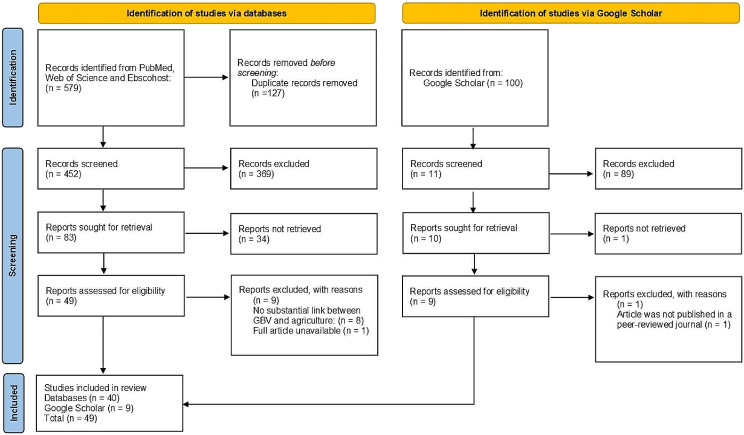
A scoping review was conducted using PubMed, Web of Science, Ebscohost and Google Scholar using keywords related to GBV and women producers in LMICs. Peer-reviewed journal articles published between January 2012 and June 2022 were included in the review. Duplicates were removed, titles and abstracts were screened, and characteristics and main results of included studies were recorded in a data charting form. A total of 579 records were identified, of which 49 studies were eligible for inclusion in this study.
Five major themes were identified from our analysis: (1) extent and nature of GBV, (2) the impact of GBV on agricultural/primary production livelihood activities, (3) sociocultural beliefs, practices, and attitudes, (4) aggravating or protective factors, and (5) GBV interventions. Addressing GBV in agriculture requires inclusive research approaches and targeted interventions to empower women producers, promote gender equality, enhance agricultural productivity, and contribute to broader societal development. Despite attempts by researchers to delve into this issue, the pervasive under-reporting of GBV remains a challenge. The true extent and nature of GBV perpetrated against women is far from fully understood in this context.
Despite the significant challenges posed by GBV to the health, economy and livelihoods of women primary producers in LMICs, there is a paucity in the current state of knowledge. To make meaningful progress, more research is required to understand the relationship between GBV and agricultural settings, and to gain nuanced insight into the nature and impact of GBV on women primary producers in different regions and contexts.
在中低收入国家(LMICs),女性是生计食品的主要生产者,也是农业经济的重要贡献者。性别暴力(GBV)会对她们为家庭做出贡献和维持生计的能力产生负面影响,并破坏社会、经济和人力资本。因此,解决性别暴力问题对于为女性主要生产者创造安全和包容的环境以充分参与农村社区至关重要。本研究旨在探讨中低收入国家女性主要生产者背景下性别暴力的现有证据,以了解研究差距和重点。
本研究使用 PubMed、Web of Science、Ebscohost 和 Google Scholar 进行了范围综述,使用与中低收入国家性别暴力和女性生产者相关的关键词。纳入的文献是 2012 年 1 月至 2022 年 6 月发表的同行评审期刊文章。去除重复项,筛选标题和摘要,并将纳入研究的特征和主要结果记录在数据图表中。共确定了 579 条记录,其中 49 项研究符合纳入本研究的标准。
从我们的分析中确定了五个主要主题:(1)GBV 的程度和性质,(2)GBV 对农业/初级生产生计活动的影响,(3)社会文化信仰、实践和态度,(4)加重或保护因素,以及(5)GBV 干预措施。在农业中解决性别暴力问题需要包容性的研究方法和有针对性的干预措施,以增强女性生产者的权能,促进性别平等,提高农业生产力,并为更广泛的社会发展做出贡献。尽管研究人员试图深入研究这个问题,但 GBV 报告不足仍然是一个挑战。在这种情况下,对针对女性实施的 GBV 的真实程度和性质的了解还远远不够。
尽管性别暴力对中低收入国家女性主要生产者的健康、经济和生计构成了重大挑战,但目前的知识状况仍然不足。为了取得有意义的进展,需要进行更多的研究,以了解性别暴力与农业环境之间的关系,并深入了解不同地区和背景下性别暴力对女性主要生产者的性质和影响。