Department of Anesthesia Operation, The First People's Hospital of Shuangliu District (West China Airport Hospital of Sichuan University), No.120, Chengbei Street, Dongsheng Street, Shuangliu District, Chengdu, 610200, China.
J Cardiothorac Surg. 2024 Jul 8;19(1):425. doi: 10.1186/s13019-024-02881-x.
Postoperative pulmonary complications (PPCs) after one-lung ventilation (OLV) significantly impact patient prognosis and quality of life.
To study the impact of an optimal inspiratory flow rate on PPCs in thoracic surgery patients.
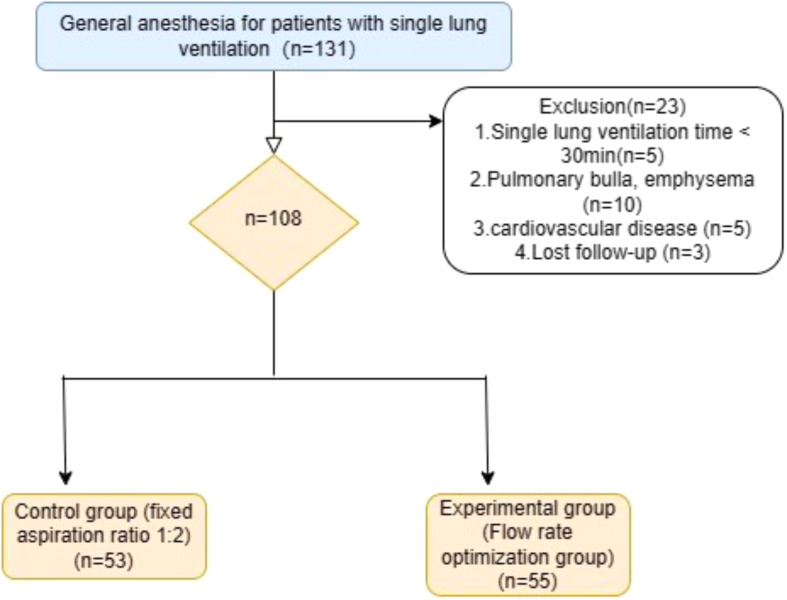
One hundred eight elective thoracic surgery patients were randomly assigned to 2 groups in this consort study (control group: n = 53 with a fixed inspiratory expiratory ratio of 1:2; and experimental group [flow rate optimization group]: n = 55). Measurements of Ppeak, Pplat, PETCO, lung dynamic compliance (Cdyn), respiratory rate, and oxygen concentration were obtained at the following specific time points: immediately after intubation (T0); immediately after starting OLV (T1); 30 min after OLV (T2); and 10 min after 2-lung ventilation (T4). The PaO:FiO ratio was measured using blood gas analysis 30 min after initiating one-lung breathing (T2) and immediately when OLV ended (T3). The lung ultrasound score (LUS) was assessed following anesthesia and resuscitation (T5). The occurrence of atelectasis was documented immediately after the surgery. PPCs occurrences were noted 3 days after surgery.
The treatment group had a significantly lower total prevalence of PPCs compared to the control group (3.64% vs. 16.98%; P = 0.022). There were no notable variations in peak airway pressure, airway plateau pressure, dynamic lung compliance, PETCO, respiratory rate, and oxygen concentration between the two groups during intubation (T0). Dynamic lung compliance and the oxygenation index were significantly increased at T1, T2, and T4 (P < 0.05), whereas the CRP level and number of inflammatory cells decreased dramatically (P < 0.05).
Optimizing inspiratory flow rate and utilizing pressure control ventilation -volume guaranteed (PCV-VG) mode can decrease PPCs and enhance lung dynamic compliance in OLV patients.
单肺通气(OLV)后发生的术后肺部并发症(PPCs)显著影响患者的预后和生活质量。
研究最佳吸气流量对接受胸外科手术患者 PPCs 的影响。
本队列研究中,108 例择期胸外科手术患者被随机分为 2 组(对照组,n = 53,吸气/呼气比固定为 1:2;实验组[流量优化组],n = 55)。在以下特定时间点测量 Ppeak、Pplat、PETCO2、肺动态顺应性(Cdyn)、呼吸频率和氧浓度:插管后即刻(T0);开始 OLV 后即刻(T1);OLV 后 30 分钟(T2);双肺通气后 10 分钟(T4)。在开始单肺通气 30 分钟后(T2)和 OLV 结束后即刻(T3),通过血气分析测量 PaO2/FiO2 比值。麻醉复苏后(T5)评估肺超声评分(LUS)。术后即刻记录肺不张的发生情况。术后 3 天记录 PPCs 的发生情况。
与对照组相比,实验组 PPCs 的总发生率明显较低(3.64% vs. 16.98%;P = 0.022)。两组在插管时(T0)的气道峰压、气道平台压、动态肺顺应性、PETCO2、呼吸频率和氧浓度均无明显变化。T1、T2 和 T4 时,动态肺顺应性和氧合指数显著升高(P < 0.05),而 CRP 水平和炎症细胞数量则显著下降(P < 0.05)。
优化吸气流量并采用压力控制通气-容量保证(PCV-VG)模式可降低 OLV 患者的 PPCs 发生率,并提高肺动态顺应性。