Hirose Sotaro, Satake Akiko
Graduate School of Systems Life Sciences Kyushu University Fukuoka Japan.
Department of Biology, Faculty of Science Kyushu University Fukuoka Japan.
Ecol Evol. 2024 Jul 9;14(7):e11548. doi: 10.1002/ece3.11548. eCollection 2024 Jul.
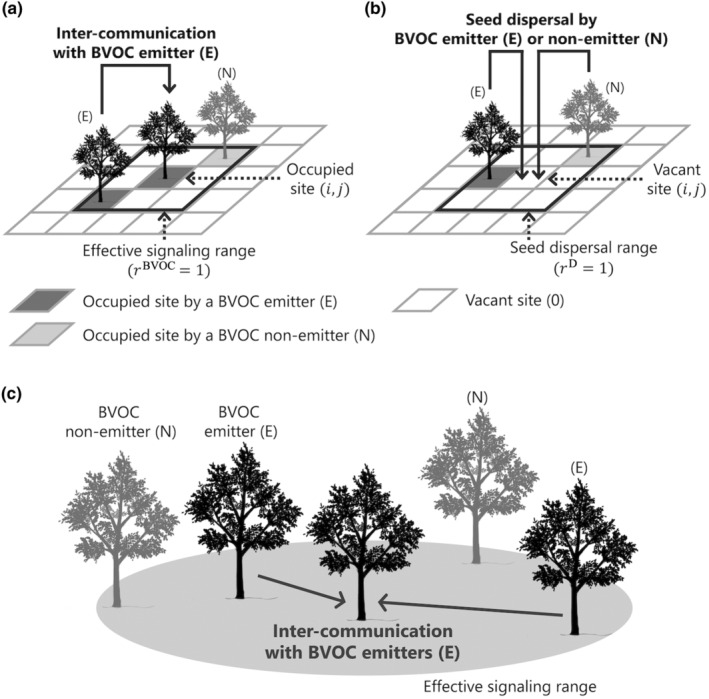
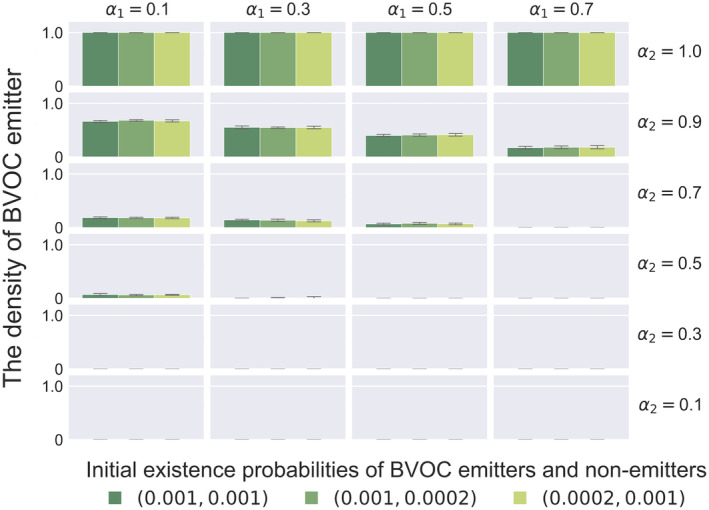
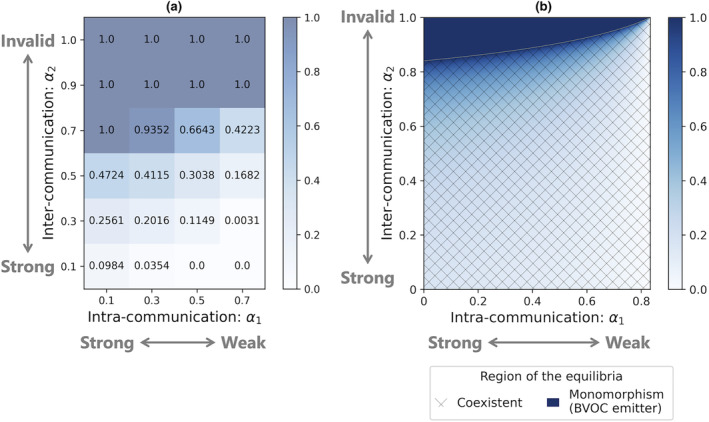
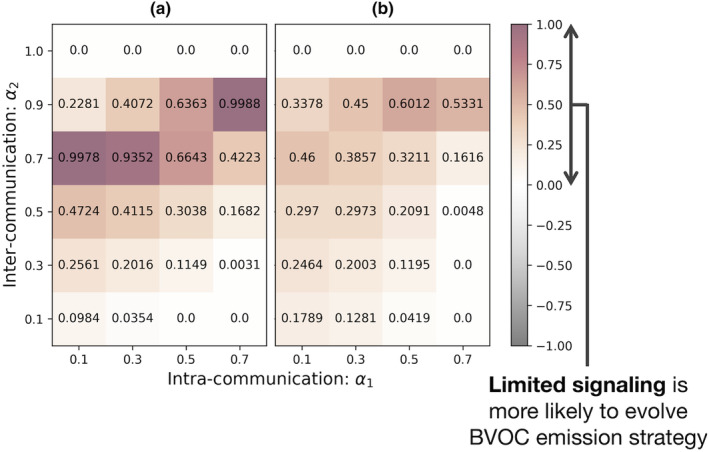
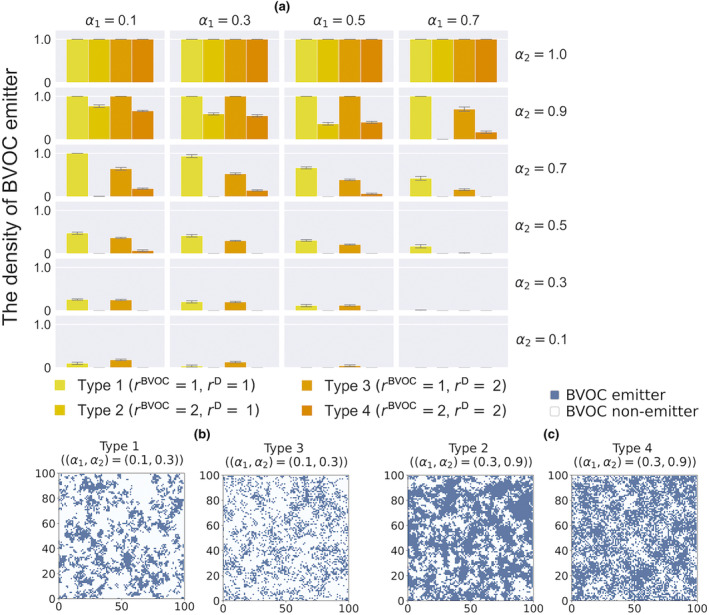
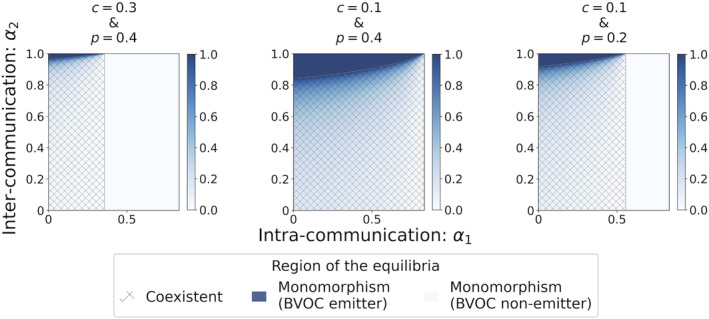
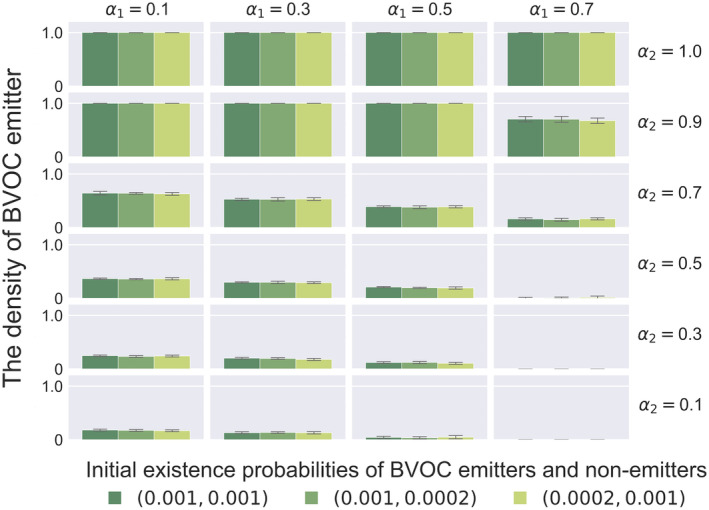
Plants emit biogenic volatile organic compounds (BVOCs) as signaling molecules, playing a crucial role in inducing resistance against herbivores. Neighboring plants that eavesdrop on BVOC signals can also increase defenses against herbivores or alter growth patterns to respond to potential risks of herbivore damage. Despite the significance of BVOC emissions, the evolutionary rationales behind their release and the factors contributing to the diversity in such emissions remain poorly understood. To unravel the conditions for the evolution of BVOC emission, we developed a spatially explicit model that formalizes the evolutionary dynamics of BVOC emission and non-emission strategies. Our model considered two effects of BVOC signaling that impact the fitness of plants: intra-individual communication, which mitigates herbivore damage through the plant's own BVOC signaling incurring emission costs, and inter-individual communication, which alters the influence of herbivory based on BVOC signals from other individuals without incurring emission costs. Employing two mathematical models-the lattice model and the random distribution model-we investigated how intra-individual communication, inter-individual communication, and spatial structure influenced the evolution of BVOC emission strategies. Our analysis revealed that the increase in intra-individual communication promotes the evolution of the BVOC emission strategy. In contrast, the increase in inter-individual communication effect favors cheaters who benefit from the BVOCs released from neighboring plants without bearing the costs associated with BVOC emission. Our analysis also demonstrated that the narrower the spatial scale of BVOC signaling, the higher the likelihood of BVOC evolution. This research sheds light on the intricate dynamics governing the evolution of BVOC emissions and their implications for plant-plant communication.
植物会释放生物源挥发性有机化合物(BVOCs)作为信号分子,在诱导对食草动物的抗性方面发挥着关键作用。窃听BVOC信号的相邻植物也可以增强对食草动物的防御,或改变生长模式以应对食草动物损害的潜在风险。尽管BVOC排放具有重要意义,但其释放背后的进化原理以及导致此类排放多样性的因素仍知之甚少。为了揭示BVOC排放进化的条件,我们开发了一个空间明确的模型,该模型将BVOC排放和不排放策略的进化动态形式化。我们的模型考虑了BVOC信号传导对植物适合度的两种影响:个体内通讯,即通过植物自身的BVOC信号传导减轻食草动物损害,但会产生排放成本;个体间通讯,即基于来自其他个体的BVOC信号改变食草作用的影响,而不会产生排放成本。我们使用两种数学模型——格子模型和随机分布模型——研究了个体内通讯、个体间通讯和空间结构如何影响BVOC排放策略的进化。我们的分析表明,个体内通讯的增加促进了BVOC排放策略的进化。相比之下,个体间通讯效应的增加有利于那些从相邻植物释放的BVOC中获益而无需承担与BVOC排放相关成本的作弊者。我们的分析还表明,BVOC信号传导的空间尺度越窄,BVOC进化的可能性就越高。这项研究揭示了控制BVOC排放进化的复杂动态及其对植物间通讯的影响。