Julovi Sohel M, Trinh Katie, Robertson Harry, Xu Cuicui, Minhas Nikita, Viswanathan Seethalakshmi, Patrick Ellis, Horowitz John D, Meijles Daniel N, Rogers Natasha M
Kidney Injury Group, Centre for Transplant and Renal Research, Westmead Institute for Medical Research, Westmead, New South Wales, Australia.
Faculty of Medicine and Health, The University of Sydney, Camperdown, New South Wales, Australia.
JACC Basic Transl Sci. 2024 Mar 27;9(5):607-627. doi: 10.1016/j.jacbts.2024.01.010. eCollection 2024 May.
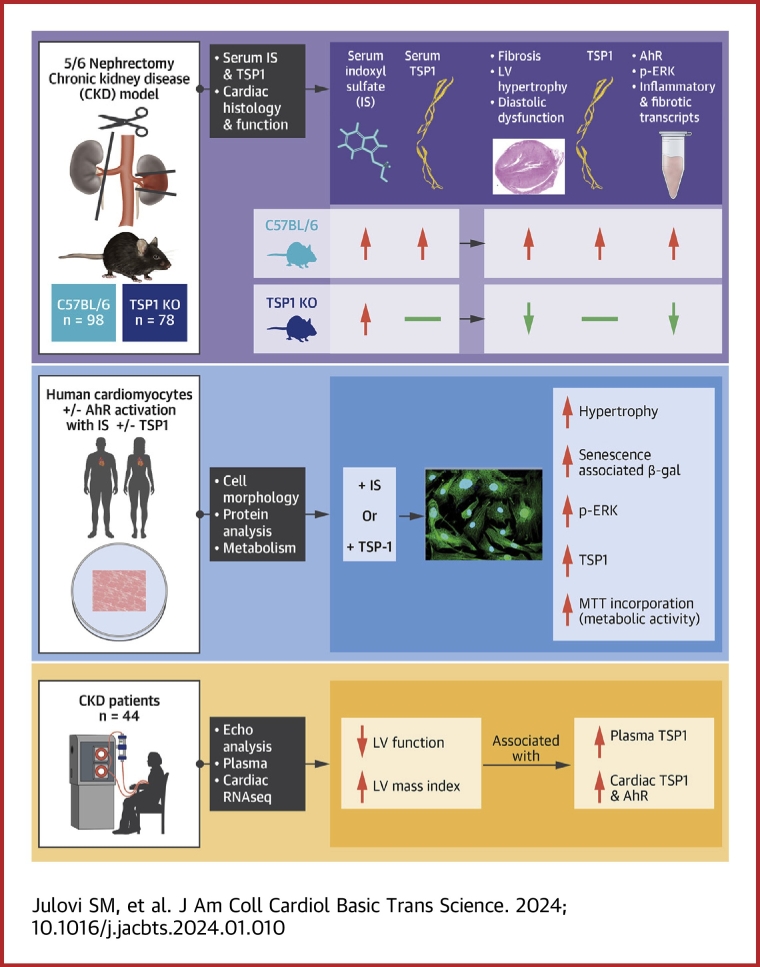
Patients with chronic kidney disease (CKD) face a high risk of cardiovascular disease. Previous studies reported that endogenous thrombospondin 1 (TSP1) involves right ventricular remodeling and dysfunction. Here we show that a murine model of CKD increased myocardial TSP1 expression and produced left ventricular hypertrophy, fibrosis, and dysfunction. TSP1 knockout mice were protected from these features. In vitro, indoxyl sulfate is driving deleterious changes in cardiomyocyte through the TSP1. In patients with CKD, TSP1 and aryl hydrocarbon receptor were both differentially expressed in the myocardium. Our findings summon large clinical studies to confirm the translational role of TSP1 in patients with CKD.
慢性肾脏病(CKD)患者面临着较高的心血管疾病风险。先前的研究报道,内源性血小板反应蛋白1(TSP1)与右心室重构和功能障碍有关。在此我们表明,CKD小鼠模型会增加心肌TSP1表达,并导致左心室肥厚、纤维化和功能障碍。TSP1基因敲除小鼠可免受这些特征的影响。在体外,硫酸吲哚酚通过TSP1驱动心肌细胞发生有害变化。在CKD患者中,TSP1和芳烃受体在心肌中均有差异表达。我们的研究结果呼吁开展大规模临床研究,以证实TSP1在CKD患者中的转化作用。