Catherine and Joseph Aresty Department of Urology, University of Southern California Institute of Urology, Keck School of Medicine, University of Southern California, Los Angeles, California, USA.
Department of Surgery, MedStar Franklin Square Medical Center, Baltimore, Maryland, USA.
BJS Open. 2024 Jul 2;8(4). doi: 10.1093/bjsopen/zrae056.
Inguinal lymph node dissection plays an important role in the management of melanoma, penile and vulval cancer. Inguinal lymph node dissection is associated with various intraoperative and postoperative complications with significant heterogeneity in classification and reporting. This lack of standardization challenges efforts to study and report inguinal lymph node dissection outcomes. The aim of this study was to devise a system to standardize the classification and reporting of inguinal lymph node dissection perioperative complications by creating a worldwide collaborative, the complications and adverse events in lymphadenectomy of the inguinal area (CALI) group.
A modified 3-round Delphi consensus approach surveyed a worldwide group of experts in inguinal lymph node dissection for melanoma, penile and vulval cancer. The group of experts included general surgeons, urologists and oncologists (gynaecological and surgical). The survey assessed expert agreement on inguinal lymph node dissection perioperative complications. Panel interrater agreement and consistency were assessed as the overall percentage agreement and Cronbach's α.
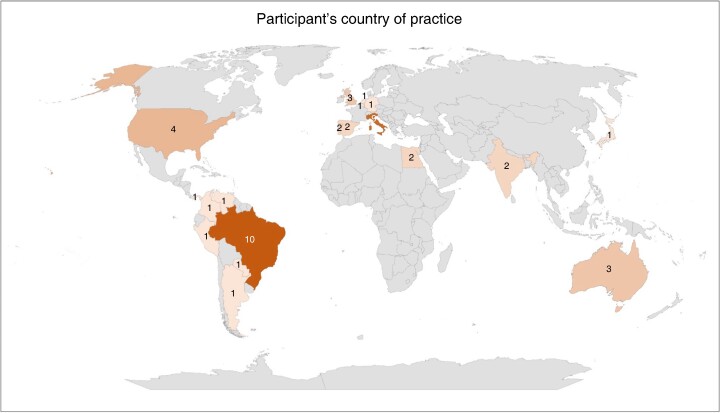
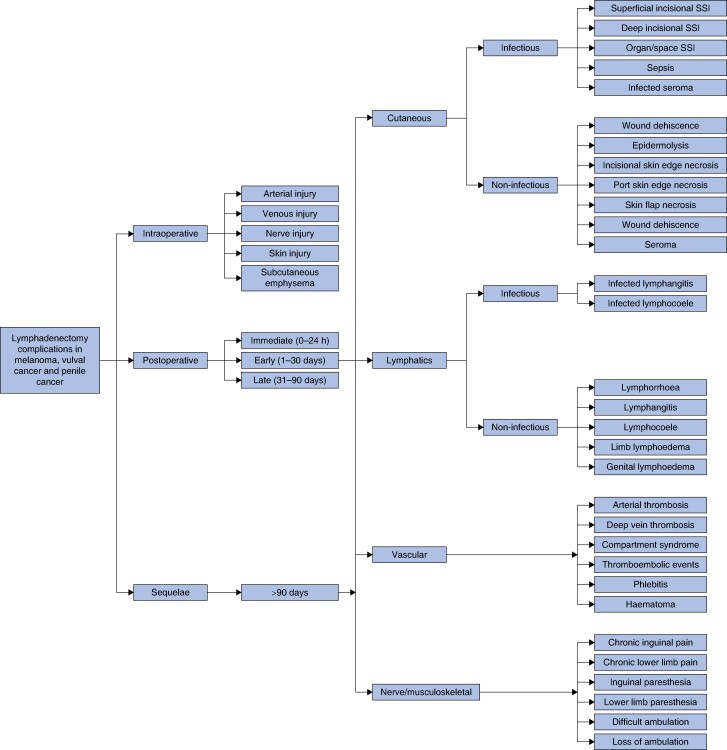
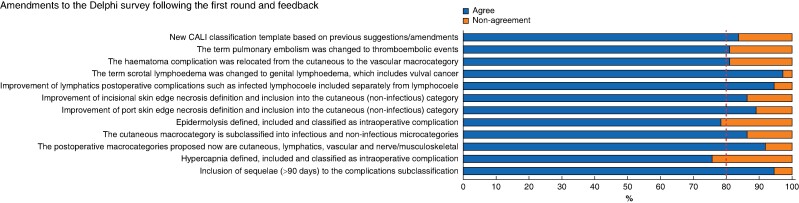
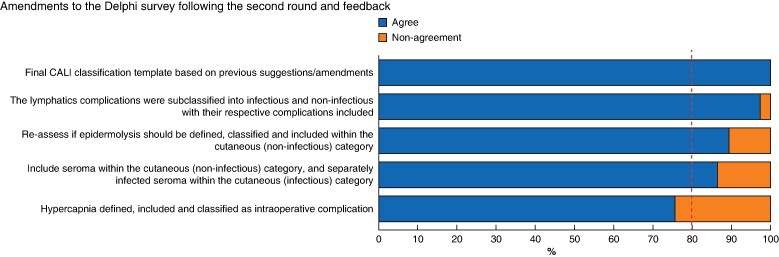
Forty-seven experienced consultants were enrolled: 26 (55.3%) urologists, 11 (23.4%) surgical oncologists, 6 (12.8%) general surgeons and 4 (8.5%) gynaecology oncologists. Based on their expertise, 31 (66%), 10 (21.3%) and 22 (46.8%) of the participants treat penile cancer, vulval cancer and melanoma using inguinal lymph node dissection respectively; 89.4% (42 of 47) agreed with the definitions and inclusion as part of the inguinal lymph node dissection intraoperative complication group, while 93.6% (44 of 47) agreed that postoperative complications should be subclassified into five macrocategories. Unanimous agreement (100%, 37 of 37) was achieved with the final standardized classification system for reporting inguinal lymph node dissection complications in melanoma, vulval cancer and penile cancer.
The complications and adverse events in lymphadenectomy of the inguinal area classification system has been developed as a tool to standardize the assessment and reporting of complications during inguinal lymph node dissection for the treatment of melanoma, vulval and penile cancer.
腹股沟淋巴结清扫术在黑色素瘤、阴茎和外阴癌的治疗中起着重要作用。腹股沟淋巴结清扫术与各种术中及术后并发症相关,其分类和报告存在显著的异质性。这种缺乏标准化的情况给研究和报告腹股沟淋巴结清扫术的结果带来了挑战。本研究的目的是通过建立一个全球性的合作组织——腹股沟区域淋巴结清扫术并发症和不良事件(CALI)小组,制定一个系统来规范腹股沟淋巴结清扫术围手术期并发症的分类和报告。
采用改良的 3 轮 Delphi 共识方法,对黑色素瘤、阴茎和外阴癌的腹股沟淋巴结清扫术专家进行了全球调查。该专家组包括普通外科医生、泌尿科医生和肿瘤学家(妇科和外科)。该调查评估了专家对腹股沟淋巴结清扫术围手术期并发症的共识程度。通过总体百分比一致率和 Cronbach's α 评估小组内评分者间的一致性和一致性。
共纳入 47 名经验丰富的顾问:26 名(55.3%)泌尿科医生、11 名(23.4%)外科肿瘤学家、6 名(12.8%)普通外科医生和 4 名(8.5%)妇科肿瘤学家。根据他们的专业知识,31 名(66%)、10 名(21.3%)和 22 名(46.8%)参与者分别采用腹股沟淋巴结清扫术治疗阴茎癌、外阴癌和黑色素瘤;89.4%(42/47)同意将定义和纳入作为腹股沟淋巴结清扫术术中并发症组的一部分,而 93.6%(44/47)同意将术后并发症分为五个宏观类别。最终标准化的报告黑色素瘤、外阴癌和阴茎癌腹股沟淋巴结清扫术并发症的分类系统得到了一致同意(100%,37/37)。
腹股沟淋巴结清扫术并发症和不良事件分类系统已被开发为一种工具,用于规范腹股沟淋巴结清扫术治疗黑色素瘤、外阴和阴茎癌的并发症评估和报告。