Department of Medicine, Harvard Medical School, Mount Auburn Hospital, 330 Mount Auburn Street, Cambridge, MA, 02131, USA.
Harvard Medical School, Boston, MA, USA.
Sci Rep. 2024 Jul 10;14(1):15953. doi: 10.1038/s41598-024-61616-z.
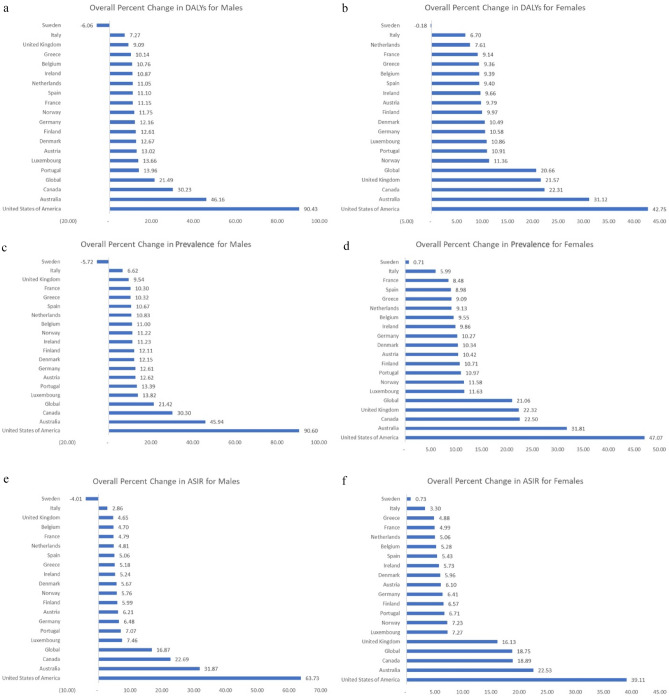
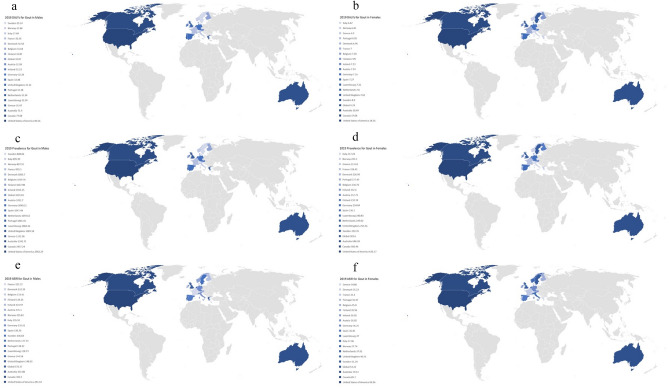
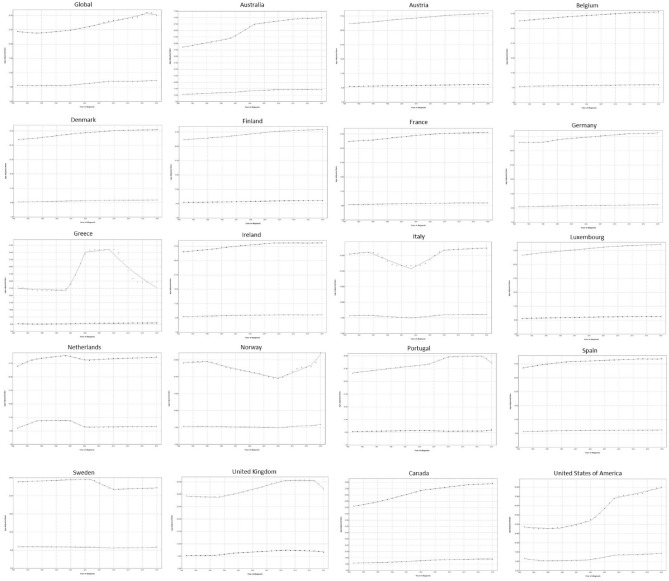
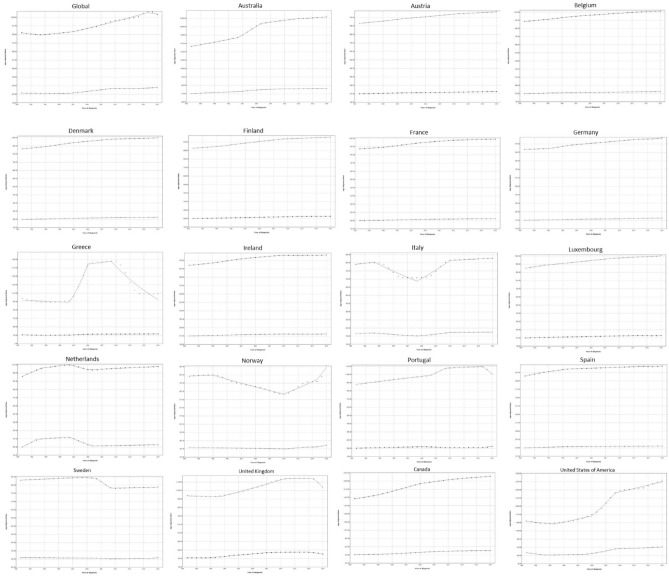
The global incidence of gout has increased rapidly, likely secondary to the increase in the prevalence of conditions that predispose to gout, such as obesity. Depending on the population studied, the prevalence of gout ranges from less than 1 to 6.8%. Thus, gout can be a significant burden on healthcare systems. The objective of this study is to observe the trends in the incidence, prevalence, and disability-adjusted life years (DALYs) of gout between 1990 and 2019 globally and in the European Union (EU) 15+ nations. We extracted data from the Global Burden of Disease Study database based on the International Classification of Diseases (ICD) versions 10 and 9. Incidence, prevalence, and disability-adjusted life years (DALYs) were extracted for individual EU15+ countries and globally in males and females between 1990 and 2019. Joinpoint regression analysis was used to describe trends. Between 1990 and 2019, gout prevalence, incidence, and DALYs increased in both males (+ 21.42%, + 16.87%, + 21.49%, respectively) and females (+ 21.06%, + 18.75%, + 20.66%, respectively) globally. The United States of America had the highest increase in prevalence (males: + 90.6%; females + 47.1%), incidence (males: + 63.73%; females: + 39.11%) and DALYs (males: + 90.43%; females: + 42.75%). Incidence, prevalence, and DALYs from gout are increasing worldwide and in most of the EU15+ countries for males and females. Studies have reported the association of gout with comorbidities such as metabolic syndrome, diabetes mellitus, and cardiovascular disease. Health policies and resource allocation are required to increase awareness and modify risk factors globally.
全球范围内痛风的发病率迅速上升,这可能是由于导致痛风的易患疾病(如肥胖症)的患病率增加所致。根据研究的人群不同,痛风的患病率从不足 1%到 6.8%不等。因此,痛风可能给医疗保健系统带来重大负担。本研究旨在观察全球和欧盟 15 国(EU15)痛风发病率、患病率和伤残调整生命年(DALYs)在 1990 年至 2019 年间的变化趋势。我们从全球疾病负担研究数据库中提取了基于国际疾病分类(ICD)第 10 版和第 9 版的数据。我们在 1990 年至 2019 年间,在欧盟 15 国男性和女性中分别提取了痛风在个体国家和全球的发病率、患病率和伤残调整生命年(DALYs)。采用 Joinpoint 回归分析描述趋势。1990 年至 2019 年间,全球男性(+21.42%、+16.87%、+21.49%)和女性(+21.06%、+18.75%、+20.66%)痛风的患病率、发病率和 DALYs 均有所增加。美国的患病率增长最高(男性:+90.6%;女性:+47.1%)、发病率增长最高(男性:+63.73%;女性:+39.11%)、DALYs 增长最高(男性:+90.43%;女性:+42.75%)。全球范围内,男性和女性痛风的发病率、患病率和 DALYs 都在增加,在大多数欧盟 15 国也是如此。研究报告称,痛风与代谢综合征、糖尿病和心血管疾病等合并症有关。需要制定卫生政策和资源配置,以提高全球的认识并改变风险因素。