Medicinal Chemistry Research Group and National Drug Discovery and Development Laboratory, HUN-REN Research Centre for Natural Sciences, Budapest 1117, Hungary.
Department of Organic Chemistry and Technology, Budapest University of Technology and Economics, Budapest 1111, Hungary.
ACS Chem Biol. 2024 Aug 16;19(8):1743-1756. doi: 10.1021/acschembio.4c00217. Epub 2024 Jul 11.
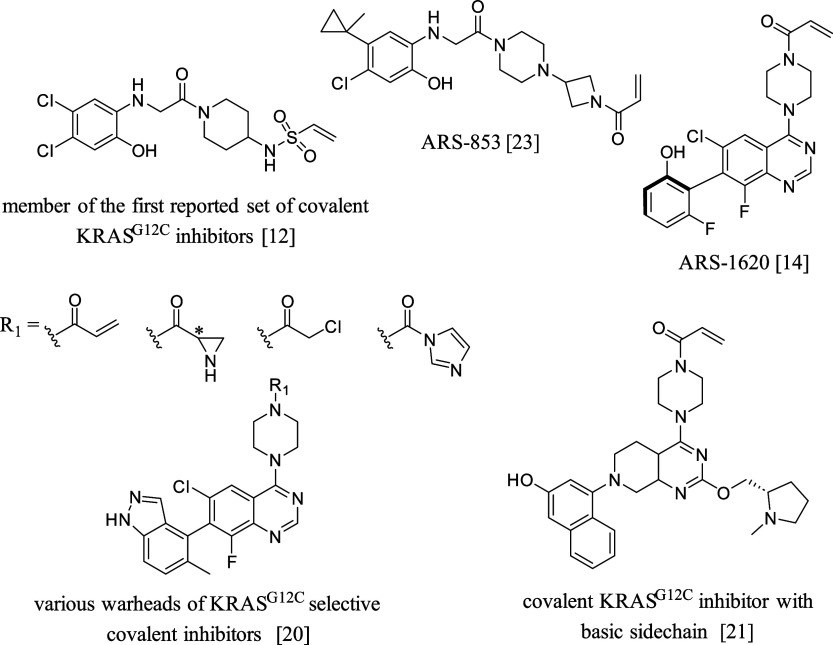
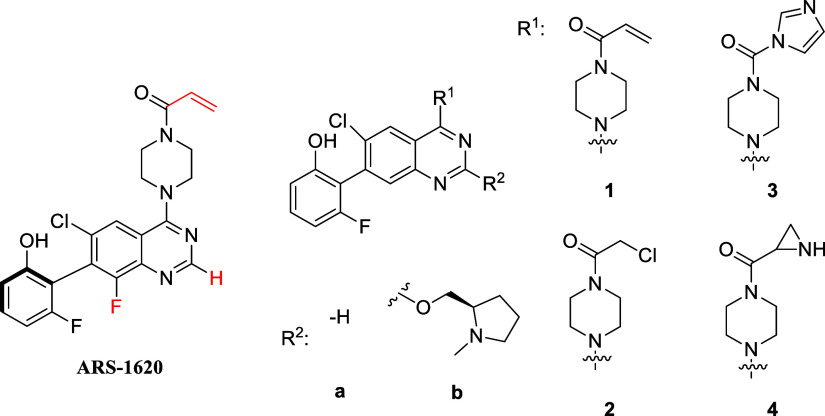
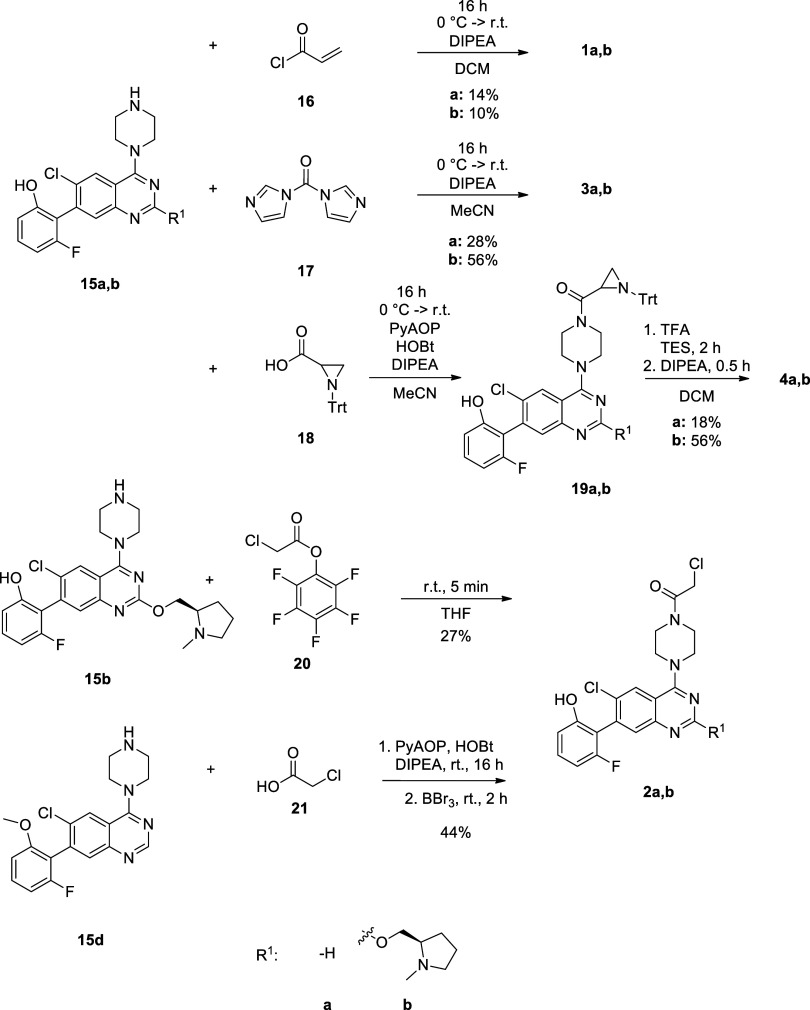
Covalent drugs might bear electrophiles to chemically modify their targets and have the potential to target previously undruggable proteins with high potency. Covalent binding of drug-size molecules includes a noncovalent recognition provided by secondary interactions and a chemical reaction leading to covalent complex formation. Optimization of their covalent mechanism of action should involve both types of interactions. Noncovalent and covalent binding steps can be characterized by an equilibrium dissociation constant () and a reaction rate constant (), respectively, and they are affected by both the warhead and the scaffold of the ligand. The relative contribution of these two steps was investigated on a prototypic drug target KRAS, an oncogenic mutant of KRAS. We used a synthetically more accessible nonchiral core derived from ARS-1620 that was equipped with four different warheads and a previously described KRAS-specific basic side chain. Combining these structural changes, we have synthesized novel covalent KRAS inhibitors and tested their binding and biological effect on KRAS by various biophysical and biochemical assays. These data allowed us to dissect the effect of scaffold and warhead on the noncovalent and covalent binding event. Our results revealed that the atropisomeric core of ARS-1620 is not indispensable for KRAS inhibition, the basic side chain has little effect on either binding step, and warheads affect the covalent reactivity but not the noncovalent binding. This type of analysis helps identify structural determinants of efficient covalent inhibition and may find use in the design of covalent agents.
共价药物可能带有亲电试剂,以化学方式修饰其靶标,并有可能以前所未有的效力靶向以前无法成药的蛋白质。药物大小分子的共价结合包括由次级相互作用提供的非共价识别和导致共价复合物形成的化学反应。优化其共价作用机制应涉及这两种相互作用。非共价和共价结合步骤可以通过平衡解离常数()和反应速率常数()来表征,它们受到弹头和配体支架的影响。我们使用了一种合成上更容易获得的源自 ARS-1620 的非手性核心,该核心带有四个不同的弹头和以前描述的 KRAS 特异性碱性侧链。通过结合这些结构变化,我们合成了新型共价 KRAS 抑制剂,并通过各种生物物理和生化测定测试了它们对 KRAS 的结合和生物学效应。这些数据使我们能够剖析支架和弹头对非共价和共价结合事件的影响。我们的结果表明,ARS-1620 的旋光异构核心对于 KRAS 抑制并非不可或缺,碱性侧链对结合步骤影响不大,而弹头影响共价反应性但不影响非共价结合。这种类型的分析有助于确定高效共价抑制的结构决定因素,并可能在设计共价试剂时找到用途。