Department of Biochemistry & Biophysics, University of North Carolina at Chapel Hill, Chapel Hill, North Carolina, USA.
Department of Biochemistry, Wake Forest School of Medicine, Winston-Salem, North Carolina, USA.
J Biol Chem. 2022 Aug;298(8):102186. doi: 10.1016/j.jbc.2022.102186. Epub 2022 Jun 24.
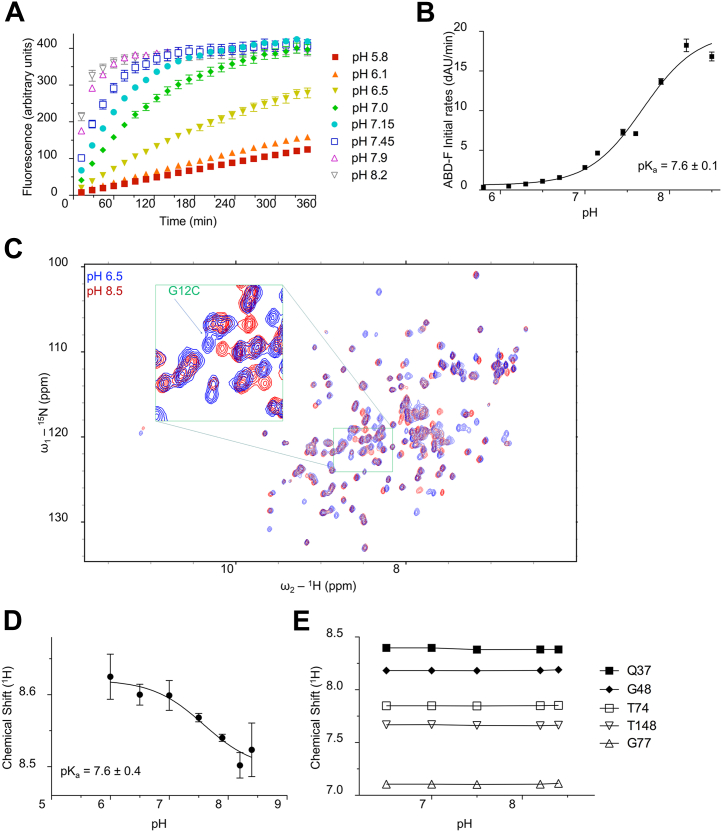
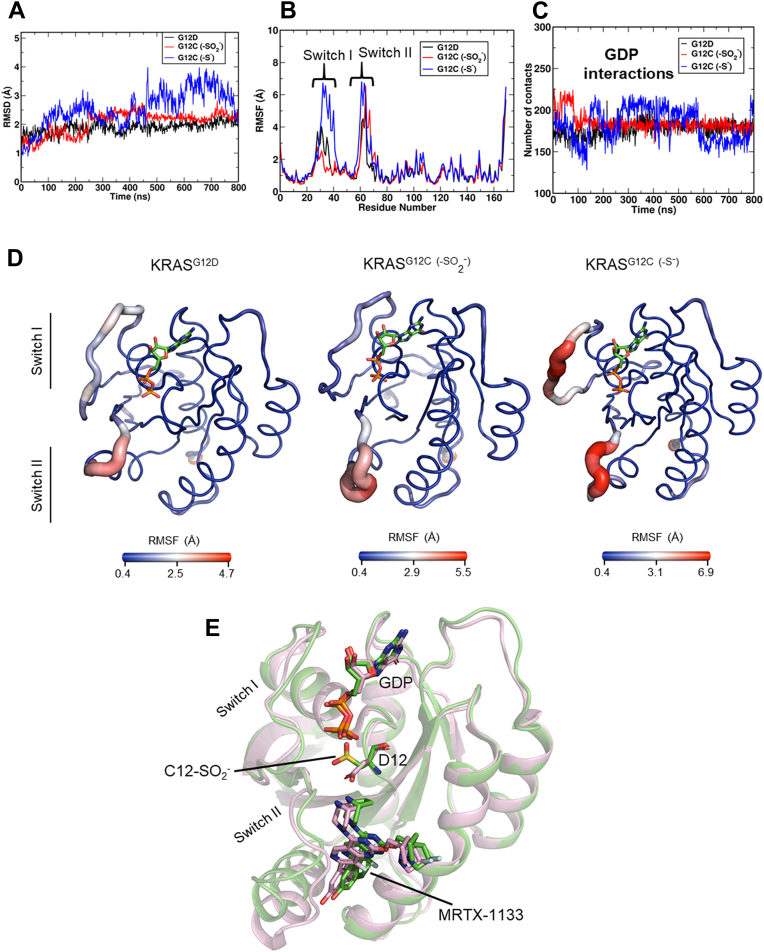
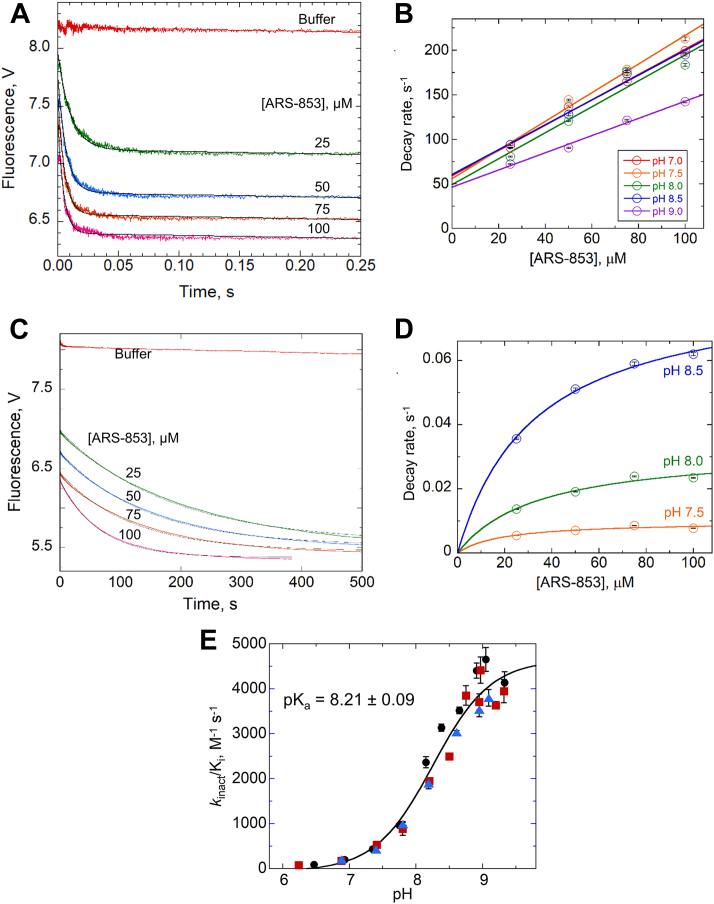
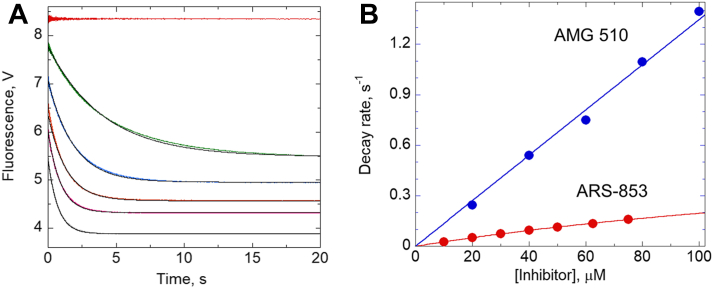
The recent development of mutant-selective inhibitors for the oncogenic KRAS allele has generated considerable excitement. These inhibitors covalently engage the mutant C12 thiol located within the phosphoryl binding loop of RAS, locking the KRAS protein in an inactive state. While clinical trials of these inhibitors have been promising, mechanistic questions regarding the reactivity of this thiol remain. Here, we show by NMR and an independent biochemical assay that the pK of the C12 thiol is depressed (pK ∼7.6), consistent with susceptibility to chemical ligation. Using a validated fluorescent KRAS variant amenable to stopped-flow spectroscopy, we characterized the kinetics of KRAS fluorescence changes upon addition of ARS-853 or AMG 510, noting that at low temperatures, ARS-853 addition elicited both a rapid first phase of fluorescence change (attributed to binding, K = 36.0 ± 0.7 μM) and a second, slower pH-dependent phase, taken to represent covalent ligation. Consistent with the lower pK of the C12 thiol, we found that reversible and irreversible oxidation of KRAS occurred readily both in vitro and in the cellular environment, preventing the covalent binding of ARS-853. Moreover, we found that oxidation of the KRAS Cys12 to a sulfinate altered RAS conformation and dynamics to be more similar to KRAS in comparison to the unmodified protein, as assessed by molecular dynamics simulations. Taken together, these findings provide insight for future KRAS drug discovery efforts, and identify the occurrence of G12C oxidation with currently unknown biological ramifications.
最近,针对致癌 KRAS 等位基因的突变选择性抑制剂的发展引起了相当大的关注。这些抑制剂通过共价结合 RAS 磷酸化结合环内的突变 C12 巯基,将 KRAS 蛋白锁定在无活性状态。虽然这些抑制剂的临床试验很有希望,但关于该巯基反应性的机制问题仍然存在。在这里,我们通过 NMR 和独立的生化测定表明,C12 巯基的 pK 值降低(pK ∼7.6),这与化学连接的易感性一致。使用经过验证的适用于停流光谱法的荧光 KRAS 变体,我们研究了添加 ARS-853 或 AMG 510 后 KRAS 荧光变化的动力学,注意到在低温下,ARS-853 的添加引发了荧光变化的快速第一相(归因于结合,K = 36.0 ± 0.7 μM)和第二相,较慢的 pH 依赖性相,被认为代表共价连接。与 C12 巯基的较低 pK 值一致,我们发现 KRAS 的可逆和不可逆氧化在体外和细胞环境中都很容易发生,从而阻止了 ARS-853 的共价结合。此外,我们发现 KRAS Cys12 氧化为亚磺酸盐会改变 RAS 的构象和动力学,与未修饰的蛋白质相比,更类似于 KRAS,这可以通过分子动力学模拟来评估。总之,这些发现为未来的 KRAS 药物发现工作提供了深入的了解,并确定了目前未知生物学后果的 G12C 氧化的发生。