Aix Marseille Université, CNRS, Université de Toulon, IRD, OSU Pythéas, Mediterranean Institute of Oceanography (MIO), UM 110, 13288 Marseille, France.
Turing Center for Living Systems, Aix-Marseille University, Marseille, France.
FEMS Microbiol Ecol. 2024 Jul 12;100(8). doi: 10.1093/femsec/fiae095.
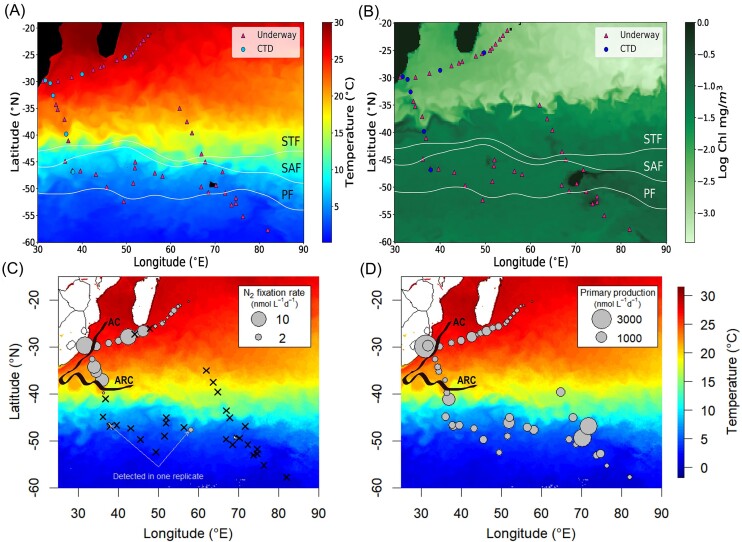
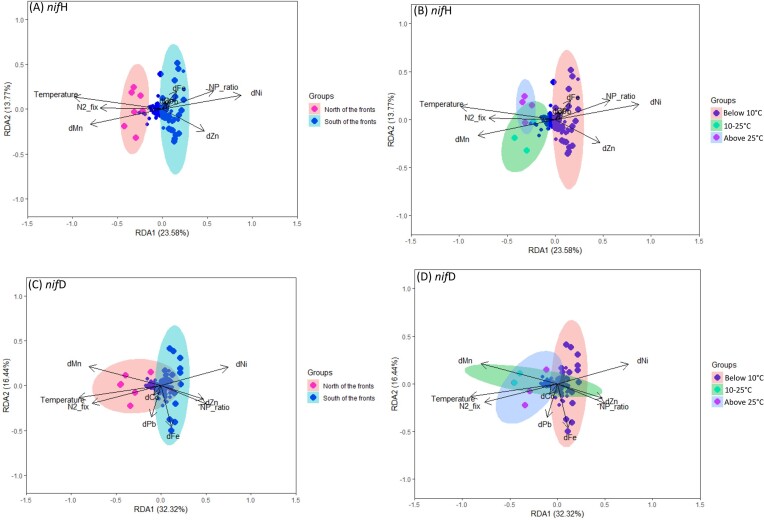
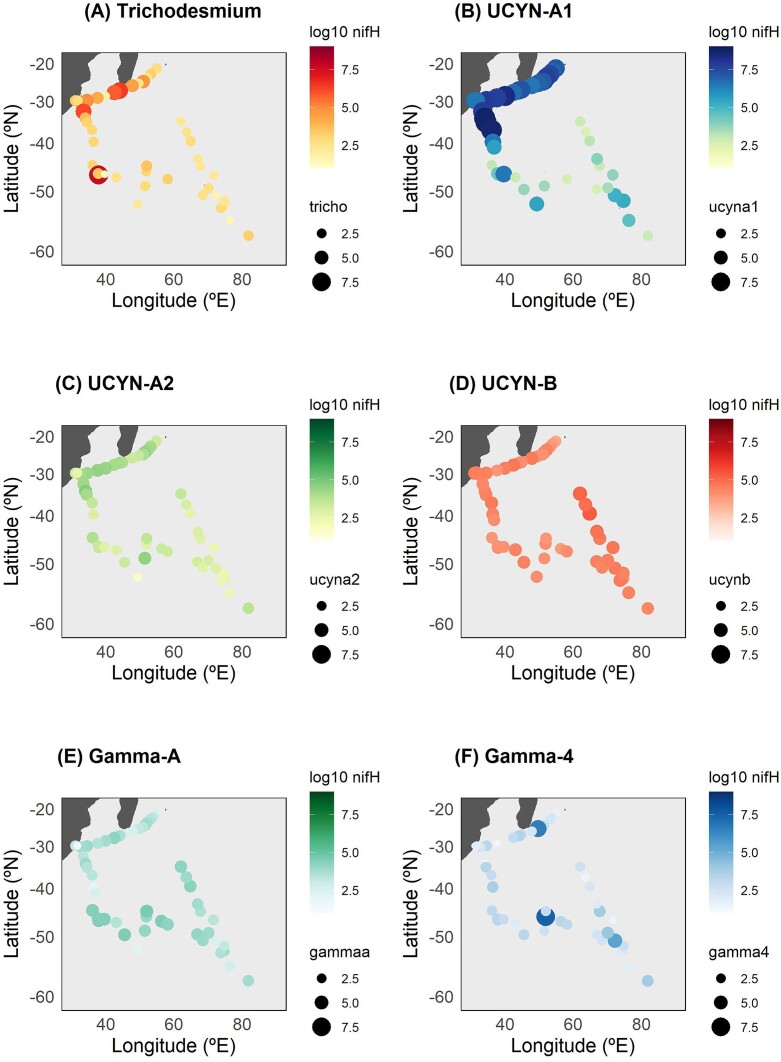
Dinitrogen (N2) fixation represents a key source of reactive nitrogen in marine ecosystems. While the process has been rather well-explored in low latitudes of the Atlantic and Pacific Oceans, other higher latitude regions and particularly the Indian Ocean have been chronically overlooked. Here, we characterize N2 fixation and diazotroph community composition across nutrient and trace metals gradients spanning the multifrontal system separating the oligotrophic waters of the Indian Ocean subtropical gyre from the high nutrient low chlorophyll waters of the Southern Ocean. We found a sharp contrasting distribution of diazotroph groups across the frontal system. Notably, cyanobacterial diazotrophs dominated north of fronts, driving high N2 fixation rates (up to 13.96 nmol N l-1 d-1) with notable peaks near the South African coast. South of the fronts non-cyanobacterial diazotrophs prevailed without significant N2 fixation activity being detected. Our results provide new crucial insights into high latitude diazotrophy in the Indian Ocean, which should contribute to improved climate model parameterization and enhanced constraints on global net primary productivity projections.
氮气(N2)固定是海洋生态系统中活性氮的主要来源之一。尽管该过程在大西洋和太平洋的低纬度地区已经得到了相当充分的研究,但其他高纬度地区,特别是印度洋,长期以来一直被忽视。在这里,我们描述了横跨营养盐和痕量金属梯度的 N2 固定和固氮生物群落组成,这些梯度跨越了将印度洋亚热带环流贫营养低盐度水与南大洋高营养低叶绿素水分隔开来的多锋系统。我们发现固氮生物群落在锋系统中呈现出明显的对比分布。值得注意的是,蓝藻固氮生物在锋面以北占主导地位,驱动着高 N2 固定率(高达 13.96 nmol N l-1 d-1),在南非海岸附近出现显著峰值。在锋面以南,非蓝藻固氮生物占主导地位,没有检测到显著的 N2 固定活性。我们的研究结果为印度洋高纬度固氮提供了新的重要见解,这将有助于改进气候模型参数化,并增强对全球净初级生产力预测的约束。