Division of Chest Surgery, Department of Surgery, Cathay General Hospital, No. 280, Sec. 4, Renai Road, Daan District, Taipei, 106, Taiwan.
School of Medicine, Fu-Jen Catholic University, No. 69, Guizi Road, Taishan District, New Taipei City, 22241, Taiwan.
Cancer Imaging. 2024 Jul 11;24(1):91. doi: 10.1186/s40644-024-00733-4.
This study compared the survival outcomes after thermal ablation versus wedge resection in patients with stage I non-small cell lung cancer (NSCLC) ≤ 2 cm.
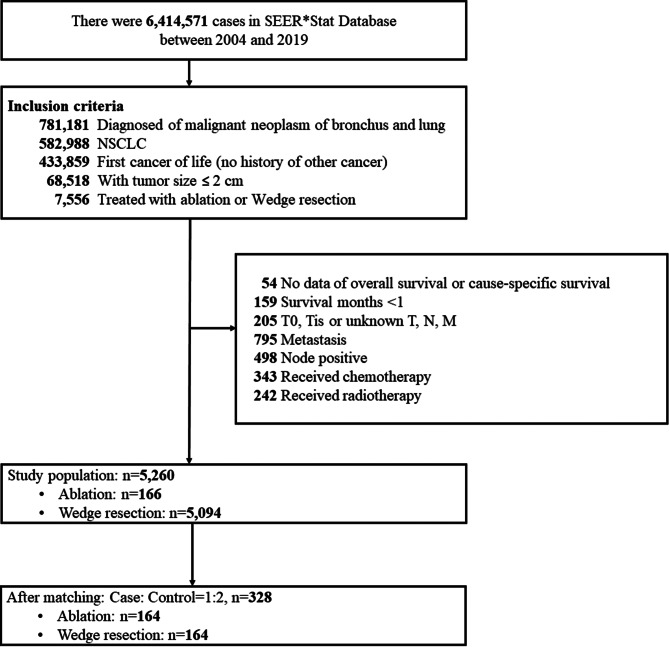
Data from the United States (US) National Cancer Institute Surveillance Epidemiology and End Results (SEER) database from 2004 to 2019 were retrospectively analyzed. Patients with stage I NSCLC and lesions ≤ 2 cm who received thermal ablation or wedge resection were included. Patients who received chemotherapy or radiotherapy were excluded. Propensity-score matching (PSM) was applied to balance the baseline characteristics between patients who underwent the two procedures.
Univariate and Cox regression analyses were performed to determine the associations between study variables, overall survival (OS), and cancer-specific survival (CSS). After PSM, 328 patients remained for analysis. Multivariable Cox regression analysis revealed, compared to wedge resection, thermal ablation was significantly associated with a greater risk of poor OS (adjusted HR [aHR]: 1.34, 95% CI: 1.09-1.63, p = 0.004) but not CSS (aHR: 1.28, 95% CI: 0.96-1.71, p = 0.094). In stratified analyses, no significant differences were observed with respect to OS and CSS between the two procedures regardless of histology and grade. In patients with tumor size 1 to 2 cm, compared to wedge resection, thermal ablation was significantly associated with a higher risk of poor OS (aHR: 1.35, 95% CI: 1.10-1.66, p = 0.004). In contrast, no significant difference was found on OS and CSS between thermal ablation and wedge resection among those with tumor size < 1 cm.
In patients with stage I NSCLC and tumor size < 1 cm, thermal ablation has similar OS and CSS with wedge resection.
本研究比较了热消融与楔形切除术治疗≤2cm Ⅰ期非小细胞肺癌(NSCLC)患者的生存结局。
回顾性分析了 2004 年至 2019 年美国国家癌症研究所监测、流行病学和最终结果(SEER)数据库的数据。纳入Ⅰ期 NSCLC 且病变≤2cm 且接受热消融或楔形切除术的患者。排除接受化疗或放疗的患者。应用倾向评分匹配(PSM)平衡两种手术患者的基线特征。
进行单变量和 Cox 回归分析,以确定研究变量与总生存期(OS)和癌症特异性生存期(CSS)之间的关系。PSM 后,328 例患者纳入分析。多变量 Cox 回归分析显示,与楔形切除术相比,热消融与较差的 OS 风险显著相关(调整后 HR[aHR]:1.34,95%CI:1.09-1.63,p=0.004),但与 CSS 无关(aHR:1.28,95%CI:0.96-1.71,p=0.094)。分层分析显示,无论组织学和分级如何,两种手术在 OS 和 CSS 方面均无显著差异。对于肿瘤大小为 1 至 2cm 的患者,与楔形切除术相比,热消融与较差的 OS 风险显著相关(aHR:1.35,95%CI:1.10-1.66,p=0.004)。相反,肿瘤大小<1cm 的患者中,热消融与楔形切除术在 OS 和 CSS 方面无显著差异。
对于Ⅰ期 NSCLC 且肿瘤大小<1cm 的患者,热消融与楔形切除术具有相似的 OS 和 CSS。