Asimakopoulos Anastasios D, Kochergin Maxim, Colalillo Gaia, Fahmy Omar, Hassan Fahmy, Renninger Markus, Gallioli Andrea, Gavrilov Pavel, Gakis Georgios
Urology Unit, Fondazione PTV Policlinico Tor Vergata, Rome, Italy.
Department of Urology and Neurourology, BG Unfallkrankenhaus Berlin, Berlin, Germany.
Bladder Cancer. 2023 Sep 25;9(3):237-251. doi: 10.3233/BLC-230043. eCollection 2023.
With the exception of the FDA-approved valrubicin and pembrolizumab, there are no standard second-line treaments for BCG-unresponsive high-risk non-muscle invasive bladder cancer (NMIBC).
To provide a systematic review of the novel intravesically administered therapeutic agents for the salvage treatment of BCG-unresponsive NMIBC.
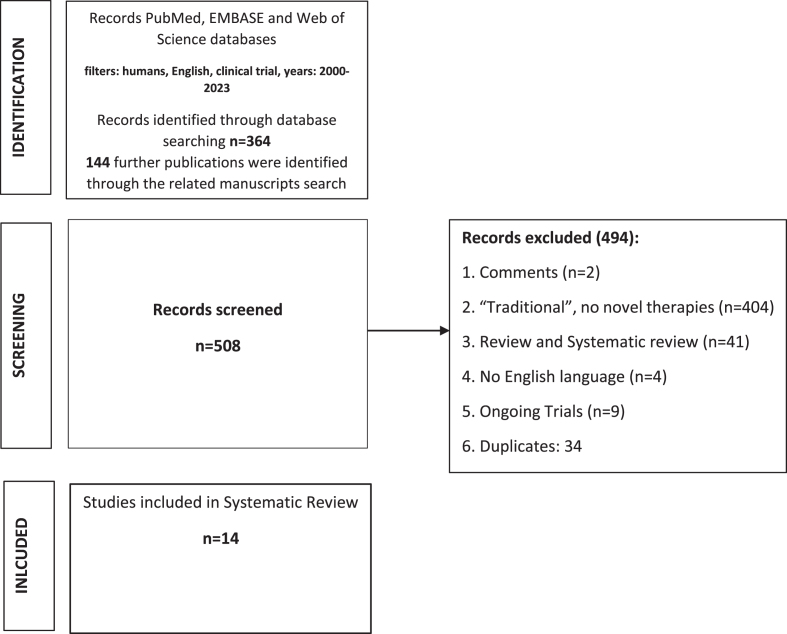
Online search of the PubMed, EMBASE and Web of Science databases was performed. The endpoints of this review were to evaluate the efficacy of the agents in terms of complete response rates (CR) and durability of CR, overall survival, recurrence-free survival and cancer-specific survival and to report on their toxicity profile. A search on Clinicaltrials.gov was performed to identify ongoing clinical trials.
14 studies were included in this review. The critical clinical need for the development of an effective, safe and durable intravesical drug for the salvage treatment of high-risk NMIBC seems to be met mainly by intravesical gene therapy; in fact, data support the FDA-approved nadofaragene firadenovec as a potentially important therapeutic advancement in this context. Promising results are also being obtained by the combination of N-803/BCG and by innovative drug delivery systems.
Considering the plethora of novel intravesical treatments that have completed phase II evaluation, one can reasonably expect that clinicians will soon have at their disposal new agents and treatment options for BCG-unresponsive NMIBC. In the near future, it will be up to the urologist to identify, for each specific patient, the right agent to use, based on safety, results and cost-effectiveness.
除了美国食品药品监督管理局(FDA)批准的瓦鲁比星和帕博利珠单抗外,对于卡介苗无反应的高危非肌肉浸润性膀胱癌(NMIBC),尚无标准的二线治疗方法。
对用于卡介苗无反应性NMIBC挽救治疗的新型膀胱内给药治疗药物进行系统评价。
对PubMed、EMBASE和科学网数据库进行在线检索。本综述的终点是根据完全缓解率(CR)和CR的持久性、总生存期、无复发生存期和癌症特异性生存期评估药物的疗效,并报告其毒性特征。在Clinicaltrials.gov上进行检索以识别正在进行的临床试验。
本综述纳入了14项研究。开发一种有效、安全且持久的膀胱内药物用于高危NMIBC挽救治疗的关键临床需求似乎主要通过膀胱内基因治疗来满足;事实上,数据支持FDA批准的纳多柔比星腺病毒载体在这方面是一项潜在的重要治疗进展。N-803/卡介苗联合应用和创新给药系统也取得了有前景的结果。
考虑到大量新型膀胱内治疗已完成II期评估,人们可以合理预期临床医生很快将有新的药物和治疗选择用于卡介苗无反应性NMIBC。在不久的将来,泌尿外科医生的职责是根据安全性、疗效和成本效益,为每个特定患者确定合适的用药。