Kumnig Martin, Kobler Caroline, Zaccardelli Alessandra, Brandacher Gerald, Talbot Simon G
Department of Psychiatry, Psychotherapy, Psychosomatics and Medical Psychology, Center for Advanced Psychology in Plastic and Transplant Surgery, Medical University of Innsbruck, Innsbruck, Austria.
Division of Plastic Surgery, Brigham and Women's Hospital, Boston, MA, United States.
Front Transplant. 2024 Jun 11;3:1406626. doi: 10.3389/frtra.2024.1406626. eCollection 2024.
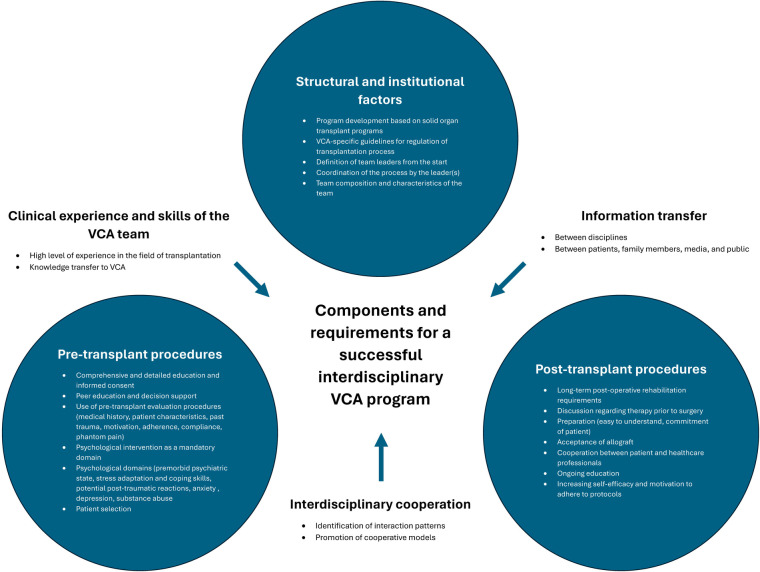
Vascularized Composite Allotransplantation (VCA) offers a unique option to restore form and function after limb loss or facial trauma that cannot be satisfactorily accomplished through traditional prosthetics or reconstructions. Establishing a successful Upper Extremity Transplantation (UET) program requires strong leadership and a structured surgical team, and extensive interdisciplinary collaboration. We conducted a qualitative study among 12 health care professionals and patients. Informed consent was obtained per protocol, and semi-structured interviews were conducted online and recorded. Participants reported their perceptions of factors that either favored or hindered a successful outcome, including functional status before and after surgery, preparation for transplant, shared decision-making, rehabilitation, and psychosocial support. Thematic analysis revealed that it is essential to establish a team comprising various disciplines well before performing VCA procedures. Defining a common goal and choosing a defined leader is a key factor in procedural success and requires open collaboration beyond what is typical. Primary described categories are interdisciplinary collaboration and skills of the VCA team, building and leading a VCA team, pre-transplant procedures, post-transplant course, and factors to consider when establishing a program. The basic roles of team science play an outsized role in establishing a VCA program. Transplantation medicine involves various overlapping scientific and medical categories requiring health professionals to consciously work together to establish complex vertical and horizontal communication webs between teams to obtain positive outcomes. In addition to medical considerations, patient-specific factors such as transparent communication, therapy plan establishment, plan adherence, and continual follow-up are significant factors to overall success.
血管化复合组织异体移植(VCA)为肢体缺失或面部创伤后恢复外形和功能提供了一种独特的选择,而这是传统假肢或重建手术无法令人满意地实现的。建立一个成功的上肢移植(UET)项目需要强有力的领导、结构化的手术团队以及广泛的跨学科协作。我们对12名医疗保健专业人员和患者进行了一项定性研究。按照方案获得了知情同意,并通过在线方式进行了半结构化访谈并录音。参与者报告了他们对有利于或阻碍成功结果的因素的看法,包括手术前后的功能状态、移植准备、共同决策、康复以及心理社会支持。主题分析表明,在进行VCA手术之前很久就组建一个由各学科组成的团队至关重要。确定一个共同目标并选择一位明确的领导者是手术成功的关键因素,这需要超越常规的开放协作。主要描述的类别包括跨学科协作和VCA团队的技能、组建和领导VCA团队、移植前程序、移植后过程以及建立项目时需要考虑的因素。团队科学的基本作用在建立VCA项目中发挥着巨大作用。移植医学涉及各种重叠的科学和医学类别,要求卫生专业人员有意识地共同努力,在团队之间建立复杂的纵向和横向沟通网络,以取得积极成果。除了医学方面的考虑,患者特定因素,如透明沟通、治疗计划制定、计划依从性和持续随访,也是总体成功的重要因素。