Bao Jianying, Shen Guangchen, Shi Haibin, Lin Zheng, Liu Sheng
Department of Interventional Radiology, The First Affiliated Hospital of Nanjing Medical University, Nanjing, China.
Department of Radiology, The First Affiliated Hospital of Nanjing Medical University, Nanjing, China.
Front Neurol. 2024 Jun 27;15:1413557. doi: 10.3389/fneur.2024.1413557. eCollection 2024.
This study aimed to evaluate whether the "weekend effect" would affect the time metrics and the prognosis of acute ischemic stroke (AIS) patients who underwent endovascular treatment (EVT) due to basilar artery occlusion (BAO).
Clinical data of AIS patients who underwent EVT due to BAO between December 2019 and July 2023 were retrospectively analyzed. At the time when the patients were admitted, the study population was divided into the weekdays daytime group and weekends nighttime group. In the subgroup analysis, the study cohort was divided into four groups: the weekdays daytime group, weekdays nighttime group, weekend daytime group, and weekend nighttime group. A good outcome was defined as a modified Rankin Scale score of ≤3 at 90 days after EVT. Time metrics [e.g. onset-to-door time (ODT) and door-to-puncture time (DPT)] and clinical outcomes were compared using appropriate statistical methods.
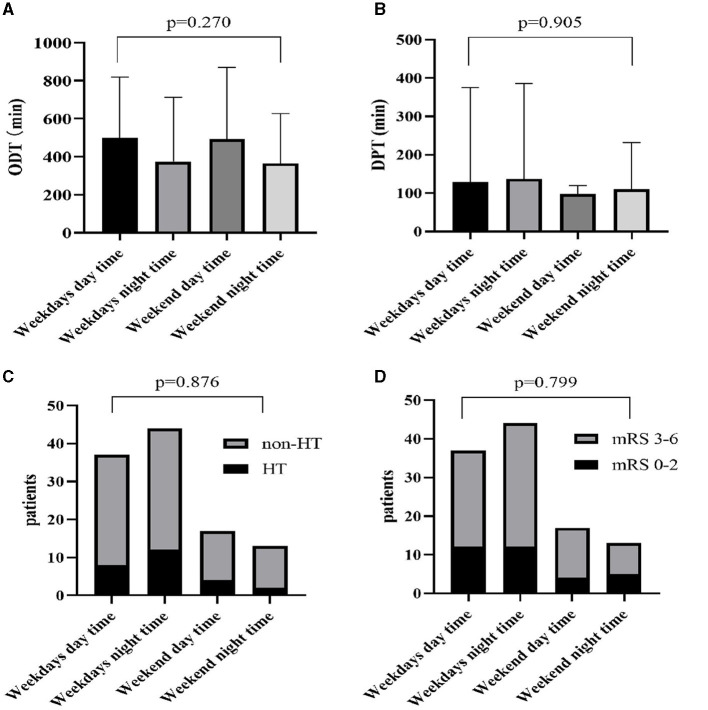
A total of 111 patients (88 male patients, mean age, 67.7 ± 11.7 years) were included. Of these, 37 patients were treated during weekdays daytime, while 74 patients were treated during nights or weekends. There were no statistically significant differences in ODT ( = 0.136), DPT ( = 0.931), and also clinical outcomes ( = 0.826) between the two groups. Similarly, we found no significant differences in the time metrics and clinical outcomes among the four sub-groups (all > 0.05).
This study did not reveal any influence of the "weekend effect" on the time metrics and clinical outcomes in AIS patients who underwent EVT due to BAO at a comprehensive stroke center.
本研究旨在评估“周末效应”是否会影响因基底动脉闭塞(BAO)而接受血管内治疗(EVT)的急性缺血性卒中(AIS)患者的时间指标和预后。
回顾性分析2019年12月至2023年7月期间因BAO接受EVT的AIS患者的临床资料。在患者入院时,将研究人群分为工作日白天组和周末夜间组。在亚组分析中,将研究队列分为四组:工作日白天组、工作日夜间组、周末白天组和周末夜间组。良好预后定义为EVT后90天时改良Rankin量表评分≤3分。使用适当的统计方法比较时间指标[如发病至入院时间(ODT)和入院至穿刺时间(DPT)]和临床结局。
共纳入111例患者(88例男性患者,平均年龄67.7±11.7岁)。其中,37例患者在工作日白天接受治疗,74例患者在夜间或周末接受治疗。两组之间的ODT(P = 0.136)、DPT(P = 0.931)以及临床结局(P = 0.826)均无统计学显著差异。同样,我们发现四个亚组之间的时间指标和临床结局也无显著差异(均P>0.05)。
本研究未发现“周末效应”对在综合卒中中心因BAO接受EVT的AIS患者的时间指标和临床结局有任何影响。