Anderson Evan J, Tippett Ashley, Begier Elizabeth, Gibson Theda, Ess Gabby, Patel Vikash, Taylor Meg, Reese Olivia, Salazar Luis, Jadhao Samadhan, Sun He-Ying, Hsiao Hui-Mien, Gupta Shadwal, Li Wensheng, Stephens Kathleen, Keane Amy, Ciric Caroline, Hellmeister Kieffer, Cheng Andrew, Al-Husein Zayna, Bristow Laurel, Hubler Robin, Liu Qing, Gessner Bradford D, Jodar Luis, Swerdlow David, Kalina Warren, Uppal Sonal, Kamidani Satoshi, Rouphael Nadine, Anderson Larry J, Rostad Christina A
Division of Infectious Diseases, Department of Pediatrics, Emory University School of Medicine, Atlanta, Georgia, USA.
Center for Childhood Infections and Vaccines, Children's Healthcare of Atlanta, Atlanta, Georgia, USA.
J Infect Dis. 2024 Dec 16;230(6):1342-1351. doi: 10.1093/infdis/jiae346.
Respiratory syncytial virus (RSV) is a leading cause of acute respiratory illness (ARI) in older adults. Optimizing diagnosis could improve understanding of RSV burden.
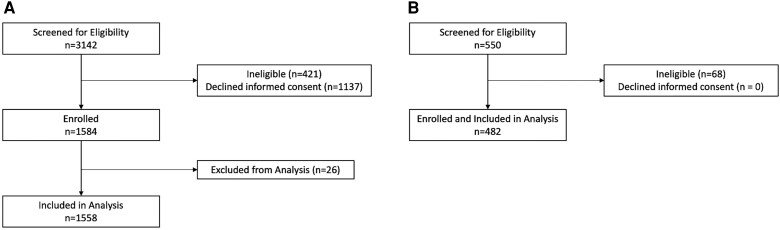
We enrolled adults ≥50 years of age hospitalized with ARI and adults of any age hospitalized with congestive heart failure or chronic obstructive pulmonary disease exacerbations at 2 hospitals during 2 respiratory seasons (2018-2020). We collected nasopharyngeal (NP) and oropharyngeal (OP) swabs (n = 1558), acute and convalescent sera (n = 568), and expectorated sputum (n = 153) from participants, and recorded standard-of-care (SOC) NP results (n = 805). We measured RSV antibodies by 2 immunoassays and performed BioFire testing on respiratory specimens.
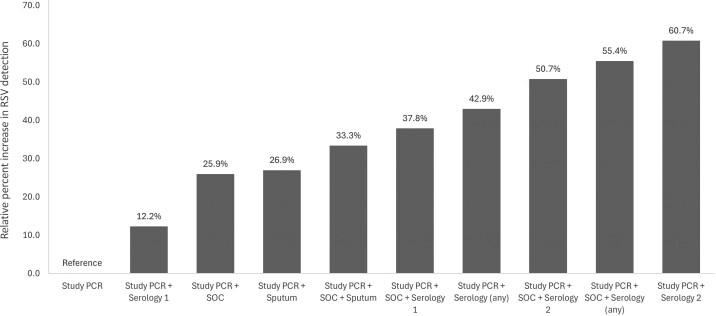
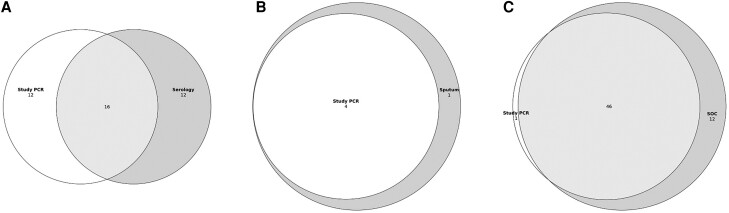
Of 1558 eligible participants, 92 (5.9%) tested positive for RSV by any diagnostic method. Combined NP/OP polymerase chain reaction (PCR) testing yielded 58 positives, while separate NP and OP testing identified 11 additional positives (18.9% increase). Compared to study NP/OP PCR alone, the addition of paired serology increased RSV detection by 42.9% (28 vs 40) among those with both specimen types, while the addition of SOC swab PCR increased RSV detection by 25.9% (47 vs 59).
The addition of paired serology testing, SOC swab results, and separate testing of NP and OP swabs improved RSV diagnostic yield in hospitalized adults.
呼吸道合胞病毒(RSV)是老年人急性呼吸道疾病(ARI)的主要病因。优化诊断有助于更好地了解RSV负担。
我们纳入了在两个呼吸季节(2018 - 2020年)期间,因ARI住院的≥50岁成年人以及在两家医院因充血性心力衰竭或慢性阻塞性肺疾病急性加重住院的任何年龄的成年人。我们从参与者那里收集了鼻咽(NP)和口咽(OP)拭子(n = 1558)、急性期和恢复期血清(n = 568)以及咳出的痰液(n = 153),并记录了标准护理(SOC)NP检测结果(n = 805)。我们通过两种免疫测定法测量RSV抗体,并对呼吸道标本进行BioFire检测。
在1558名符合条件的参与者中,通过任何诊断方法检测到92人(5.9%)RSV呈阳性。NP/OP联合聚合酶链反应(PCR)检测产生了58个阳性结果,而单独的NP和OP检测又发现了11个额外的阳性结果(增加了18.9%)。与仅研究NP/OP PCR相比,在同时拥有两种标本类型的人群中,添加配对血清学检测使RSV检测率提高了42.9%(28例对40例),而添加SOC拭子PCR使RSV检测率提高了25.9%(47例对59例)。
添加配对血清学检测、SOC拭子结果以及对NP和OP拭子进行单独检测可提高住院成人RSV的诊断率。