Ramirez Julio, Carrico Ruth, Wilde Ashley, Junkins Alan, Furmanek Stephen, Chandler Thomas, Schulz Paul, Hubler Robin, Peyrani Paula, Liu Qing, Trivedi Sonali, Uppal Sonal, Kalina Warren V, Falsey Ann R, Walsh Edward E, Yacisin Kari, Jodar Luis, Gessner Bradford D, Begier Elizabeth
Norton Infectious Diseases Institute, Norton Healthcare, 601 S Floyd St, Louisville, KY, 40202, USA.
Pfizer Inc, Collegeville, PA, USA.
Infect Dis Ther. 2023 Jun;12(6):1593-1603. doi: 10.1007/s40121-023-00805-1. Epub 2023 May 6.
Nearly all existing respiratory syncytial virus (RSV) incidence estimates are based on real-time polymerase chain reaction (RT-PCR) testing of nasal or nasopharyngeal (NP) swabs. Adding testing of additional specimen types to NP swab RT-PCR increases RSV detection. However, prior studies only made pairwise comparisons and the synergistic effect of adding multiple specimen types has not been quantified. We compared RSV diagnosis by NP swab RT-PCR alone versus NP swab plus saliva, sputum, and serology.
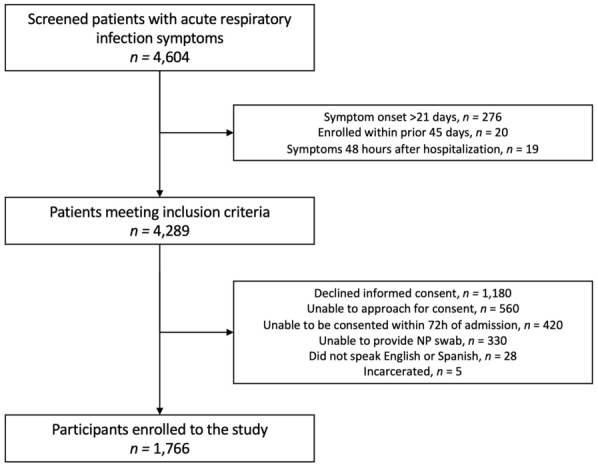
This was a prospective cohort study over two study periods (27 December 2021 to 1 April 2022 and 22 August 2022 to 11 November 2022) of patients aged ≥ 40 years hospitalized for acute respiratory illness (ARI) in Louisville, KY. NP swab, saliva, and sputum specimens were collected at enrollment and PCR tested (Luminex ARIES platform). Serology specimens were obtained at acute and convalescent timepoints (enrollment and 30-60-day visit). RSV detection rate was calculated for NP swab alone and for NP swab plus all other specimen type/test.
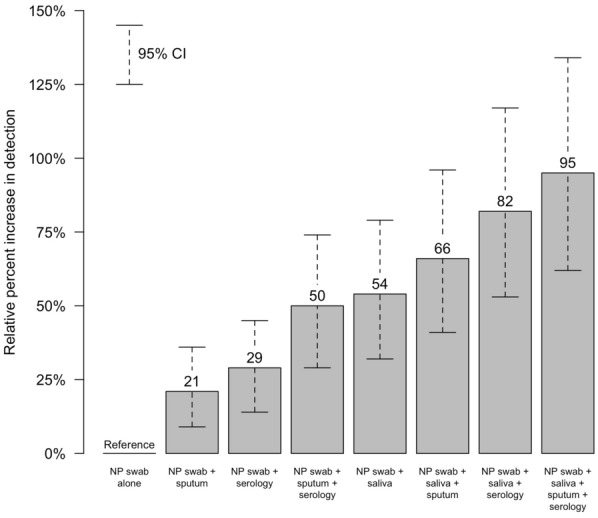
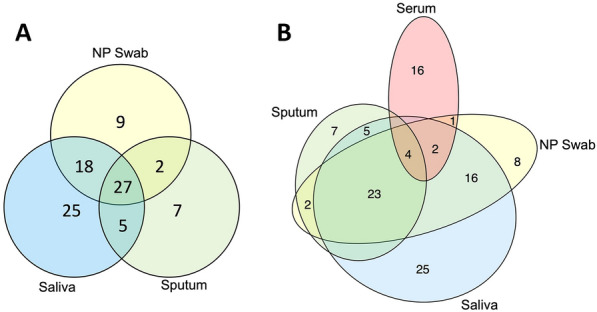
Among 1766 patients enrolled, 100% had NP swab, 99% saliva, 34% sputum, and 21% paired serology specimens. RSV was diagnosed in 56 (3.2%) patients by NP swab alone, and in 109 (6.2%) patients by NP swab plus additional specimens, corresponding to a 1.95 times higher rate [95% confidence interval (CI) 1.62, 2.34]. Limiting the comparison to the 150 subjects with all four specimen types available (i.e., NP swab, saliva, sputum, and serology), there was a 2.60-fold increase (95% CI 1.31, 5.17) compared to NP swab alone (3.3% versus 8.7%). Sensitivities by specimen type were: NP swab 51%, saliva 70%, sputum 72%, and serology 79%.
Diagnosis of RSV in adults was several-fold greater when additional specimen types were added to NP swab, even with a relatively low percentage of subjects with sputum and serology results available. Hospitalized RSV ARI burden estimates in adults based solely on NP swab RT-PCR should be adjusted for underestimation.
几乎所有现有的呼吸道合胞病毒(RSV)发病率估计均基于鼻拭子或鼻咽(NP)拭子的实时聚合酶链反应(RT-PCR)检测。在NP拭子RT-PCR检测基础上增加其他标本类型的检测可提高RSV的检出率。然而,既往研究仅进行了两两比较,添加多种标本类型的协同效应尚未量化。我们比较了单纯NP拭子RT-PCR与NP拭子联合唾液、痰液和血清学检测对RSV的诊断情况。
这是一项前瞻性队列研究,研究对象为肯塔基州路易斯维尔市年龄≥40岁因急性呼吸道疾病(ARI)住院的患者,研究分为两个阶段(2021年12月27日至2022年4月1日和2022年8月22日至2022年11月11日)。入组时采集NP拭子标本、唾液标本和痰液标本,并进行PCR检测(Luminex ARIES平台)。在急性期和恢复期(入组时及30 - 60天随访时)采集血清学标本。计算单纯NP拭子及NP拭子联合所有其他标本类型/检测的RSV检出率。
在1766例入组患者中,100%采集了NP拭子标本,99%采集了唾液标本,34%采集了痰液标本,21%采集了配对血清学标本。单纯NP拭子诊断出56例(3.2%)RSV患者,NP拭子联合其他标本诊断出109例(6.2%)RSV患者,相应检出率高出1.95倍[95%置信区间(CI)1.62, 2.34]。将比较限制在150例具备所有四种标本类型(即NP拭子、唾液、痰液和血清学标本)的受试者中,与单纯NP拭子相比(3.3%对8.7%),检出率提高了2.60倍(95% CI 1.31, 5.17)。各标本类型的敏感性分别为:NP拭子51%,唾液70%,痰液72%,血清学79%。
即使有痰标本和血清学结果的受试者比例相对较低,但在NP拭子检测基础上增加其他标本类型时,成人RSV的诊断率提高了数倍。仅基于NP拭子RT-PCR对成人住院RSV ARI负担的估计应进行调整,以避免低估。