State Key Laboratory of Genetic Engineering, Human Phenome Institute, Zhangjiang Fudan International Innovation Center, Center for Evolutionary Biology, School of Life Sciences, Department of Liver Surgery and Transplantation, Liver Cancer Institute, Zhongshan Hospital, Fudan University, Shanghai 200032, China.
Key Laboratory of Computational Biology, Shanghai Institute of Nutrition and Health, University of Chinese Academy of Sciences, Chinese Academy of Sciences, Shanghai 200031, China.
Mol Biol Evol. 2024 Jul 3;41(7). doi: 10.1093/molbev/msae144.
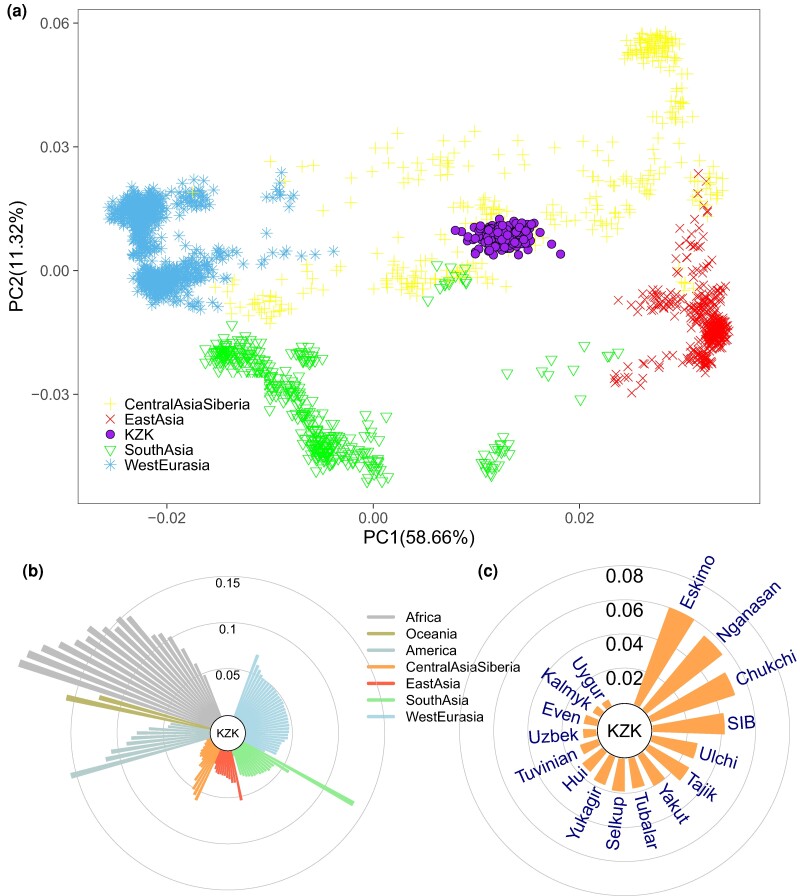
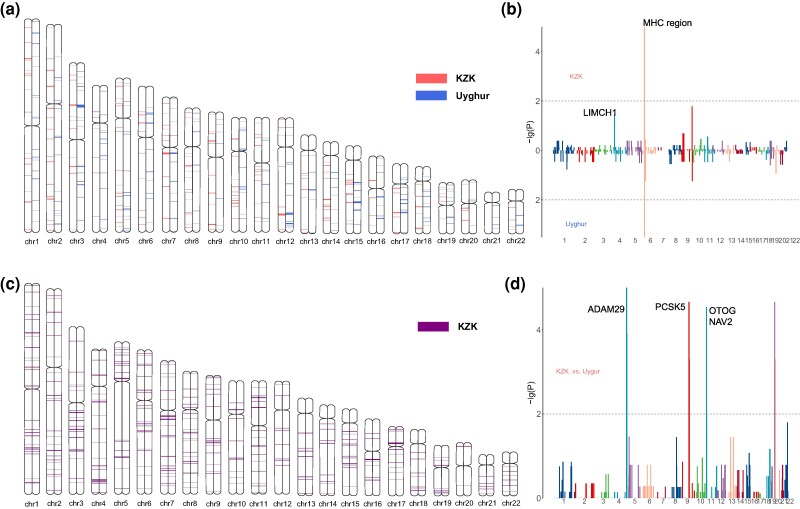
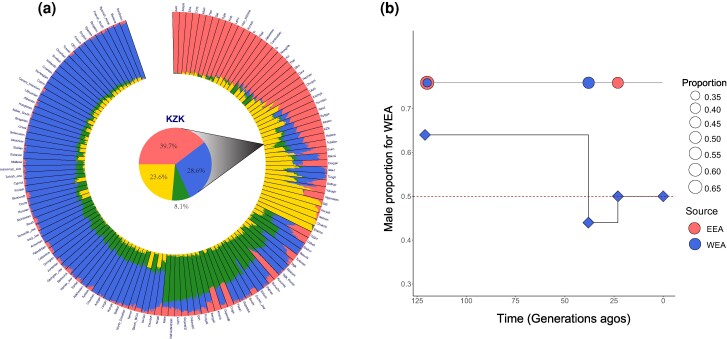
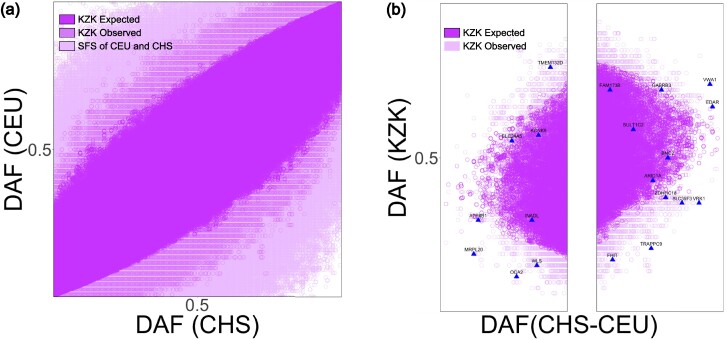
Kazakh people, like many other populations that settled in Central Asia, demonstrate an array of mixed anthropological features of East Eurasian (EEA) and West Eurasian (WEA) populations, indicating a possible scenario of biological admixture between already differentiated EEA and WEA populations. However, their complex biological origin, genomic makeup, and genetic interaction with surrounding populations are not well understood. To decipher their genetic structure and population history, we conducted, to our knowledge, the first whole-genome sequencing study of Kazakhs residing in Xinjiang (KZK). We demonstrated that KZK derived their ancestries from 4 ancestral source populations: East Asian (∼39.7%), West Asian (∼28.6%), Siberian (∼23.6%), and South Asian (∼8.1%). The recognizable interactions of EEA and WEA ancestries in Kazakhs were dated back to the 15th century BCE. Kazakhs were genetically distinctive from the Uyghurs in terms of their overall genomic makeup, although the 2 populations were closely related in genetics, and both showed a substantial admixture of western and eastern peoples. Notably, we identified a considerable sex-biased admixture, with an excess of western males and eastern females contributing to the KZK gene pool. We further identified a set of genes that showed remarkable differentiation in KZK from the surrounding populations, including those associated with skin color (SLC24A5, OCA2), essential hypertension (HLA-DQB1), hypertension (MTHFR, SLC35F3), and neuron development (CNTNAP2). These results advance our understanding of the complex history of contacts between Western and Eastern Eurasians, especially those living or along the old Silk Road.
哈萨克人,与许多其他在中亚定居的人群一样,表现出东亚(EEA)和西欧(WEA)人群混合的人类学特征,这表明已经分化的 EEA 和 WEA 人群之间可能存在生物混合。然而,他们复杂的生物起源、基因组构成以及与周围人群的遗传相互作用尚不清楚。为了解开他们的遗传结构和人口历史,我们进行了,据我们所知,对居住在新疆的哈萨克人(KZK)的全基因组测序研究。我们证明,KZK 的祖先来自 4 个祖先来源的人群:东亚(∼39.7%)、西亚(∼28.6%)、西伯利亚(∼23.6%)和南亚(∼8.1%)。可以追溯到公元前 15 世纪的 EEA 和 WEA 祖先的可识别相互作用。哈萨克人在整体基因组构成方面与维吾尔人在遗传学上有明显的区别,尽管这两个群体在遗传学上密切相关,并且都显示出东西方人群的大量混合。值得注意的是,我们发现了相当大的性别偏向混合,西方男性和东方女性的数量超过了其他群体,为 KZK 的基因库做出了贡献。我们还发现了一组在 KZK 与周围人群中表现出显著分化的基因,包括与肤色相关的基因(SLC24A5、OCA2)、原发性高血压相关的基因(HLA-DQB1)、高血压相关的基因(MTHFR、SLC35F3)和神经元发育相关的基因(CNTNAP2)。这些结果加深了我们对西方和东方欧亚人之间复杂接触历史的理解,特别是那些居住在或沿着古丝绸之路的人。