Equipe Labellisee Ligue 2015, Departement de Biologie Structurale Integrative, Institut de Genetique et de Biologie Moleculaire et Cellulaire (IGBMC), INSERM U1258/CNRS UMR 7104/Universite de Strasbourg, Illkirch, France.
Institut de Genetique et de Biologie Moléculaire et Cellulaire (IGBMC), INSERM U1258/CNRS UMR 7104/Université de Strasbourg, Illkirch, France.
Elife. 2024 Jul 12;13:RP95397. doi: 10.7554/eLife.95397.
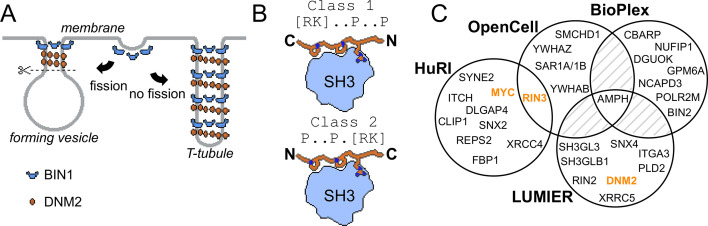
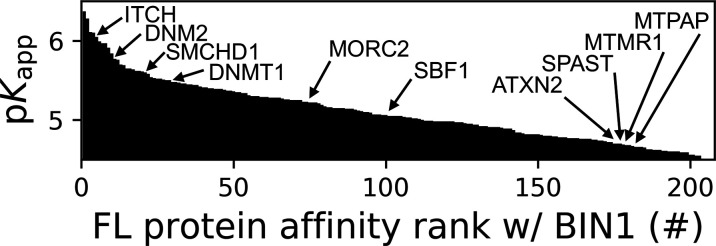
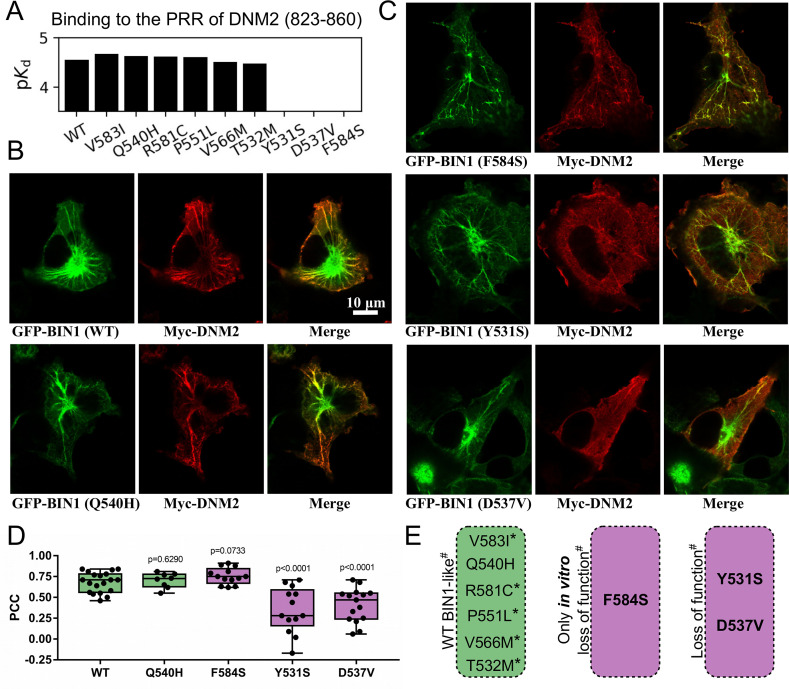
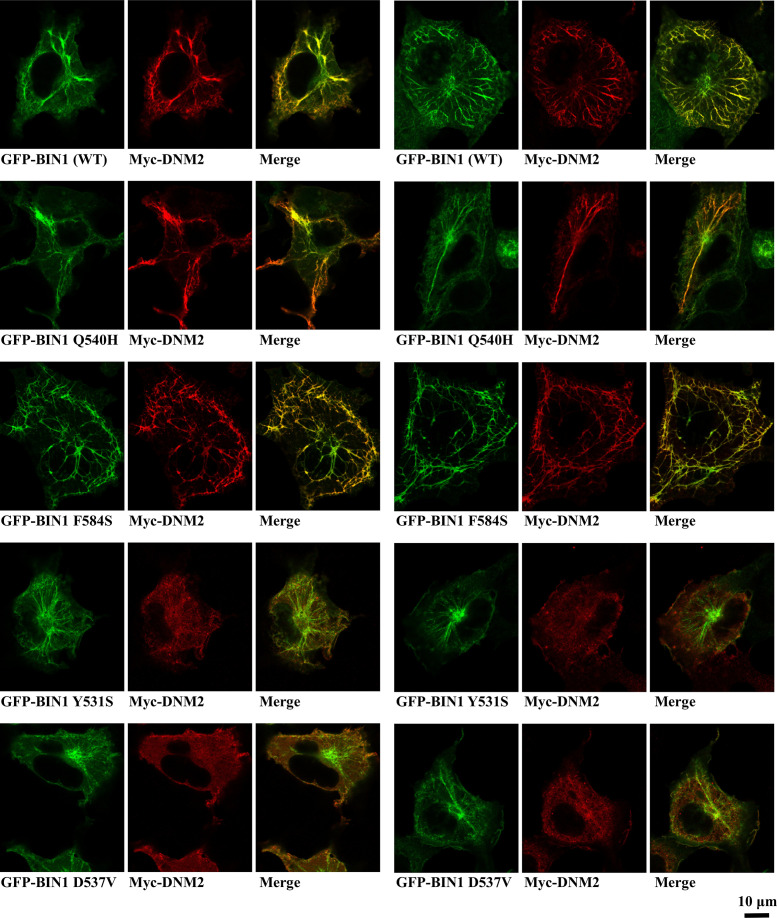
Truncation of the protein-protein interaction SH3 domain of the membrane remodeling Bridging Integrator 1 (BIN1, Amphiphysin 2) protein leads to centronuclear myopathy. Here, we assessed the impact of a set of naturally observed, previously uncharacterized BIN1 SH3 domain variants using conventional and cell-based assays monitoring the BIN1 interaction with dynamin 2 (DNM2) and identified potentially harmful ones that can be also tentatively connected to neuromuscular disorders. However, SH3 domains are typically promiscuous and it is expected that other, so far unknown partners of BIN1 exist besides DNM2, that also participate in the development of centronuclear myopathy. In order to shed light on these other relevant interaction partners and to get a holistic picture of the pathomechanism behind BIN1 SH3 domain variants, we used affinity interactomics. We identified hundreds of new BIN1 interaction partners proteome-wide, among which many appear to participate in cell division, suggesting a critical role of BIN1 in the regulation of mitosis. Finally, we show that the identified BIN1 mutations indeed cause proteome-wide affinity perturbation, signifying the importance of employing unbiased affinity interactomic approaches.
截断膜重塑桥连整合因子 1(BIN1, amphiphysin 2)蛋白的蛋白质-蛋白质相互作用 SH3 结构域会导致核纤层肌病。在这里,我们使用传统的和基于细胞的测定法评估了一组自然观察到的、以前未表征的 BIN1 SH3 结构域变体的影响,这些变体监测 BIN1 与 dynamin 2(DNM2)的相互作用,并确定了可能有害的变体,这些变体也可以与神经肌肉疾病联系起来。然而,SH3 结构域通常是混杂的,预计除了 DNM2 之外,BIN1 还存在其他迄今未知的伙伴,它们也参与核纤层肌病的发生。为了阐明这些其他相关的相互作用伙伴,并全面了解 BIN1 SH3 结构域变体背后的发病机制,我们使用了亲和相互作用组学。我们在全蛋白质组范围内鉴定了数百种新的 BIN1 相互作用伙伴,其中许多似乎参与细胞分裂,表明 BIN1 在有丝分裂调控中的关键作用。最后,我们表明鉴定出的 BIN1 突变确实会导致全蛋白质组亲和力的改变,这表明采用无偏见的亲和相互作用组学方法的重要性。