Aragona Francesca, Rizzo Maria, Arfuso Francesca, Acri Giuseppe, Fazio Francesco, Piccione Giuseppe, Giannetto Claudia
Department of Veterinary Sciences, University of Messina, Polo Annunziata, 98168 Messina, Italy.
Department of Biomedical and Dental Sciences and Morphofunctional Imaging, University of Messina, Via Consolare Valeria, 98125 Messina, Italy.
Animals (Basel). 2024 Jun 26;14(13):1877. doi: 10.3390/ani14131877.
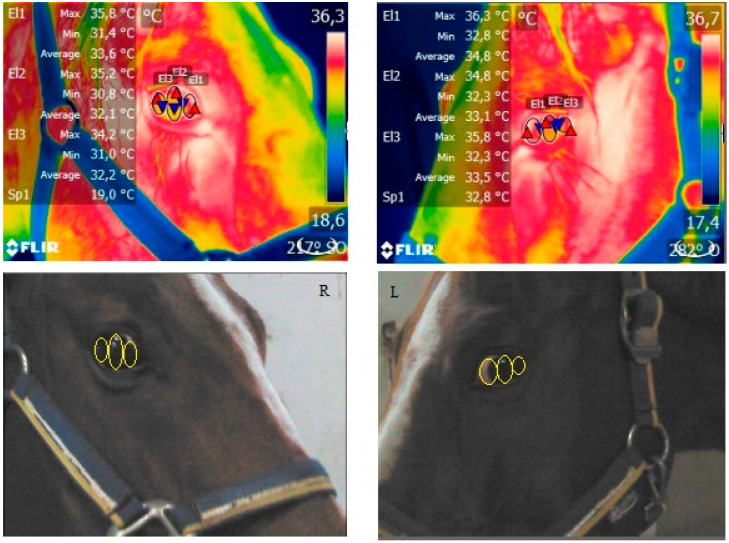
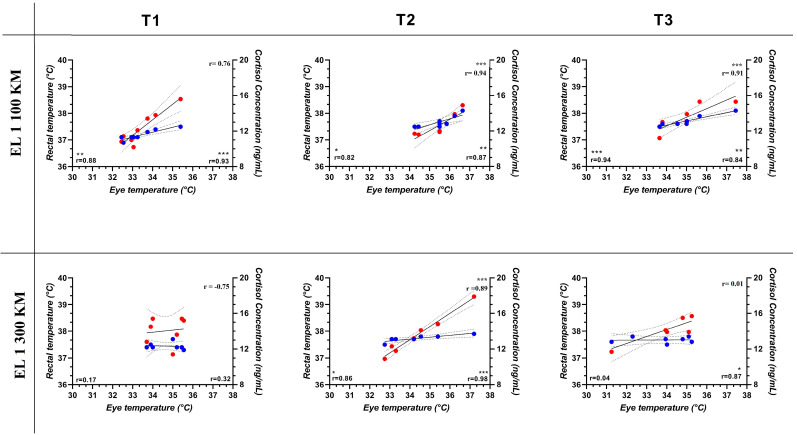
The aim of the present study was to investigate eye temperature modifications after road transport in athletic horses habituated to travel. Eight adult Italian saddle horses traveled 100 km and, two weeks later, 300 km. Eye temperature (ET), rectal temperature (RT) and serum cortisol concentration were assessed before (T1), after (T2) and 60 min (T3) after the road transport. ET was evaluated with infrared thermography (IRT) in three regions of interest: EL1 (medial canthus), EL2 (central cornea) and EL3 (lateral canthus). Two-way analysis of variance (ANOVA) for repeated measures showed statistically higher values at T2 and T3 for EL1 ( < 0.01), EL2 ( < 0.01) and EL3 ( < 0.01) following the 100 km journey. RT ( < 0.01) showed higher values at T2 and T3 after the 100 km journey and higher values at T2 ( < 0.01) following the 300 km journey. ET values were positively correlated with RT at T1, T2 and T3 following the 100 km journey and at T2 following the 300 km journey and positively correlated with serum cortisol concentration at T1, T2 and T3 following the 100 km journey and at T2 and T3 following the 300 km journey. Eye temperature monitoring with IRT allows quick and practical strategies to monitor an animal's physiological state and welfare during daily activities.
本研究的目的是调查习惯运输的运动马匹在公路运输后的眼温变化。八匹成年意大利鞍马先行进100公里,两周后行进300公里。在公路运输前(T1)、运输后(T2)以及运输后60分钟(T3)评估眼温(ET)、直肠温度(RT)和血清皮质醇浓度。使用红外热成像(IRT)在三个感兴趣区域评估ET:EL1(内眦)、EL2(角膜中央)和EL3(外眦)。重复测量的双向方差分析(ANOVA)显示,在100公里行程后,EL1(<0.01)、EL2(<0.01)和EL3(<0.01)在T2和T3时的值在统计学上显著更高。RT(<0.01)在100公里行程后的T2和T3时显示更高的值,在300公里行程后的T2时显示更高的值(<0.01)。在100公里行程后的T1、T2和T3以及300公里行程后的T2时,ET值与RT呈正相关,在100公里行程后的T1、T2和T3以及300公里行程后的T2和T3时,ET值与血清皮质醇浓度呈正相关。使用IRT监测眼温可提供快速且实用的策略,以在日常活动中监测动物的生理状态和福利。