Department of Human Nutrition and Metabolomics, Pomeranian Medical University in Szczecin, 71-460 Szczecin, Poland.
Department of General Pathology, Pomeranian Medical University in Szczecin, 71-204 Szczecin, Poland.
Int J Mol Sci. 2024 Jun 23;25(13):6883. doi: 10.3390/ijms25136883.
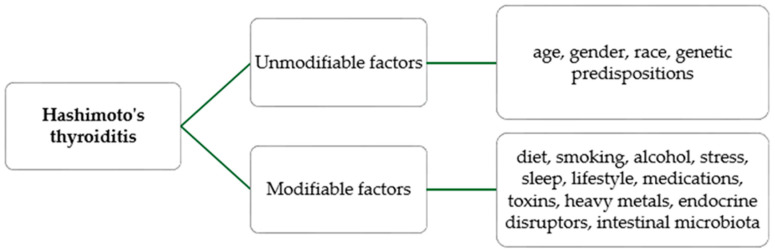
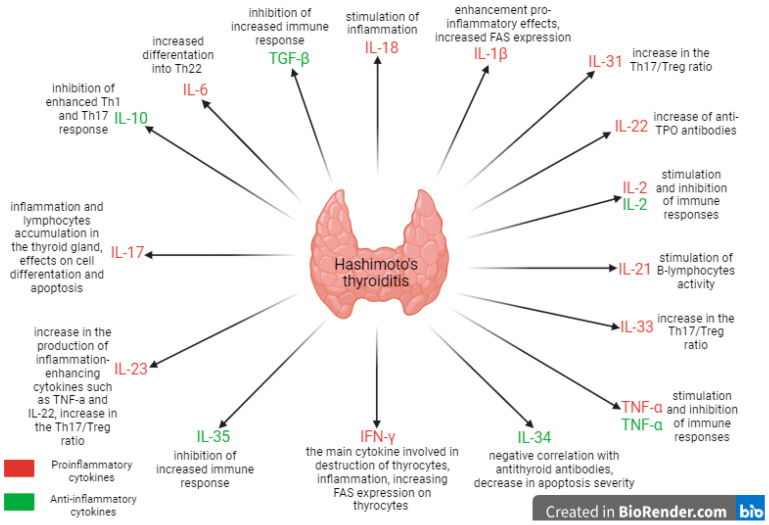
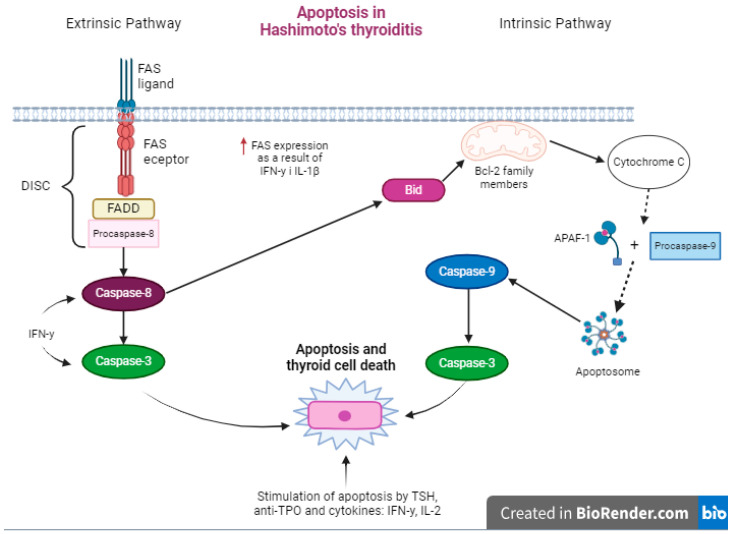
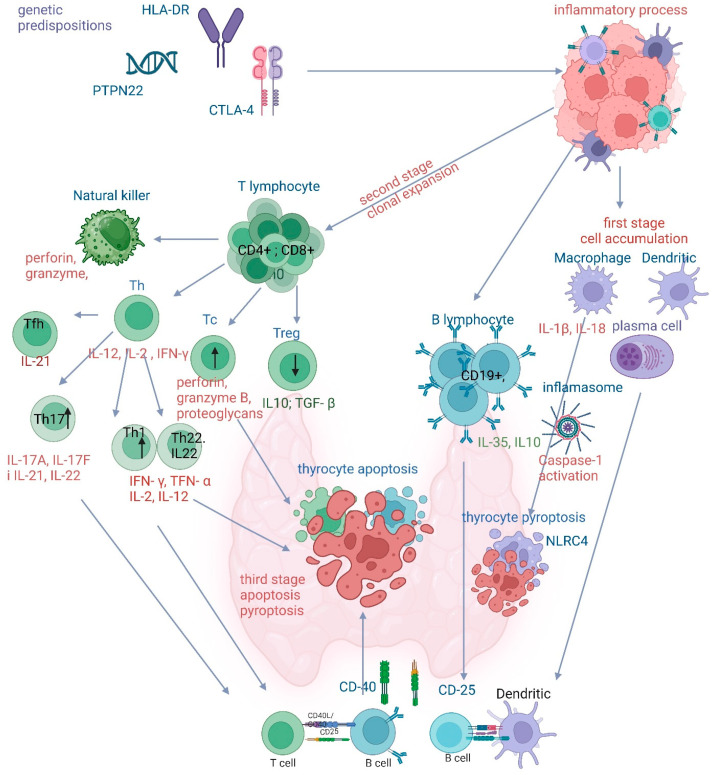
The process of thyroid autoimmunization develops against the background of genetic predispositions associated with class II human leukocyte antigens (HLA-DR), as well as cytotoxic T-lymphocyte-associated protein 4 (CTLA-4), protein tyrosine phosphatase non-receptor type 22 (PTPN22), and forkhead transcription box protein P3 (FOXP3). Environmental factors, such as vitamin D deficiency, Zn, Se, and Mg, as well as infections, chronic stress, pregnancy, smoking, alcohol, medications, intestinal dysbiosis, and malnutrition, also play an important role. The first stage of autoimmunization involves the accumulation of macrophages and dendritic cells, as well as plasma cells. In the second stage, the mutual interactions of individual cells in the immune system lead to a decrease in the level of CD8+ in favor of CD4+, which intensifies the synthesis of T lymphocyte derivatives, especially Th1, Th17, Tfh, and Tc, reducing the level of Treg. Consequently, the number of the anti-inflammatory cytokines IL10 and IL2 decreases, and the synthesis of the pro-inflammatory cytokines IL-2, Il-12, Il-17, IL-21, IL-22, IFN-γ, and TNF-α increases. The latter two especially trigger the pyroptosis process involving the inflammasome. Activation of the inflammasome by IL-β and IL-18 produced by macrophages is one of the mechanisms of pyroptosis in the course of Hashimoto's thyroiditis, involving Gram-negative bacteria and NLRC4. In the next step, the apoptosis of thyroid cells is initiated by the intensification of perforin, granzyme, and proteoglycan synthesis by Tc and NK cells. The current findings raise many possibilities regarding interventions related to the inhibition of pro-inflammatory cytokines and the stimulation of anti-inflammatory cytokines produced by both T and B lymphocytes. Furthermore, since there is currently no effective method for treating thyroid autoimmunity, a summary of the review may provide answers regarding the treatment of not only Hashimoto's thyroiditis, but also other autoimmune diseases associated with autoimmunity.
甲状腺自身免疫的发生发展过程与遗传易感性有关,与人类白细胞抗原 II 类(HLA-DR)、细胞毒性 T 淋巴细胞相关蛋白 4(CTLA-4)、蛋白酪氨酸磷酸酶非受体型 22(PTPN22)和叉头转录框蛋白 P3(FOXP3)等有关。环境因素,如维生素 D 缺乏、Zn、Se 和 Mg,以及感染、慢性应激、妊娠、吸烟、酒精、药物、肠道菌群失调和营养不良等也起重要作用。自身免疫的第一阶段涉及巨噬细胞和树突状细胞以及浆细胞的积累。在第二阶段,免疫系统中各个细胞的相互作用导致 CD8+水平下降,CD4+水平上升,这加剧了 T 淋巴细胞衍生物的合成,特别是 Th1、Th17、Tfh 和 Tc,降低了 Treg 水平。结果,抗炎细胞因子 IL10 和 IL2 的合成减少,促炎细胞因子 IL-2、Il-12、Il-17、IL-21、IL-22、IFN-γ和 TNF-α的合成增加。后两者特别触发涉及炎性体的细胞焦亡过程。巨噬细胞产生的白细胞介素-1β(IL-β)和白细胞介素-18(IL-18)激活炎性体,是桥本甲状腺炎过程中细胞焦亡的机制之一,涉及革兰氏阴性菌和 NLRC4。下一步,Tc 和 NK 细胞通过增强穿孔素、颗粒酶和糖胺聚糖的合成,启动甲状腺细胞的凋亡。目前的研究结果为干预措施提供了许多可能性,这些干预措施涉及抑制促炎细胞因子和刺激 T、B 淋巴细胞产生抗炎细胞因子。此外,由于目前尚无治疗甲状腺自身免疫的有效方法,因此对该综述的总结可能不仅为桥本甲状腺炎的治疗提供答案,还可能为其他与自身免疫相关的自身免疫性疾病的治疗提供答案。