Ghasemkhani Bita, Kut Recep Alp, Yilmaz Reyat, Birant Derya, Arıkök Yiğit Ahmet, Güzelyol Tugay Eren, Kut Tuna
Graduate School of Natural and Applied Sciences, Dokuz Eylul University, Izmir 35390, Turkey.
Department of Computer Engineering, Dokuz Eylul University, Izmir 35390, Turkey.
Sensors (Basel). 2024 Jul 2;24(13):4313. doi: 10.3390/s24134313.
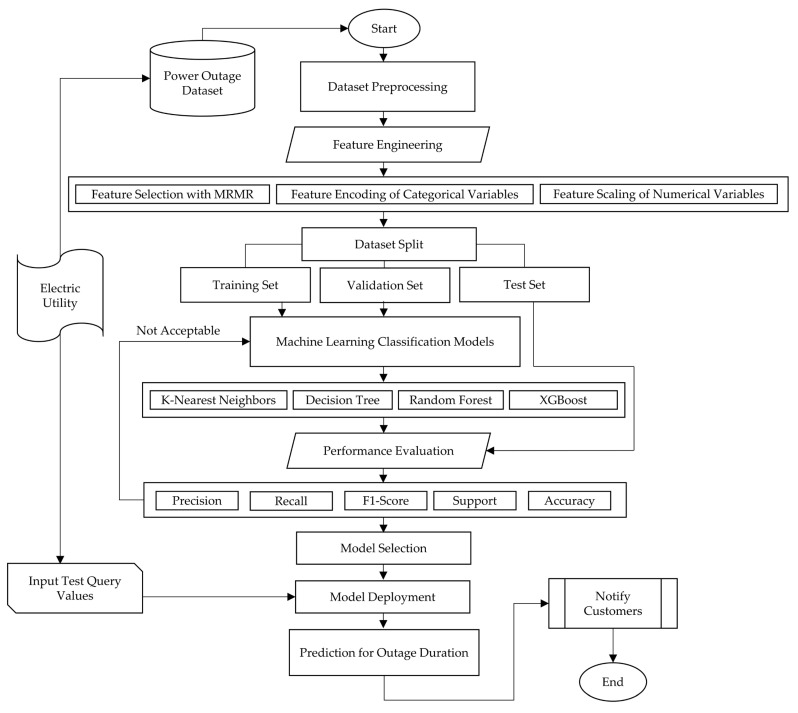
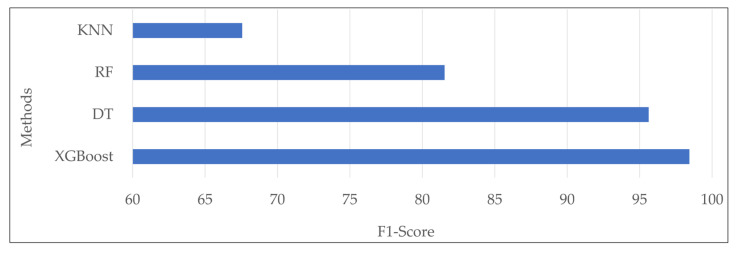
In the face of increasing climate variability and the complexities of modern power grids, managing power outages in electric utilities has emerged as a critical challenge. This paper introduces a novel predictive model employing machine learning algorithms, including decision tree (DT), random forest (RF), k-nearest neighbors (KNN), and extreme gradient boosting (XGBoost). Leveraging historical sensors-based and non-sensors-based outage data from a Turkish electric utility company, the model demonstrates adaptability to diverse grid structures, considers meteorological and non-meteorological outage causes, and provides real-time feedback to customers to effectively address the problem of power outage duration. Using the XGBoost algorithm with the minimum redundancy maximum relevance (MRMR) feature selection attained 98.433% accuracy in predicting outage durations, better than the state-of-the-art methods showing 85.511% accuracy on average over various datasets, a 12.922% improvement. This paper contributes a practical solution to enhance outage management and customer communication, showcasing the potential of machine learning to transform electric utility responses and improve grid resilience and reliability.
面对日益增加的气候变异性和现代电网的复杂性,电力公司管理停电问题已成为一项严峻挑战。本文介绍了一种采用机器学习算法的新型预测模型,包括决策树(DT)、随机森林(RF)、k近邻(KNN)和极端梯度提升(XGBoost)。该模型利用土耳其一家电力公司基于历史传感器和非传感器的停电数据,展示了对不同电网结构的适应性,考虑了气象和非气象停电原因,并向客户提供实时反馈,以有效解决停电持续时间问题。使用具有最小冗余最大相关性(MRMR)特征选择的XGBoost算法,在预测停电持续时间方面达到了98.433%的准确率,优于在各种数据集上平均准确率为85.511%的现有最佳方法,提高了12.922%。本文为加强停电管理和客户沟通提供了一个切实可行的解决方案,展示了机器学习在转变电力公司应对措施、提高电网弹性和可靠性方面的潜力。