Özlü Beylun, Yardım Mustafa Sinan
Transportation Ph.D. Program, Graduate School of Science and Engineering, Yildiz Technical University, Istanbul 34220, Turkey.
Civil Engineering Faculty, Civil Engineering Department, Yildiz Technical University, Istanbul 34220, Turkey.
Sensors (Basel). 2024 Jul 5;24(13):4375. doi: 10.3390/s24134375.
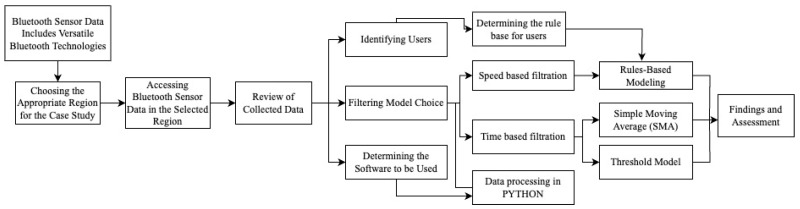
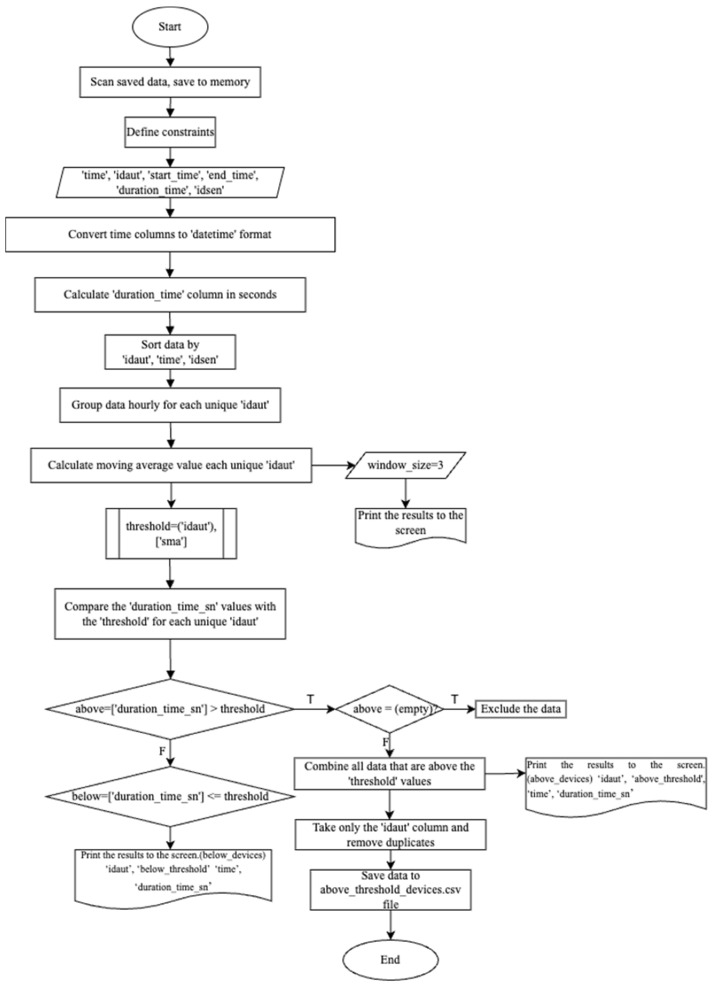
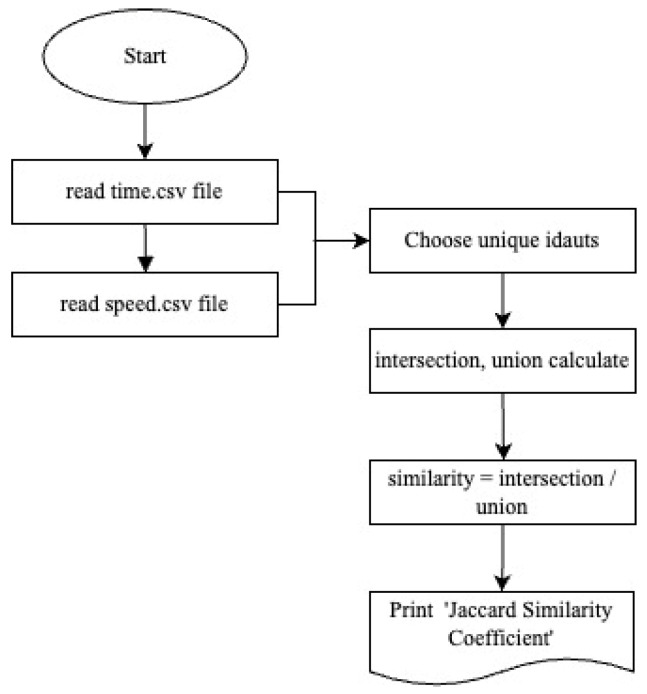
Bluetooth sensors in intelligent transportation systems possess extensive coverage and access to a large number of identity (ID) data, but they cannot distinguish between vehicles and persons. This study aims to classify and differentiate raw data collected from Bluetooth sensors positioned between various origin-destination (i-j) points into vehicles and persons and to determine their distribution ratios. To reduce data noise, two different filtering algorithms are proposed. The first algorithm employs time series simplification based on Simple Moving Average (SMA) and threshold models, which are tools of statistical analysis. The second algorithm is rule-based, using speed data of Bluetooth devices derived from sensor data to provide a simplification algorithm. The study area was the Historic Peninsula Traffic Cord Region of Istanbul, utilizing data from 39 sensors in the region. As a result of time-based filtering, the ratio of person ID addresses for Bluetooth devices participating in circulation in the region was found to be 65.57% (397,799 person IDs), while the ratio of vehicle ID addresses was 34.43% (208,941 vehicle IDs). In contrast, the rule-based algorithm based on speed data found that the ratio of vehicle ID addresses was 35.82% (389,392 vehicle IDs), while the ratio of person ID addresses was 64.17% (217,348 person IDs). The Jaccard similarity coefficient was utilized to identify similarities in the data obtained from the applied filtering approaches, yielding a coefficient (J) of 0.628. The identity addresses of the vehicles common throughout the two date sets which are obtained represent the sampling size for traffic measurements.
智能交通系统中的蓝牙传感器覆盖范围广,可获取大量身份(ID)数据,但无法区分车辆和人员。本研究旨在将从位于不同起点 - 终点(i - j)点之间的蓝牙传感器收集的原始数据分类并区分为车辆和人员,并确定它们的分布比例。为了减少数据噪声,提出了两种不同的过滤算法。第一种算法采用基于简单移动平均(SMA)和阈值模型的时间序列简化方法,这两种方法是统计分析工具。第二种算法是基于规则的,利用从传感器数据中得出的蓝牙设备速度数据提供一种简化算法。研究区域为伊斯坦布尔历史半岛交通枢纽地区,使用了该地区39个传感器的数据。经过基于时间的过滤,发现该地区参与流通的蓝牙设备的个人ID地址比例为65.57%(397,799个个人ID),而车辆ID地址比例为34.43%(208,941个车辆ID)。相比之下,基于速度数据的基于规则的算法发现车辆ID地址比例为35.82%(389,392个车辆ID),而个人ID地址比例为64.17%(217,348个个人ID)。利用杰卡德相似系数来识别从应用的过滤方法中获得的数据中的相似性,得出系数(J)为0.628。在两个日期集里都通用的车辆身份地址代表了交通测量的样本量。