Noronha Carolina, Ribeiro Ana Sofia, Carvalho Rita, Mendes Nuno, Reis Joaquim, Faria Claudia C, Taipa Ricardo, Paredes Joana
Neurosurgery Department, Hospital de Santo António, Centro Hospitalar e Universitário do Porto, 4050-366 Porto, Portugal.
Cancer Metastasis, i3S, Institute for Research and Innovation in Health, University of Porto, 4200-135 Porto, Portugal.
Cancers (Basel). 2024 Jun 22;16(13):2298. doi: 10.3390/cancers16132298.
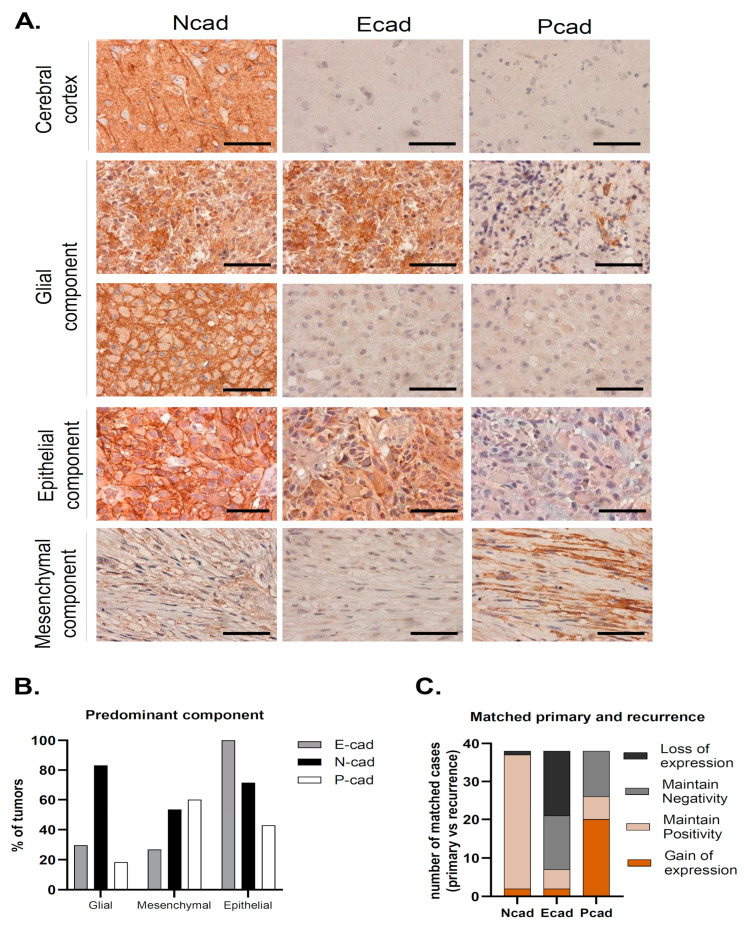
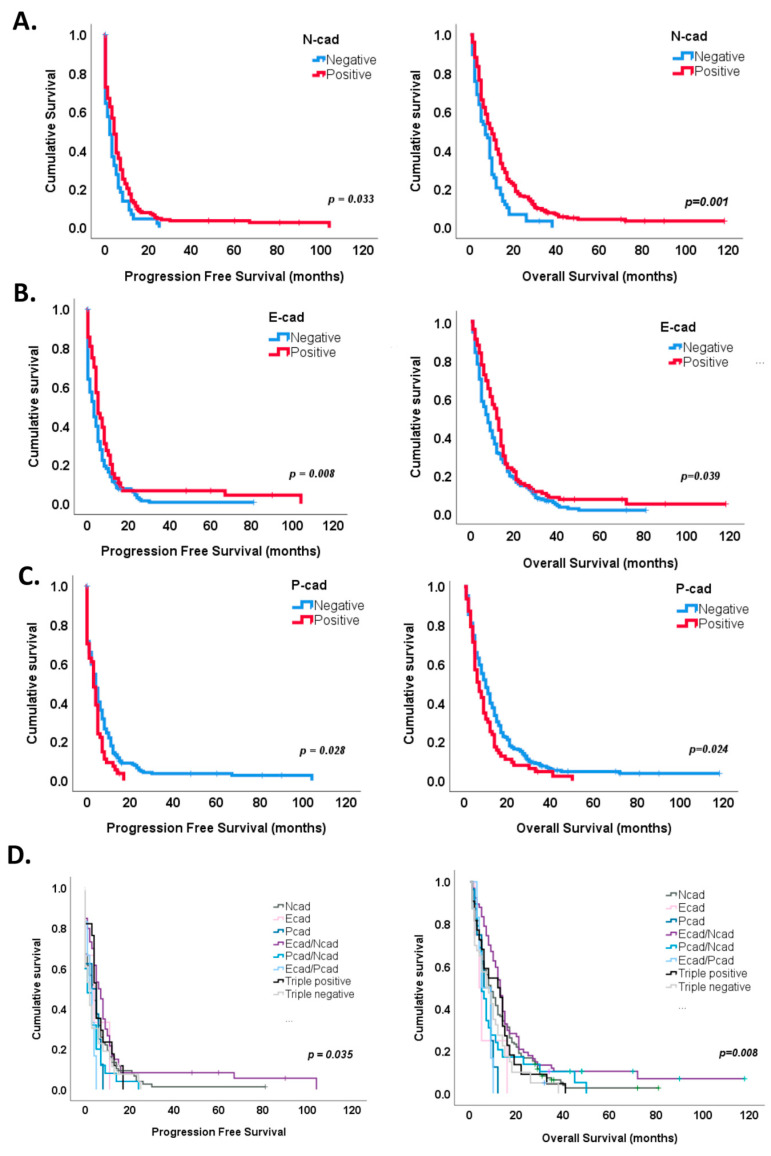
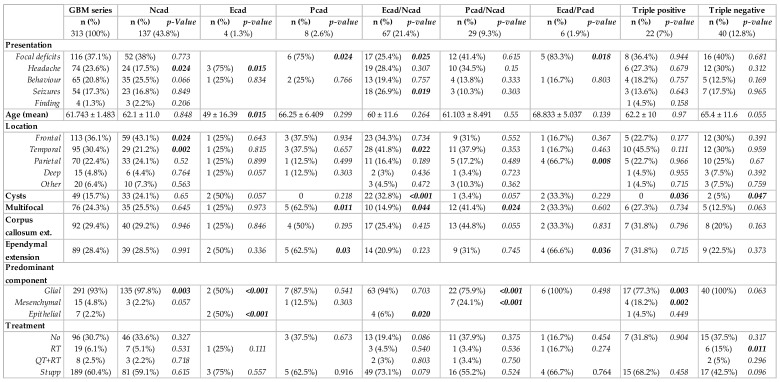
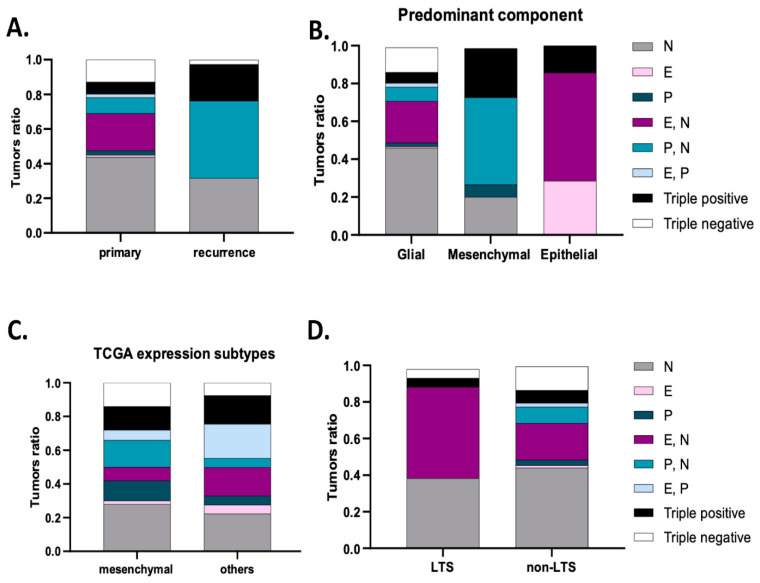
Cadherins are cell-cell adhesion proteins which have been strongly implicated in cancer invasion, dissemination and metastasis capacity; thus, they are key players in the epithelial-to-mesenchymal transition (EMT) program. However, their role in glioblastoma (GBM), a primary central nervous system aggressive tumor, remains to be clarified. N-, E- and P-cadherin expression was analyzed on a large series of GBMs, characterized with clinical, imaging and neuropathological parameters, as well as with patients' survival data. In addition, cadherins' expression was studied in match-recurrent cases. Using TCGA data, cadherin expression profiles were also evaluated according to GBM transcription subtypes. N-cadherin expression was observed in 81.5% of GBM, followed by E-cadherin in 31% and P-cadherin in 20.8%. Upon tumor recurrence, P-cadherin was the only significantly upregulated cadherin compared with the primary tumor, being positive in 65.8% of the cases. Actually, P-cadherin gain was observed in 51.4% of matched primary-recurrent cases. Cadherins' co-expression was also explored. Interestingly, E- and N-cadherin co-expression identified a GBM subgroup with frequent epithelial differentiation and a significant survival benefit. On the other hand, subgroups with P-cadherin expression carried the worse prognosis. P- and N-cadherin co-expression correlated with the presence of a mesenchymal phenotype. Expressions of isolated P-cadherin or E- and P-cadherin co-expression were associated with imaging characteristics of aggressiveness, to highly heterogeneous tumors, an d to worse patient survival. Classical cadherins co-expression subgroups present consistent clinical, imaging, neuropathological and survival differences, which probably reflect different states of an EMT-like program in GBM.
钙黏蛋白是细胞间黏附蛋白,与癌症侵袭、播散和转移能力密切相关;因此,它们是上皮-间质转化(EMT)程序中的关键因子。然而,它们在胶质母细胞瘤(GBM)(一种原发性中枢神经系统侵袭性肿瘤)中的作用仍有待阐明。我们对大量GBM病例的N-、E-和P-钙黏蛋白表达进行了分析,这些病例具有临床、影像学和神经病理学参数以及患者生存数据。此外,还研究了匹配复发病例中钙黏蛋白的表达情况。利用癌症基因组图谱(TCGA)数据,还根据GBM转录亚型评估了钙黏蛋白的表达谱。在81.5%的GBM中观察到N-钙黏蛋白表达,其次是31%的E-钙黏蛋白表达和20.8%的P-钙黏蛋白表达。肿瘤复发时,与原发性肿瘤相比,P-钙黏蛋白是唯一显著上调的钙黏蛋白,65.8%的病例呈阳性。实际上,在51.4%的匹配原发性-复发病例中观察到P-钙黏蛋白增加。我们还探讨了钙黏蛋白的共表达情况。有趣的是,E-和N-钙黏蛋白共表达确定了一个GBM亚组,该亚组具有频繁的上皮分化和显著的生存获益。另一方面,有P-钙黏蛋白表达的亚组预后较差。P-和N-钙黏蛋白共表达与间充质表型的存在相关。单独的P-钙黏蛋白表达或E-和P-钙黏蛋白共表达与侵袭性影像学特征、高度异质性肿瘤以及患者较差的生存相关。经典钙黏蛋白共表达亚组呈现出一致的临床、影像学、神经病理学和生存差异,这可能反映了GBM中类似EMT程序的不同状态。