Department of Anesthesia, MeQrez General Hospital, Addis Ababa, Ethiopia.
Department of Anesthesia, St. Paul's Hospital Millennium Medical College, Addis Ababa, Ethiopia.
BMC Anesthesiol. 2024 Jul 13;24(1):236. doi: 10.1186/s12871-024-02623-5.
Emergence agitation is a transient confusional state of a child associated with consciousness from general anaesthesia, commonly occurs in the postoperative setting which delays their recovery and exposes them to traumas. The main objective of the current study was to investigate the magnitude of emergence agitation, its interventions and associated factors among paediatric surgical patients at Saint Paul's Hospital Millennium Medical College, Addis Ababa, Ethiopia.
Hospital based cross-sectional study with prospective follow-up framework was conducted on a paediatric surgical patients aged 2-14 years who underwent surgery under general anaesthesia between June 1 - October 30 2022. Stratified sampling method followed by simple random sampling technique was employed to reach study participants. Magnitude of emergence agitation and its interventions done at post-anaesthetic care units were recorded. Data analysis was carried out using a descriptive statistics method and the results were summarized using tables and diagrams. Bivariate analysis was done to identify causal relationship and multivariable analysis to assess the confounding effects of factors associated with emergence agitation. A p-value of less than 0.05 was considered statistically significant factor.
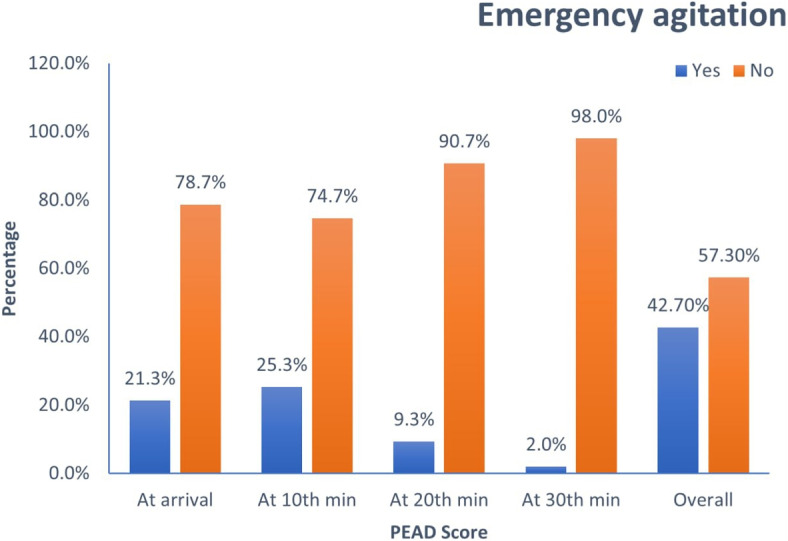
A total of 150 participants were included in the current study, where 107 (71.3%) were male and 97 (64.7%) were preschool aged. About 81 (54%) of care givers were female and majority of them have completed primary school. The mean (standard deviation) age of the participants was 6.4 (3.57) years. Around 42.7% of them developed emergence agitation with an average duration of 8.39 ± 4.45 minutes. Factors such as propofol administration at the end of procedure (OR of 0.104 with 95% CI [0.035, 0305]), Ear, nose, throat surgery and oral maxillofacial surgery (OR of 2.341 with 95% CI [1.051, 5.211]) and arrival of patient to recovery awake (OR of 0.456 95% CI [0.209, 0.994]) showed statistically significant association with emergence agitation.
Almost half of the study participants experienced emergence agitation which is high magnitude. Ear, nose, throat surgery and oral maxillofacial surgeries were predictive factors of emergence agitation while propofol administration at the end of procedure and arrival of patient to recovery awake significantly decreased risk of emergence agitation. Therefore, anaesthesia personnel should have essential skills and knowledge to effectively care for children perioperatively including to minimize and treat emergence agitation.
术后躁动是一种与全身麻醉后意识相关的儿童短暂意识混乱状态,常发生在术后,这会延迟他们的恢复并使他们遭受创伤。本研究的主要目的是调查圣保禄医院千年医科大学儿科手术患者的术后躁动程度、干预措施及其相关因素。
这是一项在 2022 年 6 月 1 日至 10 月 30 日期间接受全身麻醉下手术的 2-14 岁儿科手术患者的基于医院的横断面研究,采用前瞻性随访框架。采用分层抽样法,然后采用简单随机抽样技术抽取研究对象。记录术后麻醉护理单元出现的躁动程度及其干预措施。采用描述性统计方法进行数据分析,结果用表格和图表进行总结。采用二变量分析确定因果关系,采用多变量分析评估与术后躁动相关的因素的混杂效应。p 值小于 0.05 被认为是有统计学意义的因素。
本研究共纳入 150 名参与者,其中 107 名(71.3%)为男性,97 名(64.7%)为学龄前儿童。约 81 名(54%)的照顾者为女性,其中大多数完成了小学学业。参与者的平均(标准差)年龄为 6.4(3.57)岁。大约 42.7%的人出现术后躁动,平均持续时间为 8.39±4.45 分钟。在结束手术时使用丙泊酚(比值比为 0.104,95%置信区间[0.035,0.305])、耳鼻喉和口腔颌面外科手术(比值比为 2.341,95%置信区间[1.051,5.211])以及患者到达复苏清醒状态(比值比为 0.456,95%置信区间[0.209,0.994])等因素与术后躁动有统计学显著关联。
近一半的研究参与者出现了严重程度较高的术后躁动。耳鼻喉和口腔颌面外科手术是术后躁动的预测因素,而在手术结束时使用丙泊酚和患者到达复苏清醒状态则显著降低了术后躁动的风险。因此,麻醉人员应具备基本技能和知识,以便在围手术期有效照顾儿童,包括尽量减少和治疗术后躁动。