Pontifícia Universidade Católica do Paraná - Graduate Program of Animal Science, School of Medicine and Life Science - Curitiba, Paraná, Brazil.
Universidade Estadual do Oeste do Paraná - Graduate Program in Animal Science - Marechal Candido Rondon, Paraná, Brazil.
Poult Sci. 2024 Sep;103(9):103986. doi: 10.1016/j.psj.2024.103986. Epub 2024 Jun 17.
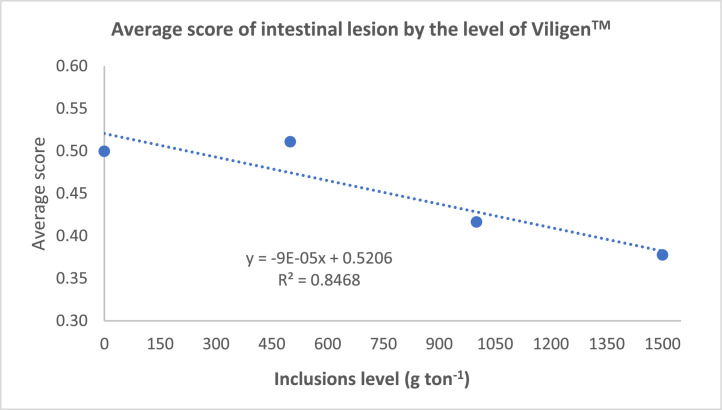
Necrotic enteritis (NE) is a disease of worldwide distribution, which affects young broilers and causes economic losses on a scale of 6 billion dollars per year. For decades, NE was controlled in poultry flocks by dietary administration of low doses of antimicrobial growth promoters (AGPs). However, an increase in NE incidence was noted after the AGP ban. This study aimed to compare the effect of an antibiotic (Enramycin) diet to a combination of sodium butyrate, hydrolyzed yeast, and zinc proteinate (Viligen) on broiler diets regarding performance, blood parameters, intestinal permeability, morphology and lesions, and carcass yield of broilers challenged with Eimeria spp. and Clostridium perfringens to simulate subclinical necrotic enteritis. A total of 1,150 one-day-old male broiler chickens with an initial average weight of 43.9 ± 0.65 g were allocated to 50 experimental pens. Animals were divided into 5 groups: Negative control (NC) without additives; Positive control (PC) with 0.12 g/ton of Enramycin (8%); V500, V1000, and V1500 with the addition of 500, 1.000, and 1.500 g/ton of Viligen, respectively. All animals were challenged by Eimeria spp. at 7 d of age and by C. perfringens at 17, 18, and 19 d for induction of subclinical NE. The broilers fed with all concentrations of Viligen showed similar performance, blood parameters, intestinal permeability, and carcass yield compared to PC broilers. However, NC broilers showed higher FCR compared to PC broilers from 1 to 33 d (1.42 vs. 1.39) (P = 0.048) and from 1 to 42 d (1.51 vs. 1.49) (P < 0.001). V1500 broilers had fewer intestinal lesions at 28 d when compared to the PC treatment (P < 0.05) and showed that higher Viligen inclusion resulted in lower intestinal damage. At 21 d, the V500 group showed higher intestinal morphology characteristics (VH:VD 4.9 vs. 3.5) compared to the PC treatment (P < 0.001). Thus, in this study, the dietary addition of Viligen to broilers challenged by an experimental model of subclinical NE resulted in lower intestinal damage and similar performance to that obtained by the addition of Enramycin.
坏死性肠炎(NE)是一种分布广泛的疾病,影响年轻肉鸡并造成每年 60 亿美元的经济损失。几十年来,通过在禽类饲料中添加低剂量的抗菌生长促进剂(AGP)来控制禽类中的 NE。然而,在 AGP 禁令之后,NE 的发病率有所增加。本研究旨在比较抗生素(恩拉霉素)饲料与丁酸钠、水解酵母和锌蛋白盐(Viligen)组合对肉鸡饲料的影响,这些饲料在挑战艾美耳球虫和产气荚膜梭菌以模拟亚临床坏死性肠炎时,对肉鸡的性能、血液参数、肠道通透性、形态和病变以及肉鸡的屠体产量的影响。共有 1150 只 1 日龄雄性肉鸡,初始平均体重为 43.9±0.65g,被分配到 50 个实验栏中。动物被分为 5 组:无添加剂的阴性对照组(NC);添加 0.12g/吨恩拉霉素(8%)的阳性对照组(PC);添加 500、1000 和 1500g/吨 Viligen 的 V500、V1000 和 V1500 组。所有动物在 7 日龄时用艾美耳球虫攻毒,在 17、18 和 19 日龄时用产气荚膜梭菌攻毒,以诱导亚临床坏死性肠炎。与 PC 组肉鸡相比,所有 Viligen 浓度组的肉鸡表现、血液参数、肠道通透性和屠体产量相似。然而,NC 组肉鸡在 1 至 33 日龄(1.42 对 1.39)(P=0.048)和 1 至 42 日龄(1.51 对 1.49)(P<0.001)的 FCR 均高于 PC 组。与 PC 处理相比,28 日龄时 V1500 组肉鸡的肠道病变较少(P<0.05),并且表明更高的 Viligen 含量导致更低的肠道损伤。在 21 日龄时,V500 组的肠道形态特征(VH:VD 为 4.9)高于 PC 处理组(P<0.001)。因此,在本研究中,在亚临床 NE 实验模型中添加 Viligen 可降低肠道损伤,并获得与添加恩拉霉素相似的性能。