Graduate Program in Dentistry, Department of Odontology , Cruzeiro do Sul University, São Paulo (SP), Brazil.
Albert Einstein Center for Studies, Research and Practice in Primary Health Care (CEPPAR), Hospital Israelita Albert Einstein, São Paulo (SP), Brazil.
BMC Oral Health. 2024 Jul 14;24(1):791. doi: 10.1186/s12903-024-04531-z.
Dental Vulnerability Scale (EVO-BR) is an instrument developed to help identifying oral health-vulnerable individuals. This scale comprises 15 items distributed into 4 dimensions. It is the first instrument with the potential to guide clinical and managerial decisions in the oral health field. The aim is to validate a score to enable using EVO-BR in Primary Health Care (PHC).
The investigated sample included PHC users in five Brazilian regions. Data were collected at two different stages: in 2019 (São Paulo) and in 2022 (Minas Gerais, Mato Grosso, Roraima, Pernambuco e Paraná). Exploratory descriptive study of this scale scores was carried out to create classification ranges. Subsequently, discriminant analysis was performed to assess the accuracy of the established classification. Boosting regression was carried out to check items' weight for the instrument score.
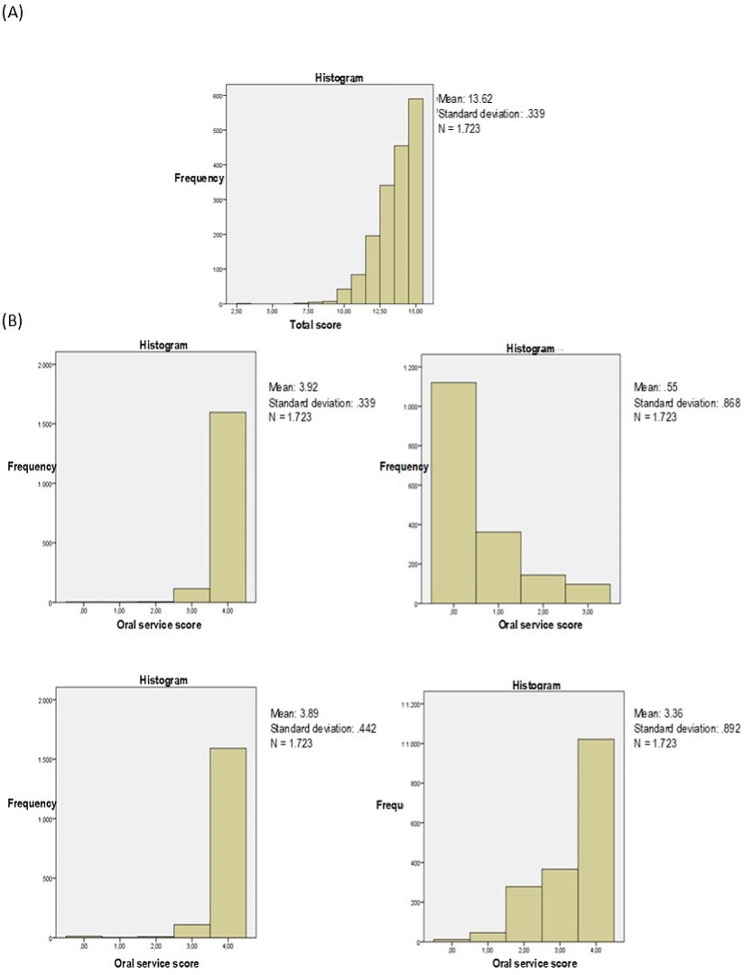
EVO-BR score ranged from 0 (highest vulnerability) to 15 (lowest vulnerability). Four (4) classification configurations were tested. Score equal to 12 points was the one presenting the best classification of the assessed individuals (100% were correctly classified). Boosting regression has evidenced that items 1 and 2 (Overall health domain) and 14 and 15 (Health Services domain) had the strongest influence on this instrument's score.
The process to standardize the EVO-BR score and, consequently, to develop assessment ranges, is an important step in the fight against health inequalities, since it provides a tool to help planning actions and interventions aimed at meeting specific needs of the population in the Primary Health Care context.
EVO-BR 牙科易损性量表是一种用于帮助识别口腔健康脆弱个体的工具。该量表包含 15 个项目,分布在 4 个维度中。它是第一个具有指导口腔健康领域临床和管理决策潜力的工具。目的是验证一个评分标准,以便在初级保健中使用 EVO-BR。
调查样本包括巴西五个地区的初级保健使用者。数据分两个阶段收集:2019 年(圣保罗)和 2022 年(米纳斯吉拉斯州、马托格罗索州、罗赖马州、伯南布哥州和巴拉那州)。对该量表的评分进行了探索性描述性研究,以创建分类范围。随后,进行判别分析以评估所建立分类的准确性。进行了提升回归以检查仪器评分的项目权重。
EVO-BR 评分范围从 0(最高脆弱性)到 15(最低脆弱性)。测试了四个(4)分类配置。12 分的评分是评估个体分类效果最佳的评分(100%的个体被正确分类)。提升回归表明,项目 1 和 2(总体健康领域)以及项目 14 和 15(卫生服务领域)对该仪器的评分有最强的影响。
EVO-BR 评分标准化的过程,以及评估范围的开发,是对抗健康不平等的重要步骤,因为它提供了一个工具,有助于规划旨在满足初级保健背景下特定人群需求的行动和干预措施。